
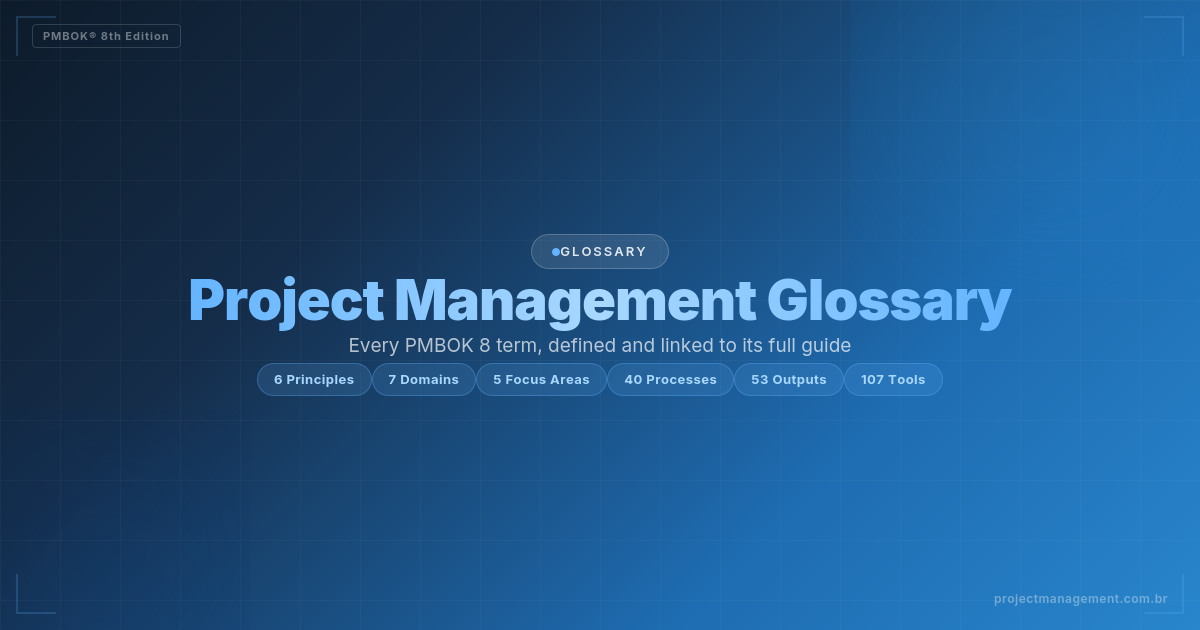
This is the project management glossary of the PMBOK® Guide, Eighth Edition: every principle, performance domain, focus area, process, output and technique the standard uses, defined in one place and linked to its full guide on this site. 221 terms, free and without registration.
It was written for the eighth edition from the start. If you learned project management from the sixth, the vocabulary moved underneath you: there are no knowledge areas any more — there are 7 performance domains and 40 processes, where the sixth edition had 10 areas and 49 processes. A term you remember may be here under a different name, or may have been absorbed by another process; the definition says which.
| Group | How many | What it holds |
|---|---|---|
| Principles | 6 | How to decide when the guide has no ready answer |
| Performance domains | 7 | How the body of knowledge is organised |
| Focus areas | 5 | When in the project each process is used |
| Processes | 40 | The work itself, each in one domain and one focus area |
| Outputs | 53 | What the processes produce — plans, baselines, registers, reports |
| Tools and techniques | 107 | How the work gets done inside each process |
Search the project management glossary
Type any word to filter, pick a group to narrow it, or click a column heading to sort. Every term that has a full guide on this site links to it.
| Term | Group | Definition |
|---|---|---|
| Project Management Principles | Guide | The PMBOK® Guide, Eighth Edition has 6 principles, which guide the behaviour of the people doing the project: holistic view, focus on value, embedded quality, accountable leader, sustainability and empowered culture. Principles do not say what to do — they say which way to decide when the guide has no ready answer. (The seventh edition had 12; the sixth had none as a chapter.) |
| Adopt a holistic view | Principle | First principle of the PMBOK® Guide, Eighth Edition. See the whole project and the context it lives in — the organisation’s strategy, the stakeholders, the systems the deliverable will run in — instead of optimising one part and losing the whole. A project can deliver exactly what the scope said and still fail to create the value expected. |
| Focus on value | Principle | Second principle of the PMBOK® Guide, Eighth Edition. The project’s success criterion is the value it creates, not the number of deliverables it produces. Align the project with the business objectives and maximise the return per unit of investment. |
| Embed quality into processes and deliverables | Principle | Third principle of the PMBOK® Guide, Eighth Edition. Quality is built into the process and into the deliverable; it is not inspected in at the end. This is why the eighth edition no longer has a quality knowledge area with processes of its own — quality became a principle that runs through all 40 processes. |
| Be an accountable leader | Principle | Fourth principle of the PMBOK® Guide, Eighth Edition (also rendered as diligent leader). Lead the team with integrity, own the decisions and their effects, and create the conditions for people to do the best work they are capable of. |
| Integrate sustainability within all project areas | Principle | Fifth principle of the PMBOK® Guide, Eighth Edition, and the only entirely new one. Consider people, planet and value in every project decision — the environmental, social and economic impact of what is delivered, not only the cost and the date of delivering it. |
| Build an empowered culture | Principle | Sixth principle of the PMBOK® Guide, Eighth Edition. Build a culture where the team decides what it is competent to decide, collaborates proactively and unites around shared objectives — instead of waiting for authorisation at every step. |
| Performance Domains | Guide | The PMBOK® Guide, Eighth Edition organises the body of knowledge into 7 performance domains: Governance, Scope, Schedule, Finance, Stakeholders, Resources and Risk. They replace the sixth edition’s 10 knowledge areas — quality, communications, integration and procurement stopped being areas of their own and were absorbed by the domains and by the principles. |
| Governance | Performance domain | Performance domain of the PMBOK® Guide, Eighth Edition, with 9 processes — the largest of the seven. It is the foundation the project stands on: authorise, integrate the plans, decide what is made and what is bought, direct execution, assure quality, keep the knowledge, measure performance, decide the changes and close. |
| Scope | Performance domain | Performance domain of the PMBOK® Guide, Eighth Edition, with 6 processes. It covers defining what the project will deliver — and, the harder half, what it will not — structuring that into work packages, and then controlling and validating what was delivered. |
| Schedule | Performance domain | Performance domain of the PMBOK® Guide, Eighth Edition, with 3 processes. The sixth edition had 6: defining, sequencing and estimating activity durations were consolidated into Develop Schedule. |
| Finance | Performance domain | Performance domain of the PMBOK® Guide, Eighth Edition, with 4 processes. It replaces and widens what the sixth edition called cost management: besides estimating, budgeting and controlling, the eighth edition deals with how the project is funded and with the revenue it generates. |
| Stakeholders | Performance domain | Performance domain of the PMBOK® Guide, Eighth Edition, with 7 processes — it absorbed communications, which was a separate knowledge area in the sixth edition. Identify, plan engagement and communication, engage, communicate, and monitor both. |
| Resources | Performance domain | Performance domain of the PMBOK® Guide, Eighth Edition, with 5 processes. Plan, estimate and acquire the resources — people, equipment and materials —, lead the team and control what was assigned. |
| Risk | Performance domain | Performance domain of the PMBOK® Guide, Eighth Edition, with 6 processes. Plan risk management, identify, analyse, plan responses, implement those responses and monitor. The eighth edition merged qualitative and quantitative analysis into a single process, Perform Risk Analysis. |
| Project Management Focus Areas | Guide | The PMBOK® Guide, Eighth Edition groups the 40 processes into 5 focus areas: Initiating (2 processes), Planning (19), Executing (8), Monitoring and Controlling (10) and Closing (1). It is the new name for the sixth edition’s Process Groups — and the name changed precisely to remove the idea that a project walks through them once, in order. |
| Initiating | Focus area | Focus area of the PMBOK® Guide, Eighth Edition, with 2 processes. Where the project is formally authorised: the business case is approved, the sponsor commits the budget, the manager is assigned and the key stakeholders are identified. |
| Planning | Focus area | Focus area of the PMBOK® Guide, Eighth Edition, with 19 of the 40 processes — almost half the standard. It decides how the project will get where it committed to go: scope, schedule, cost, resources, stakeholders, communications, risk and sourcing. |
| Executing | Focus area | Focus area of the PMBOK® Guide, Eighth Edition, with 8 processes. Where the work happens and the money is spent: acquiring and leading the team, communicating, assuring quality and producing the deliverables. |
| Monitoring and Controlling | Focus area | Focus area of the PMBOK® Guide, Eighth Edition, with 10 processes. It does not wait for Executing to finish — the two run together. Here the project compares what is happening with what was agreed and decides what changes. |
| Closing | Focus area | Focus area of the PMBOK® Guide, Eighth Edition, with a single process, and the most often skipped of the forty. Hand over, close the contracts and the accounts, write the final report and release the team. |
| Initiate Project or Phase | Process | Process of the PMBOK® Guide, Eighth Edition, in the Governance performance domain, focus area Initiating. Authorise the work and name the sponsor, the manager and the mandate. Key outputs: Project charter, Assumption log. Replaces the sixth edition’s Develop Project Charter, and now also covers starting a phase. |
| Integrate and Align Project Plans | Process | Process of the PMBOK® Guide, Eighth Edition, in the Governance performance domain, focus area Planning. Merge every subsidiary plan into one plan that does not contradict itself. Key outputs: Project management plan. Replaces the sixth edition’s Develop Project Management Plan, with the emphasis on align: nine plans that contradict each other are not a plan. |
| Plan Sourcing Strategy | Process | Process of the PMBOK® Guide, Eighth Edition, in the Governance performance domain, focus area Planning. Decide what you make, what you buy, and how you will contract for it. Key outputs: Sourcing strategy plan. In the eighth edition procurement stopped being a knowledge area with six processes and became this single process, inside the Governance domain. |
| Manage Project Execution | Process | Process of the PMBOK® Guide, Eighth Edition, in the Governance performance domain, focus area Executing. Direct the work that produces the deliverables and the raw performance data. Key outputs: Deliverables, Work performance data, Issue log, Change requests. Replaces the sixth edition’s Direct and Manage Project Work. |
| Manage Quality Assurance | Process | Process of the PMBOK® Guide, Eighth Edition, in the Governance performance domain, focus area Executing. Audit the process, not only the product — quality is built in, not inspected in. Key outputs: Quality reports, Change requests. Replaces the sixth edition’s Manage Quality. |
| Manage Project Knowledge | Process | Process of the PMBOK® Guide, Eighth Edition, in the Governance performance domain, focus area Executing. Capture what the project is learning while it is still learning it. Key outputs: Lessons learned register. |
| Monitor and Control Project Performance | Process | Process of the PMBOK® Guide, Eighth Edition, in the Governance performance domain, focus area Monitoring and Controlling. Turn performance data into information and reports the sponsor can act on. Key outputs: Work performance reports, Change requests. Replaces the sixth edition’s Monitor and Control Project Work. |
| Assess and Implement Changes | Process | Process of the PMBOK® Guide, Eighth Edition, in the Governance performance domain, focus area Monitoring and Controlling. Decide each change request and record the decision — approved or rejected. Key outputs: Approved change requests. Replaces the sixth edition’s Perform Integrated Change Control. |
| Close Project or Phase | Process | Process of the PMBOK® Guide, Eighth Edition, in the Governance performance domain, focus area Closing. Hand over, close the accounts, write the final report, release the team. Key outputs: Final product, service, or result transition, Final report. |
| Plan Scope Management | Process | Process of the PMBOK® Guide, Eighth Edition, in the Scope performance domain, focus area Planning. Decide how scope and requirements will be defined, approved and changed. Key outputs: Scope management plan, Requirements management plan. |
| Elicit and Analyze Requirements | Process | Process of the PMBOK® Guide, Eighth Edition, in the Scope performance domain, focus area Planning. Draw out what stakeholders actually need and trace each requirement to its source. Key outputs: Requirements documentation. Called Collect Requirements in the sixth edition; the eighth edition adds the analysis to the name. |
| Define Scope | Process | Process of the PMBOK® Guide, Eighth Edition, in the Scope performance domain, focus area Planning. Write down what is in and — the harder half — what is out. Key outputs: Project scope statement, Project documents. |
| Develop Scope Structure | Process | Process of the PMBOK® Guide, Eighth Edition, in the Scope performance domain, focus area Planning. Break the scope into work packages and freeze the scope baseline. Key outputs: Scope baseline, Work breakdown structure (WBS), WBS dictionary, User stories. Replaces the sixth edition’s Create WBS and goes further: besides the WBS and the WBS dictionary, it accepts user stories and the product backlog as valid scope structures. |
| Monitor and Control Scope | Process | Process of the PMBOK® Guide, Eighth Edition, in the Scope performance domain, focus area Monitoring and Controlling. Watch for scope creep against the baseline you froze. Key outputs: Work performance information, Change requests, Quality reports, Verified deliverables. Called Control Scope in the sixth edition. |
| Validate Scope | Process | Process of the PMBOK® Guide, Eighth Edition, in the Scope performance domain, focus area Monitoring and Controlling. Get the customer to formally accept the deliverable that now exists. Key outputs: Accepted deliverables, Lessons learned updates, Change requests. |
| Plan Schedule Management | Process | Process of the PMBOK® Guide, Eighth Edition, in the Schedule performance domain, focus area Planning. Decide how the schedule will be built, measured and re-baselined. Key outputs: Schedule management plan. |
| Develop Schedule | Process | Process of the PMBOK® Guide, Eighth Edition, in the Schedule performance domain, focus area Planning. Sequence the work, apply durations and commit to dates. Key outputs: Schedule baseline, Project schedule, Schedule data, Project calendars. Consolidates the sixth edition’s Define Activities, Sequence Activities and Estimate Activity Durations into one process. |
| Monitor and Control Schedule | Process | Process of the PMBOK® Guide, Eighth Edition, in the Schedule performance domain, focus area Monitoring and Controlling. Compare actual dates to the baseline and forecast the finish. Key outputs: Work performance information, Schedule forecasts, Change requests. Called Control Schedule in the sixth edition. |
| Plan Financial Management | Process | Process of the PMBOK® Guide, Eighth Edition, in the Finance performance domain, focus area Planning. Decide how money will be estimated, approved, funded and controlled. Key outputs: Financial management plan, Funding strategy. Replaces the sixth edition’s Plan Cost Management and adds the funding strategy — in the eighth edition the domain is Finance, not only cost. |
| Estimate Costs | Process | Process of the PMBOK® Guide, Eighth Edition, in the Finance performance domain, focus area Planning. Put a number on each work package and record how you got there. Key outputs: Cost estimates, Basis of estimates. |
| Develop Budget | Process | Process of the PMBOK® Guide, Eighth Edition, in the Finance performance domain, focus area Planning. Aggregate the estimates into a time-phased budget with contingency. Key outputs: Cost baseline, Project funding requirements. |
| Monitor and Control Finances | Process | Process of the PMBOK® Guide, Eighth Edition, in the Finance performance domain, focus area Monitoring and Controlling. Compare actual cost to the baseline and forecast what it will take to finish. Key outputs: Work performance information, Revenue and Cost forecasts, Change requests, Funding proposals. Replaces the sixth edition’s Control Costs. |
| Identify Stakeholders | Process | Process of the PMBOK® Guide, Eighth Edition, in the Stakeholders performance domain, focus area Initiating. Find out who has authority, interest or influence over the project — before you plan it. Key outputs: Stakeholder register, Change requests. |
| Plan Stakeholder Engagement | Process | Process of the PMBOK® Guide, Eighth Edition, in the Stakeholders performance domain, focus area Planning. Choose the engagement strategy for each stakeholder you registered. Key outputs: Stakeholder engagement plan. |
| Plan Communications Management | Process | Process of the PMBOK® Guide, Eighth Edition, in the Stakeholders performance domain, focus area Planning. Decide who gets what information, in what format, how often. |
| Manage Stakeholder Engagement | Process | Process of the PMBOK® Guide, Eighth Edition, in the Stakeholders performance domain, focus area Executing. Work the engagement plan: expectations, negotiation, resistance. Key outputs: Change requests. |
| Manage Communications | Process | Process of the PMBOK® Guide, Eighth Edition, in the Stakeholders performance domain, focus area Executing. Actually produce and distribute the communications you planned. Key outputs: Project communications. |
| Monitor Stakeholder Engagement | Process | Process of the PMBOK® Guide, Eighth Edition, in the Stakeholders performance domain, focus area Monitoring and Controlling. Test whether engagement is working, and adjust the strategy that is not. Key outputs: Work performance information, Change requests. Called Monitor Stakeholder Engagement from the sixth edition on; Control Stakeholder Engagement in earlier editions. |
| Monitor Communications | Process | Process of the PMBOK® Guide, Eighth Edition, in the Stakeholders performance domain, focus area Monitoring and Controlling. Check that the information reached its audience and was understood. Key outputs: Work performance information, Change requests. Called Control Communications in earlier editions. |
| Plan Resource Management | Process | Process of the PMBOK® Guide, Eighth Edition, in the Resources performance domain, focus area Planning. Decide how the team will be acquired, developed and how it will work together. Key outputs: Resource management plan, Team charter. |
| Estimate Resources | Process | Process of the PMBOK® Guide, Eighth Edition, in the Resources performance domain, focus area Planning. Say what people, equipment and materials each work package needs. Key outputs: Resource requirements, Basis of estimates, Resource breakdown structure. Replaces the sixth edition’s Estimate Activity Resources: in the eighth edition the estimate is of the work package, not of the activity. |
| Acquire Resources | Process | Process of the PMBOK® Guide, Eighth Edition, in the Resources performance domain, focus area Executing. Get the actual people and things, and record when they are available. Key outputs: Physical or virtual resource assignments, Project team assignments, Resource calendars, Change requests. |
| Lead the Team | Process | Process of the PMBOK® Guide, Eighth Edition, in the Resources performance domain, focus area Executing. Develop and lead the team through the work — the people half of delivery. Key outputs: Team performance assessments, Change requests. Merges the sixth edition’s Develop Team and Manage Team into one process. |
| Monitor and Control Resourcing | Process | Process of the PMBOK® Guide, Eighth Edition, in the Resources performance domain, focus area Monitoring and Controlling. Check that the resources you assumed are the resources you have. Key outputs: Work performance information, Change requests. Called Control Resources in the sixth edition. |
| Plan Risk Management | Process | Process of the PMBOK® Guide, Eighth Edition, in the Risk performance domain, focus area Planning. Set the risk appetite, the scales and who owns risk decisions. Key outputs: Risk management plan. |
| Identify Risks | Process | Process of the PMBOK® Guide, Eighth Edition, in the Risk performance domain, focus area Planning. List the threats and the opportunities — both belong in the register. Key outputs: Risk register, Risk report. |
| Perform Risk Analysis | Process | Process of the PMBOK® Guide, Eighth Edition, in the Risk performance domain, focus area Planning. Score probability and impact so the register can be ranked, not just long. Merges the sixth edition’s Perform Qualitative Risk Analysis and Perform Quantitative Risk Analysis into one process. |
| Plan Risk Responses | Process | Process of the PMBOK® Guide, Eighth Edition, in the Risk performance domain, focus area Planning. Choose a response and an owner for each risk that earned one. Key outputs: Change requests. |
| Implement Risk Responses | Process | Process of the PMBOK® Guide, Eighth Edition, in the Risk performance domain, focus area Executing. Execute the responses you planned — a plan nobody runs changes nothing. Key outputs: Change requests. |
| Monitor Risks | Process | Process of the PMBOK® Guide, Eighth Edition, in the Risk performance domain, focus area Monitoring and Controlling. Re-assess the register: new risks, dead risks, responses that did not work. Key outputs: Work performance information, Change requests. Called Control Risks in the fifth edition. |
| Assumption log | Output | Register of every assumption and constraint the project is relying on, with an owner and a status. An assumption that turns out false is a risk that has already happened, which is why the log is reviewed at every planning process. |
| Basis of estimates | Output | The record of how an estimate was reached: the method used, the sources, the assumptions, the constraints and the confidence range. Without it an estimate is a number nobody can defend or revise. |
| Change requests | Output | A formal proposal to alter something already agreed — scope, schedule, cost, a baseline or a document. It is produced by almost every executing and monitoring process and decided in Assess and Implement Changes. |
| Cost baseline | Output | The approved, time-phased budget against which cost performance is measured, including contingency reserve and excluding management reserve. It only changes through an approved change request. |
| Cost estimates | Output | The expected cost of each work package, with its currency, its range and the reserve applied. Always delivered together with the basis of estimates. |
| Deliverables | Output | Any unique, verifiable product, result or capability the project must produce. A deliverable is what the project hands over; an activity is what it does to get there. |
| Final product, service, or result transition | Output | The formal handover of what the project produced to whoever will operate, support or use it — including documentation, training and the acceptance that closes the transfer. |
| Final report | Output | The closing document of the project or phase: what was delivered against what was promised, how the schedule and the budget behaved, the quality and risk summary, and the acceptance record. |
| Financial management plan | Output | The component of the project management plan that says how money will be estimated, approved, funded, spent and controlled — including the currency, the reserve policy and the measurement rules. |
| Funding proposals | Output | Requests for additional funding raised when the approved funding will not cover what the forecast says is needed, with the justification and the impact of not funding it. |
| Funding strategy | Output | How the project will be paid for over time: the sources, the tranches, the conditions attached to each and the dates the money has to be available. |
| Issue log | Output | Register of the problems that are already happening — not risks, which might happen — with owner, priority, action and deadline. It is the working list of what is blocking the project today. |
| Lessons learned register | Output | What the project is learning while it is still learning it: the situation, what was done, what resulted and what should be repeated or avoided. It is written throughout, not at the end. |
| Physical or virtual resource assignments | Output | The record of which equipment, materials, facilities or virtual resources were assigned to the project, to what, and for when. |
| Product backlog | Output | The prioritised list of everything the product may need, refined continuously. In an adaptive approach it is the scope structure, alongside or instead of the WBS. |
| Project calendars | Output | The working days and shifts available to the project, including holidays and exceptions. It is what turns a duration in days into a date in the schedule. |
| Project charter | Output | The document that formally authorises the project, names the project manager and the sponsor and records the mandate: why the project exists, what it must deliver and with what authority. It is the output of Initiate Project or Phase. |
| Project communications | Output | The information actually produced and distributed to stakeholders — reports, presentations, meeting records, dashboards — as opposed to the plan that said it would be. |
| Project documents | Output | The working documents of the project that are not part of the project management plan: registers, logs, estimates, requirements, reports. They are updated constantly and are an input to almost every process. |
| Project funding requirements | Output | The total and periodic funding the project needs, derived from the cost baseline plus management reserve, expressed as the money that must be available in each period. |
| Project management plan | Output | The single, integrated and approved plan that consolidates every subsidiary plan and baseline. It is the output of Integrate and Align Project Plans, and the point of that process is that the parts must agree with each other. |
| Project schedule | Output | The dates the project committed to: activities or work packages with start and finish, dependencies, resources and milestones. Derived from the schedule model, and measured against the schedule baseline. |
| Project scope statement | Output | The written description of what is inside the project and — the half that prevents most disputes — what is explicitly outside, with the deliverables, the acceptance criteria, the assumptions and the constraints. |
| Project team assignments | Output | The record of who is on the team, in what role, with what availability and from when. It is what makes the resource plan real. |
| Quality control measurements | Output | The documented results of the quality checks: what was measured, against which criterion, and whether it conformed. |
| Quality reports | Output | The summary of quality issues, the recommendations for corrective action and the findings of audits and process reviews. |
| Requirements documentation | Output | What the stakeholders actually need, written down in a form that can be traced, tested and accepted — business, stakeholder, solution, transition and quality requirements, each with its source. |
| Requirements management plan | Output | The component of the project management plan that says how requirements will be elicited, analysed, documented, prioritised, traced and changed. |
| Resource breakdown structure | Output | The hierarchical breakdown of the resources the project needs, by category and type — the resource equivalent of the WBS. |
| Resource calendars | Output | When each resource is available to this project: working periods, shifts, vacations and competing commitments. |
| Resource management plan | Output | The component of the project management plan that says how resources will be identified, acquired, developed, managed and released, including roles, responsibilities and the organisation chart. |
| Resource requirements | Output | What people, equipment and materials each work package needs, in what quantity and with what skills — the output of Estimate Resources. |
| Revenue and cost forecasts | Output | The projection of what the project will still cost and, where applicable, what it will earn: estimate at completion, estimate to complete and the revenue expected in each period. |
| Risk management plan | Output | The component of the project management plan that sets the risk appetite, the probability and impact scales, the categories, the roles and the thresholds that trigger escalation. |
| Risk register | Output | The list of identified risks — threats and opportunities — each with its description, cause, probability, impact, response, owner and status. It is written in Identify Risks and updated by every risk process after it. |
| Risk report | Output | The view of overall project risk and of the main sources of exposure, for whoever decides above the project. The register is the detail; the report is the picture. |
| Schedule baseline | Output | The approved version of the schedule against which schedule performance is measured. It only changes through an approved change request. |
| Schedule data | Output | The information behind the schedule: activity attributes, resource requirements, calendars, leads and lags, assumptions and alternative scenarios. |
| Schedule forecasts | Output | The projected finish dates, based on the progress measured so far — what the schedule says will happen, not what it was planned to happen. |
| Schedule management plan | Output | The component of the project management plan that says how the schedule will be built, measured, reported and re-baselined, including units, tolerances and the rules for measuring progress. |
| Scope baseline | Output | The approved combination of project scope statement, WBS and WBS dictionary. It is the reference for measuring scope performance and detecting scope creep. |
| Scope management plan | Output | The component of the project management plan that says how scope will be defined, structured, validated and controlled. |
| Sourcing strategy plan | Output | How the project will decide what to make and what to buy, what contract types it will use, how suppliers will be selected and how contracts will be managed. The output of Plan Sourcing Strategy. |
| Stakeholder engagement plan | Output | The strategy for each stakeholder or group: the current and the desired level of engagement, and what the project will do to move from one to the other. |
| Stakeholder register | Output | Who has authority, interest or influence over the project, with their expectations, their influence, their attitude and how they should be engaged. The output of Identify Stakeholders. |
| Team charter | Output | The agreement the team writes for itself: values, working hours, meeting and communication rules, decision-making and how conflict will be handled. |
| Team performance assessments | Output | The evaluation of how the team is performing as a team — skills gained, turnover, cohesion, and the actions to improve it. |
| User stories | Output | A requirement written from the point of view of whoever will use it — who, what and why — with acceptance criteria. In an adaptive approach it is a scope structure output of Develop Scope Structure. |
| WBS dictionary | Output | The specification behind each WBS element: description, deliverable, acceptance criteria, owner, resources, cost and dates. Without it the WBS is a diagram with ambiguous labels. |
| Work breakdown structure (WBS) | Output | The hierarchical decomposition of the project’s scope into deliverables and work packages, obeying the 100% rule: the sum of the children is exactly the parent, no more and no less. It decomposes deliverables, not activities. |
| Work performance data | Output | The raw observations collected while the work is being done: dates, costs, quantities, defects. Data, not yet information. |
| Work performance information | Output | Work performance data compared against the baselines and turned into something with meaning — variance, forecast, status of a deliverable. |
| Work performance reports | Output | Work performance information packaged for a decision: the status report, the dashboard, the variance analysis that goes to the sponsor. |
| Cost aggregation | Tool and technique | Rolling the cost estimates of work packages up through the WBS to reach the total cost of the project. |
| Colocation | Tool and technique | Putting the team physically in the same place, or in the same virtual room, to raise the bandwidth of communication. |
| Genetic algorithms | Tool and technique | Optimisation technique that evolves candidate solutions over successive generations; used on scheduling and resource problems too large to solve exactly. |
| Data analysis | Tool and technique | The family of techniques used to examine project data — variance, trend, root cause, alternatives, cost-benefit, earned value and others. |
| Performance reviews | Tool and technique | Comparing what was measured against the baseline to judge how the work, the schedule, the cost or the team is performing. |
| Document analysis | Tool and technique | Reading what already exists — contracts, business cases, prior project files, regulations — to extract requirements, risks and constraints. |
| Make-or-buy analysis | Tool and technique | Deciding whether a deliverable is produced by the project or acquired from outside, weighing cost, capability, capacity and risk. |
| Process analysis | Tool and technique | Examining how the work is being done in order to find waste, rework and steps that add no value. |
| Product analysis | Tool and technique | Turning a high-level product description into tangible deliverables and requirements, through techniques such as value analysis and systems analysis. |
| Schedule network analysis | Tool and technique | The family of techniques that produce the schedule from the network of dependencies — critical path, critical chain, resource optimisation and what-if analysis. |
| Communication requirements analysis | Tool and technique | Working out who needs what information, when, in what format, so that nothing essential is missing and nothing useless is sent. |
| Reserve analysis | Tool and technique | Sizing and tracking the contingency and management reserves against the risk the project is carrying. |
| Source selection analysis | Tool and technique | Choosing how suppliers will be evaluated — least cost, qualifications only, quality-based, fixed budget — before the proposals arrive. |
| Predictive analytics | Tool and technique | Using historical and current data to forecast outcomes such as cost at completion, delivery date or the likelihood of a risk occurring. |
| Leads and lags | Tool and technique | Adjusting a dependency so a successor starts earlier (lead) or later (lag) than the pure logical relationship would allow. |
| Tuckman ladder | Tool and technique | The model of team development — forming, storming, norming, performing, adjourning — used to choose what the team needs at each stage. |
| Audits | Tool and technique | A structured, independent review to check that the work follows the agreed policies, processes and procedures. |
| Audits and inspections | Tool and technique | Auditing the process and inspecting the product: the first asks whether the work is being done right, the second whether the result is right. |
| Process automations | Tool and technique | Replacing manual, repetitive project work — reporting, data collection, notifications — with automated routines. |
| Individual and team assessments | Tool and technique | Instruments that reveal preferences, aspirations and capability, so the team can be built and led on evidence rather than impression. |
| Brainstorming | Tool and technique | Generating a wide list of ideas, risks or requirements with a group, without judging them while they are being generated. |
| Branch and bound | Tool and technique | Optimisation technique that explores a tree of possible solutions and discards whole branches that cannot beat the best found so far. |
| Project canvas | Tool and technique | A one-page visual model of the project — purpose, deliverables, stakeholders, risks, costs and dates — used to align people fast at the start. |
| Risk categorization | Tool and technique | Grouping risks by source, by area affected or by another useful dimension, so that concentrations of exposure become visible. |
| Data gathering | Tool and technique | The family of techniques used to collect information — interviews, questionnaires, focus groups, benchmarking, checklists and brainstorming. |
| Schedule compression | Tool and technique | Shortening the schedule without cutting scope, by crashing (adding resources) or fast tracking (overlapping activities). Both cost money or add risk. |
| Visual controls | Tool and technique | Making the state of the work visible at a glance — boards, charts, colour codes — so that problems are seen without being reported. |
| Customer talks and tests | Tool and technique | Taking what is being built to the people who will use it, early and often, and changing it on the evidence they give. |
| Daily coordination meetings | Tool and technique | A short, fixed-time meeting where the team synchronises on what happens today and what is blocking it — the Daily Scrum in Scrum. |
| Project dashboards | Tool and technique | A consolidated visual view of the project’s indicators, built for the decision the audience has to make. |
| Decomposition | Tool and technique | Breaking scope or work into smaller, manageable components, down to the level where it can be estimated and assigned. |
| Design thinking | Tool and technique | A discovery approach centred on the user: understand, define, ideate, prototype and test, iterating on what real people do with the prototype. |
| Virtual teams | Tool and technique | Teams whose members work from different places or time zones, which changes what communication, tooling and working agreements the project needs. |
| Analogous estimating | Tool and technique | Estimating by comparison with a similar past project or component. Fast and cheap, and only as good as the analogy. |
| Bottom-up estimating | Tool and technique | Estimating each of the lowest-level components and summing them up. The most accurate and the most expensive. |
| Parametric estimating | Tool and technique | Estimating from a statistical relationship between historical data and a variable — cost per square metre, hours per function point. |
| Three-point estimating | Tool and technique | Estimating with optimistic, most likely and pessimistic values, and combining them (triangular or beta) to account for uncertainty. |
| Contingent response strategies | Tool and technique | Responses that are prepared now and executed only if a defined trigger occurs — the fallback plan. |
| Strategies for threats | Tool and technique | The responses available for a negative risk: escalate, avoid, transfer, mitigate or accept. |
| Strategies for overall project risks | Tool and technique | Responses aimed at the risk of the project as a whole, not at an individual risk in the register. |
| Strategies for opportunities | Tool and technique | The responses available for a positive risk: escalate, exploit, share, enhance or accept. |
| Virtual collaboration tools | Tool and technique | The shared boards, repositories, chat and conferencing that let a distributed team work as one. |
| Change control tools | Tool and technique | The manual or automated means of recording, evaluating, deciding and communicating change requests. |
| Financing | Tool and technique | Obtaining funds for the project from outside the performing organisation — debt, equity or grants — with the conditions that come attached. |
| Knowledge management | Tool and technique | Connecting people so that tacit knowledge is shared — communities of practice, pairing, shadowing, storytelling. |
| Information management | Tool and technique | Creating and connecting explicit knowledge so it can be found again: registers, libraries, taxonomies, lessons learned. |
| Green human resource management | Tool and technique | Aligning how people are recruited, trained, rewarded and led with the project’s environmental and social commitments. |
| Backlog management | Tool and technique | Keeping the backlog ordered, sized and understood, so that the next items are always ready to be worked on. |
| Control charts | Tool and technique | Plotting a measurement over time against control limits to tell ordinary variation from a cause that needs investigating. |
| Communication skills | Tool and technique | The abilities that make a message land — listening, questioning, summarising, presenting, negotiating and managing expectations. |
| Interpersonal and team skills | Tool and technique | The soft skills the project depends on: facilitation, conflict management, influencing, motivation, emotional intelligence and decision-making with a group. |
| User stories | Tool and technique | Writing a requirement from the user’s point of view — who, what and why — with acceptance criteria, so it can be prioritised and tested. |
| To-complete performance index (TCPI) | Tool and technique | The cost performance the remaining work has to achieve to finish within a given target. When it is far above 1.0, the target is no longer realistic. |
| Inspection | Tool and technique | Examining a deliverable against its acceptance criteria; when the customer does it, it is what makes Validate Scope possible. |
| Dependency determination and integration | Tool and technique | Classifying each dependency as mandatory or discretionary and as internal or external, because only some of them can be changed. |
| Artificial intelligence | Tool and technique | Using AI to draft, summarise, classify or forecast project information — with a human deciding what is accepted. |
| Organizational cultural intelligence | Tool and technique | Reading and working with the culture of the organisations involved, so that a plan that is technically right is not socially impossible. |
| Emotional intelligence | Tool and technique | Recognising and managing one’s own emotions and those of others, which is what makes conflict, resistance and pressure manageable. |
| Leadership | Tool and technique | Setting direction and creating the conditions for people to follow it — distinct from the authority the charter grants. |
| Prompt lists | Tool and technique | Predefined lists of risk categories used to prompt identification, so that whole classes of risk are not simply forgotten. |
| Checklists | Tool and technique | Standardised lists of items to verify, built from experience, so that the same thing is not overlooked twice. |
| Value stream mapping | Tool and technique | Mapping every step from request to delivery to see where value is added and where time is spent without adding any. |
| Responsibility assignment matrix | Tool and technique | A grid crossing work packages with people, saying for each cell who is responsible, accountable, consulted and informed (RACI). |
| Continuous improvement | Tool and technique | Reviewing the way of working at a regular cadence and changing one thing at a time, on evidence. |
| Process improvement | Tool and technique | Changing a specific process to remove waste, rework or delay, and measuring whether the change worked. |
| Critical chain method | Tool and technique | Scheduling with buffers placed to protect the project’s finish date against resource constraints, instead of padding each activity. |
| Critical path method | Tool and technique | Calculating the longest path of dependent activities to find the shortest possible duration and the float available on every other path. |
| Precedence diagramming method (PDM) | Tool and technique | Drawing the schedule network with activities as nodes and four relationship types — finish-to-start, start-to-start, finish-to-finish and start-to-finish. |
| Communication methods | Tool and technique | The choice between interactive, push and pull communication for each message and audience. |
| Constructive cost model | Tool and technique | A parametric model that estimates software effort and cost from size and a set of adjustment factors (COCOMO). |
| Communication models | Tool and technique | Models of how a message is encoded, transmitted, decoded and acknowledged — used to find where communication is actually breaking down. |
| Expert judgement | Tool and technique | Judgement provided by people with specialised knowledge of the subject, the industry or the discipline. The most used technique in the whole guide. |
| Resource optimization | Tool and technique | Adjusting the schedule to the resources available — levelling, which may change the finish date, and smoothing, which may not. |
| Market research | Tool and technique | Examining what the market can supply, at what price and with what capability, before deciding to buy. |
| Agile Release Planning | Tool and technique | Planning which increments will be delivered in which iterations over a horizon, giving a roadmap without pretending to a detailed long-term schedule. |
| Test and inspection planning | Tool and technique | Deciding in advance how each deliverable will be tested or inspected, and against which criterion, so acceptance is not improvised. |
| Rolling wave planning | Tool and technique | Planning the near work in detail and the distant work at a high level, elaborating it as it approaches. |
| In-progress postmortems | Tool and technique | Reviewing what has been learned while the project is still running, instead of waiting for a final report nobody will act on. |
| Pre-assignment | Tool and technique | Naming specific people to the project before it starts, usually because the proposal or the contract committed them. |
| Prioritization/ranking | Tool and technique | Ordering requirements, risks or backlog items so that the limited capacity goes to what matters most. |
| Information radiators | Tool and technique | Displays kept where the team works, showing progress and impediments without anyone having to ask. |
| Augmented reality | Tool and technique | Overlaying project information on the physical environment — used in construction, maintenance and training. |
| Virtual reality | Tool and technique | Simulating an environment so a design, a process or a risk can be experienced before it is built. |
| Funding limit reconciliation | Tool and technique | Reconciling the planned spend with the funding limits per period, rescheduling work when the money is not available when the plan wanted it. |
| Recognition and rewards | Tool and technique | Acknowledging the behaviour the project wants repeated, in a form the person receiving it actually values. |
| Ground rules | Tool and technique | The explicit rules of conduct the team agrees to — usually recorded in the team charter. |
| Logical relationship | Tool and technique | The dependency between two activities: finish-to-start, start-to-start, finish-to-finish or start-to-finish. |
| Project reporting | Tool and technique | Collecting and distributing project information at the agreed cadence and in the agreed format. |
| Data representation | Tool and technique | The family of techniques that display information so it can be reasoned about — matrices, mind maps, flowcharts, histograms, scatter diagrams. |
| Meetings | Tool and technique | Bringing the right people together for a decision or an alignment that asynchronous communication cannot produce. |
| Historical information review | Tool and technique | Consulting the records of previous projects for estimates, risks and lessons before assuming this project is unprecedented. |
| After-action reviews | Tool and technique | A short structured review right after an event — what was expected, what happened, why, what to change — while the memory is fresh. |
| Project management information system | Tool and technique | The tools and systems used to collect, store, distribute and report project information. |
| Problem solving | Tool and technique | The structured route from symptom to cause to action: define, identify the cause, generate options, choose, implement and verify. |
| Backlog refinement | Tool and technique | Reviewing, splitting, sizing and reordering backlog items so the top of the list is always ready to be worked on. |
| Retrospective meetings | Tool and technique | A recurring meeting where the team inspects how it worked and commits to a change for the next cycle. |
| Review meetings | Tool and technique | A meeting where the increment produced is inspected against the definition of done and the stakeholders give feedback. |
| Storytelling | Tool and technique | Carrying knowledge and context in a narrative, because a story is remembered and acted on where a bullet list is not. |
| Estimation techniques | Tool and technique | The family of methods used to produce an estimate — analogous, parametric, bottom-up, three-point and relative sizing. |
| Communication technology | Tool and technique | The channels available to the project — email, chat, conferencing, shared repositories — and the criteria for choosing between them. |
| Theory of constraints | Tool and technique | Finding the bottleneck that limits the whole system’s throughput and improving that, because improving anything else changes nothing. |
| Organizational theory | Tool and technique | What is known about how people, teams and organisations behave, used to design a structure the project can actually run in. |
| Testing/product evaluations | Tool and technique | Structured investigation to give objective information on the quality of a deliverable, and to find defects before the customer does. |
| Decision making | Tool and technique | The techniques a group uses to reach a decision — voting, autocratic decision, multicriteria analysis — chosen before the decision is needed. |
| Velocity | Tool and technique | The amount of work a team completes per iteration, measured over several iterations and used to forecast, not to compare teams. |
| Resource-based view | Tool and technique | Looking at what the organisation uniquely has — capabilities, assets, knowledge — when deciding what the project should do itself. |
| Voting | Tool and technique | Reaching a group decision by unanimity, majority, plurality or fist-of-five, with the rule agreed before the vote. |
How this project management glossary is organised
The Group column is the layer of the standard a term belongs to, and it is the fastest way to use this page:
- Principle — the six principles of the eighth edition. They do not tell you what to do; they tell you which way to decide.
- Performance domain — the seven domains that organise the body of knowledge. Every process belongs to exactly one.
- Focus area — Initiating, Planning, Executing, Monitoring and Controlling, Closing. The new name for the sixth edition’s process groups.
- Process — the forty processes. Each definition names its domain, its focus area, its key outputs and, where it applies, the sixth-edition process it replaced.
- Output — what the processes produce. These are the documents you will actually write.
- Tool and technique — how the work gets done inside a process.
If you want the forty processes in the order a project runs them, rather than alphabetically, use the PMBOK 8 focus areas index. If you want them organised by performance domain, use the complete PMBOK 8 index.
Frequently asked questions
How many terms does the PMBOK 8 vocabulary have?
This glossary defines 221: 6 principles, 7 performance domains, 5 focus areas, 40 processes, 53 outputs and 107 tools and techniques, plus the three umbrella entries for principles, domains and focus areas.
Are the PMBOK 6 knowledge areas in this glossary?
No, and that is deliberate. The eighth edition has no knowledge areas — it has 7 performance domains. Where a sixth-edition process was renamed or merged, the eighth-edition entry says so in its definition, so a term you remember leads you to the term that replaced it.
Is this the official PMI glossary?
No. It is our glossary of the vocabulary used by the PMBOK® Guide, Eighth Edition, written to be read and linked to the full guides published on this site. The standard itself remains the source of truth.
Is there a Portuguese version?
Yes. The glossário de gerenciamento de projetos on Escritório de Projetos is the Portuguese glossary, also in the eighth edition structure. It carries an English Term column, so a team that works in both languages can go from one vocabulary to the other there. This page is English only.
Where is each tool and technique explained?
Every one of the 107 tools and techniques links to the passage that explains it, in the grouped articles of the PMBOK 8 index. Click the term in the table and you land on the technique itself, not on the top of a long page.
References
PMBOK Guide 8: The New Era of Value-Based Project Management.
PMBOK 8 Focus Areas — the same 40 processes in the order a project runs them.
Disclaimer
This article is an independent educational interpretation of the PMBOK® Guide – Eighth Edition, developed for informational purposes by ProjectManagement.com.br. It does not reproduce or redistribute proprietary PMI content. All trademarks, including PMI, PMBOK, and Project Management Institute, are the property of the Project Management Institute, Inc. For access to the complete and official content, purchase the guide from Amazon or download it for free at https://www.pmi.org/standards/pmbok if you are a PMI member.
As an Amazon Associate, ProjectManagement.com.br earns from qualifying purchases. Links to Amazon on this page are affiliate links; the price you pay is unchanged.
Project Together
Track your progress through PMBOK 8
Create your free account to save your reading progress, earn points on every quiz, and unlock certificates as you master each domain.
Create Free Account →Free forever • No credit card required
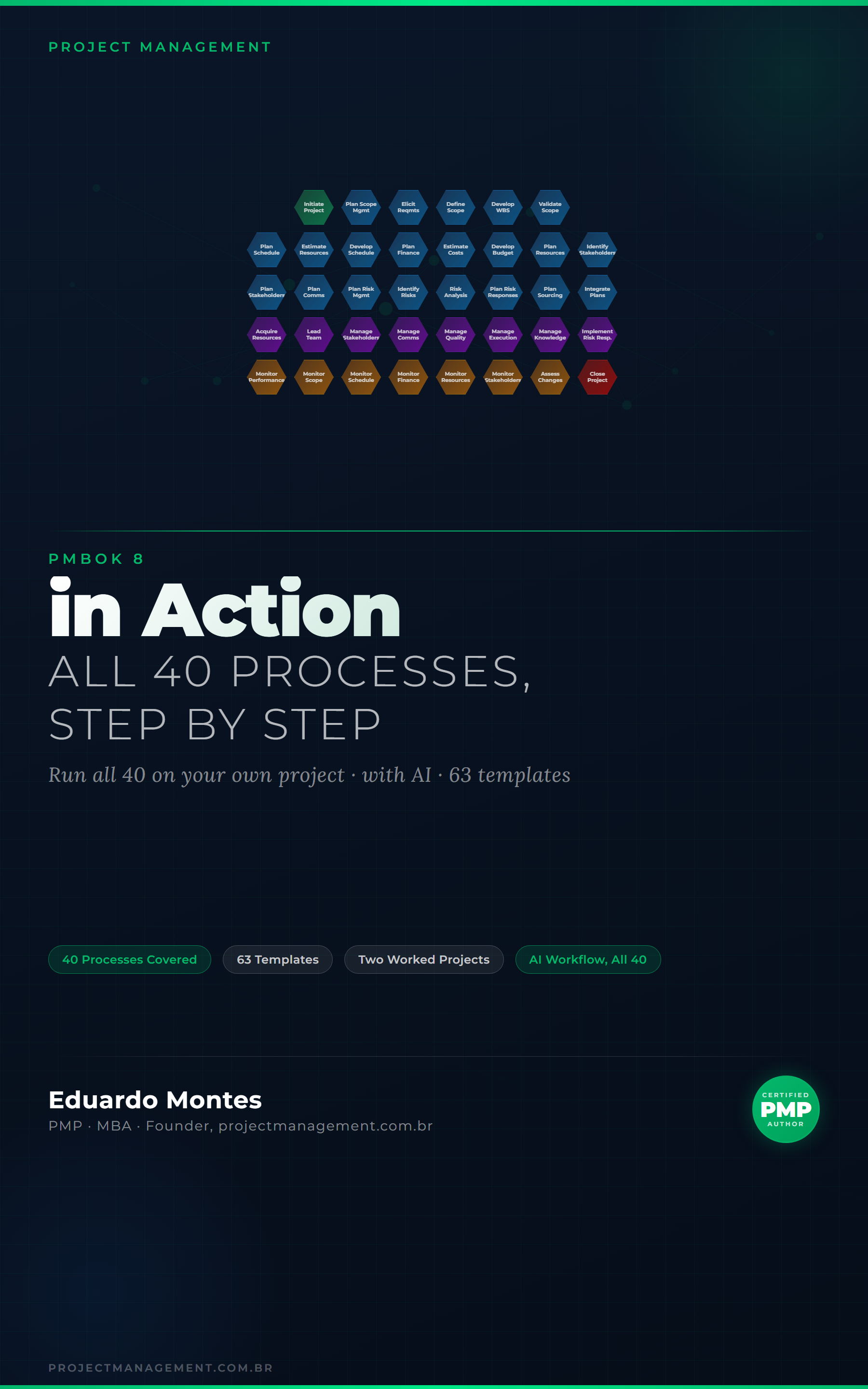
Go deeper in the book
PMBOK 8 in Action
The 40 processes of the PMBOK 8 Guide applied to one real project, with the finished artefact at every step.
See the book — US$ 9.98 →
 Project Management