
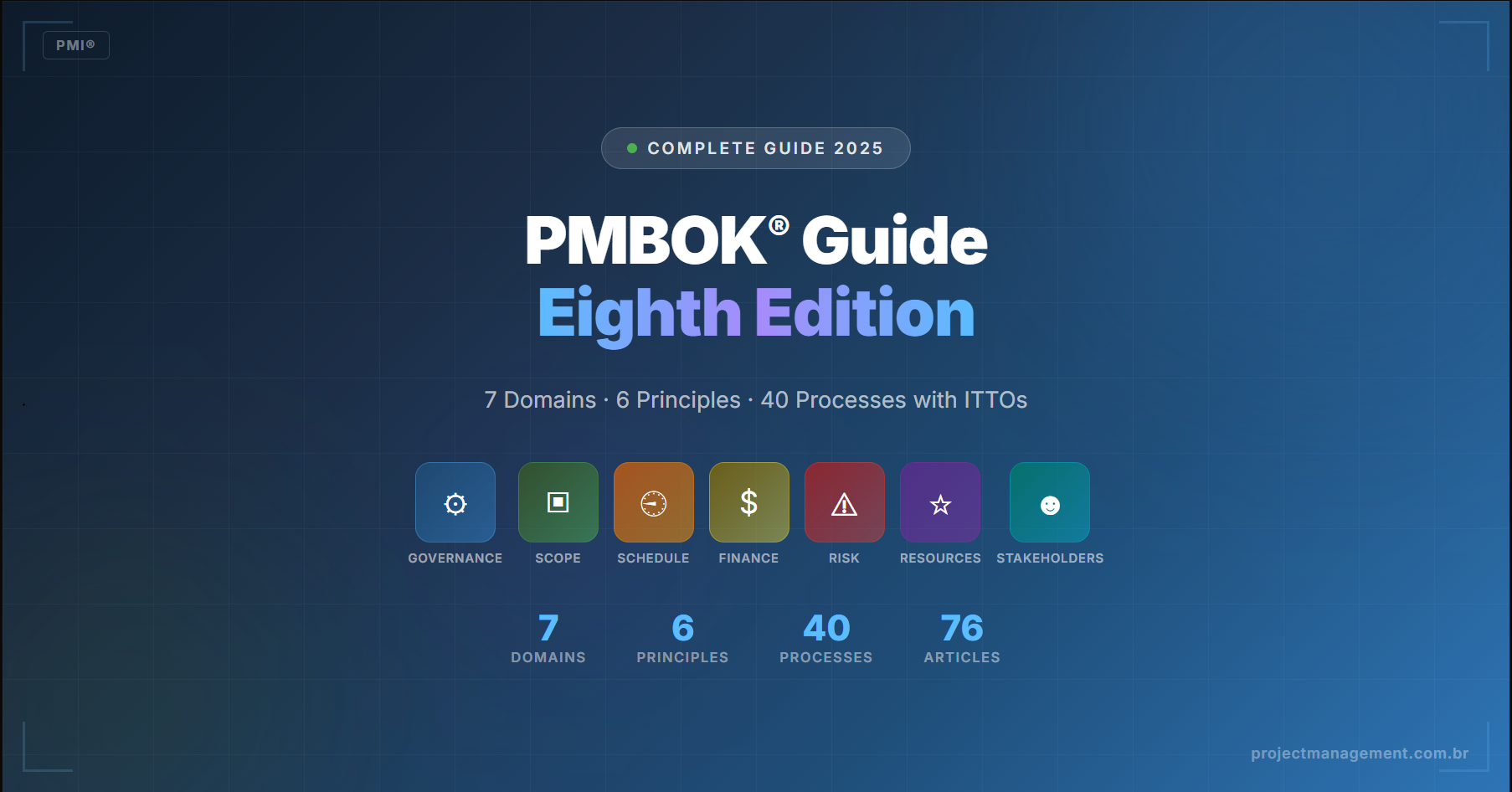
The PMBOK Guide 8th edition represents the most fundamental restructuring of PMI’s project management standard in decades — shifting from prescriptive process groups to principle-based performance domains while reintroducing 40 explicit processes suited to any delivery approach.
Complete and updated index of the
PMBOK® Guide — 8th Edition (2025)
The most complete PMBOK 8 resource on the web — 135 articles covering every process, principle, output, tool, and technique from the PMBOK® Guide 8th Edition (2025). Every topic includes practical examples, free templates, and real filled-in documents so you can apply what you learn immediately.
○ Planned
1. Introduction and Fundamentals
- ● PMBOK 8 Guide — Overview, structure and what changed
- ● What Is a Project — Definition per PMBOK 8
- ● What Is Project Management — Complete PMBOK 8 Guide
- ● Project Canvas — PMBOK 8 Template & Step-by-Step Guide
- ● Project Life Cycle
- ● Organizational Structure
- ● Project Portfolio
- ● Program Management
2. The 6 PMBOK 8 Principles
PMBOK 8 consolidated the 12 principles from the 7th edition into 6 principles that are more objective and actionable.
- ● Principle 1 — Adopt a Holistic View
- ● Principle 2 — Focus on Value
- ● Principle 3 — Embed Quality in Processes and Deliverables
- ● Principle 4 — Be a Diligent Leader
- ● Principle 5 — Integrate Sustainability Across All Project Areas
- ● Principle 6 — Build a Culture of Empowerment
- ● Consolidated Review of the 6 Principles
<!– 3. THE 7 PERFORMANCE DOMAINS –>
3. The 7 Performance Domains
PMBOK 8 organizes project management into 7 domains (down from 8 in the 7th edition), each with measurable processes and expected outcomes.
- ● Performance Domains — Overview of the 7 Domains
- ● Governance — decisions, monitoring, changes (9 processes)
- ● Scope — requirements, WBS, control and validation (6 processes)
- ● Schedule — activities, sequencing, control (3 processes)
- ● Finance — costs, budget, financial control (4 processes)
- ● Stakeholders — engagement, communication (7 processes)
- ● Resources — team, acquisition, leadership (5 processes)
- ● Risk — identification, analysis, responses (6 processes)
4. The 40 PMBOK 8 Processes
PMBOK 8 reintroduced 40 processes with ITTOs (Inputs, Tools & Techniques, and Outputs) — one of the biggest changes from PMBOK 7, which had eliminated processes entirely.
- ● Initiate Project or Phase — prev: Develop Project Charter
- ● Integrate and Align Project Plans
- ● Plan Sourcing Strategy — prev: Plan Procurement Management
- ● Manage Project Execution — prev: Direct and Manage Project Work
- ● Manage Quality Assurance — prev: Manage Quality
- ● Manage Project Knowledge
- ● Monitor and Control Project Performance
- ● Assess and Implement Changes — prev: Perform Integrated Change Control
- ● Close Project or Phase
- ● Plan Scope Management
- ● Elicit and Analyze Requirements — prev: Collect Requirements
- ● Define Scope
- ● Develop Scope Structure — prev: Create WBS
- ● Monitor and Control Scope — prev: Control Scope
- ● Validate Scope
- ● Plan Schedule Management
- ● Develop Schedule
- ● Monitor and Control Schedule — prev: Control Schedule
- ● Plan Financial Management — prev: Plan Cost Management
- ● Estimate Costs
- ● Develop Budget — prev: Determine Budget
- ● Monitor and Control Finances — prev: Control Costs
- ● Identify Stakeholders
- ● Plan Stakeholder Engagement
- ● Plan Communications Management
- ● Manage Stakeholder Engagement
- ● Manage Communications
- ● Monitor Stakeholder Engagement
- ● Monitor Communications
- ● Plan Resource Management
- ● Estimate Resources — prev: Estimate Activity Resources
- ● Acquire Resources
- ● Lead the Team — prev: Develop Team + Manage Team
- ● Monitor and Control Resourcing — prev: Control Resources
- ● Plan Risk Management
- ● Identify Risks
- ● Perform Risk Analysis — prev: Qualitative + Quantitative Analysis
- ● Plan Risk Responses
- ● Implement Risk Responses
- ● Monitor Risks
5. Tools and Techniques
PMBOK 8 documents 109 tools and techniques used across the 40 processes. Standalone articles cover the highest-traffic tools; grouped articles cover all remaining tools with individual anchors for direct linking.
Standalone articles
- ● Project Canvas new in PMBOK 8, Governance Domain
- ● Expert Judgment
- ● Earned Value Management (EVM)
- ● Make-or-Buy Analysis
- ● Meetings in Project Management
Grouped articles (all 109 tools covered with individual anchors)
- ● Estimation Techniques — Analogous, Parametric, Bottom-up, Three-point, COCOMO
- ● Schedule Techniques — CPM, CCM, PDM, Schedule Compression, Rolling Wave, Leads & Lags and more
- ● Risk Management Techniques — Risk Categorization, Reserve Analysis, Threat/Opportunity Strategies and more
- ● Communication Techniques — Methods, Models, Technology, Skills, Virtual Collaboration and more
- ● Data Analysis Tools — Control Charts, TCPI, Value Stream Mapping, Predictive Analytics and more
- ● Agile & Iterative Tools — Backlog, Sprints, Retrospectives, Velocity, User Stories and more
- ● Team & Leadership Tools — Tuckman Ladder, Emotional Intelligence, Ground Rules, Recognition and more
- ● Planning & Decision-Making Tools — Brainstorming, Decision Making, Design Thinking, Theory of Constraints and more
- ● Project Management Systems & Controls — PMIS, Dashboards, Checklists, Change Control, Audits and more
- ● Emerging Technologies in PM — AI, Augmented Reality, Virtual Reality, Genetic Algorithms
All 109 Tools & Techniques — A to Z
- After-action reviews
- Agile Release Planning
- Analogous estimating
- Artificial intelligence
- Audits
- Audits and inspections
- Augmented reality
- Backlog management
- Backlog refinement
- Bottom-up estimating
- Brainstorming
- Branch and bound
- Change control tools
- Checklists
- Colocation
- Communication methods
- Communication models
- Communication requirements analysis
- Communication skills
- Communication technology
- Constructive cost model
- Contingent response strategies
- Continuous improvement
- Control charts
- Cost aggregation
- Critical chain method
- Critical path method
- Customer talks and tests
- Daily coordination meetings
- Data analysis
- Data gathering
- Data representation
- Decision making
- Decomposition
- Dependency determination and Integration
- Design thinking
- Document analysis
- Emotional intelligence
- Estimation techniques
- Expert judgement
- Financing
- Funding limit reconciliation
- Genetic algorithms
- Green human resource management
- Ground rules
- Historical information review
- In-progress postmortems
- Individual and team assessments
- Information management
- Information radiators
- Inspection
- Integrated change control
- Interpersonal and team skills
- Knowledge management
- Leadership
- Leads and lags
- Logical relationship
- Make-or-buy analysis
- Market Research
- Meetings
- Multipoint estimating
- Organizational cultural intelligence
- Organizational theory
- Parametric estimating
- Performance reviews
- Pre-assignment
- Precedence diagramming method (PDM)
- Predictive analytics
- Prioritization/ranking
- Problem solving
- Process analysis
- Process automations
- Process improvement
- Product analysis
- Project canvas
- Project dashboards
- Project management information system
- Project reporting
- Prompt lists
- Recognition and rewards
- Reserve analysis
- Resource optimization
- Resource-based view
- Responsibility assignment matrix
- Retrospective meetings
- Retrospectives
- Review meetings
- Risk categorization
- Rolling wave planning
- Schedule compression
- Schedule network analysis
- Source selection analysis
- Sprint reviews
- Storytelling
- Strategies for opportunities
- Strategies for overall project risks
- Strategies for threats
- Test and inspection planning
- Testing/product evaluations
- Theory of constraints
- To-complete performance index (TCPI)
- Tuckman ladder
- Value stream mapping
- Velocity
- Virtual collaboration tools
- Virtual reality
- Virtual teams
- Visual controls
- Voting
6. Key Outputs
All 54 PMBOK 8 outputs are documented with full guides, blank templates, and filled-in examples from two real projects.
- ● Assumption Log
- ● Basis of Estimates
- ● Change Requests
- ● Cost Baseline
- ● Cost Estimates
- ● Deliverables
- ● Final Product/Service Transition
- ● Final Report
- ● Financial Management Plan
- ● Funding Proposals
- ● Funding Strategy
- ● Issue Log
- ● Lessons Learned Register
- ● Lessons Learned Updates
- ● Physical/Virtual Resource Assignments
- ● Product Backlog
- ● Project Calendars
- ● Project Charter
- ● Project Communications
- ● Project Documents
- ● Project Funding Requirements
- ● Project Management Plan
- ● Project Schedule
- ● Project Scope Statement
- ● Project Team Assignments
- ● Quality Control Measurements
- ● Quality Reports
- ● Requirements Documentation
- ● Requirements Management Plan
- ● Resource Breakdown Structure
- ● Resource Calendars
- ● Resource Management Plan
- ● Resource Requirements
- ● Revenue and Cost Forecasts
- ● Risk Management Plan
- ● Risk Register
- ● Risk Report
- ● Schedule Baseline
- ● Schedule Data
- ● Schedule Forecasts
- ● Schedule Management Plan
- ● Scope Baseline
- ● Scope Management Plan
- ● Sourcing Strategy Plan
- ● Stakeholder Engagement Plan
- ● Stakeholder Register
- ● Team Charter
- ● Team Performance Assessments
- ● User Stories
- ● WBS Dictionary
- ● Work Breakdown Structure (WBS)
- ● Work Performance Data
- ● Work Performance Information
- ● Work Performance Reports
7. Special Content
- ● PMBOK 8 and Agile: How They Relate
- ● Predictive, Agile, or Hybrid: How to Choose
- ● New and Discontinued Processes in PMBOK 8
🇧🇷 Leia este artigo em português
References
Project Management Institute (PMI). A Guide to the Project Management Body of Knowledge (PMBOK® Guide) — Eighth Edition. Newtown Square, Pennsylvania, USA: Project Management Institute, 2025.
Disclaimer: This index is provided for informational and educational purposes only. The content published here does not reproduce or replace PMI’s original material and fully respects their copyrights. PMI and PMBOK® Guide are registered trademarks of the Project Management Institute. For access to the complete official content, purchase the guide from Amazon or download it for free at pmi.org if you are a PMI member.
Last updated: March 2026 · Project Management
Free PMBOK 8 Quick Reference Card
All 7 Performance Domains, 6 Principles, and key tools on one printable page. Download it free — no payment required.
PMBOK Guide 8th Edition: Key Takeaways
The PMBOK Guide 8th edition introduces six principles and seven performance domains — Governance, Scope, Schedule, Finance, Stakeholders, Resources, and Risks — providing a framework flexible enough for predictive, agile, and hybrid delivery across any industry or project type.
Unlike its predecessors, the PMBOK Guide 8th edition explicitly integrates agile and adaptive practices into the standard rather than treating them as complementary supplements — making it the most comprehensive and delivery-agnostic version of the standard PMI has ever published.
Practitioners transitioning from PMBOK 6 to the PMBOK Guide 8th edition will find the language more principle-based and the structure more context-aware — designed to support professional judgment rather than prescribe a single correct approach to project management.
Was this article helpful?
Be the first to rate

 Project Management