
Product Owner, Scrum Master and Developers — what each is accountable for, and why the Guide stopped calling them roles.
The Scrum Guide describes one Scrum Team: typically ten or fewer people, with
no sub-teams and no hierarchies. Inside it there are three accountabilities.
The word matters. The 2020 Guide moved from “roles” to
“accountabilities” deliberately — a role is a job title, an accountability
is something someone is answerable for. One person can hold more than one.
Product Owner
Accountable for maximising the value of the product resulting from the work of
the Scrum Team. In practice, that means owning the Product Backlog: developing the
Product Goal, creating and ordering the items, and making sure the backlog is
transparent and understood.
Scrum Master
Accountable for the team’s effectiveness and for establishing Scrum as
defined in the Guide. The Guide calls this a true leader who serves the Scrum Team and
the larger organisation.
The Scrum Master is not a project manager with a new title and not a secretary who
books the meetings. Two of the accountabilities the Guide lists are the ones most often
dropped: causing the removal of impediments, and helping the organisation
adopt Scrum — which frequently means changing things outside the team.
Developers
The people committed to creating any aspect of a usable Increment each Sprint.
“Developer” here has nothing to do with writing code — on a marketing team,
the Developers are the marketers.
They are accountable for creating the Sprint Backlog, instilling quality by adhering
to the Definition of Done, adapting their plan each day toward the Sprint Goal, and
holding each other accountable as professionals.
Cross-functional and self-managing
The Guide asks for both: cross-functional, meaning the members have all the skills
necessary to create value each Sprint; and self-managing, meaning they decide
internally who does what, when and how.
A team that has to wait on an external group to finish anything is not
cross-functional — and every Sprint will contain a dependency it cannot resolve.
When you are alone
Plenty of people run Scrum on a project with no team. The accountabilities do not
disappear; they collapse into one person, and it is worth knowing which hat you are
wearing.
- Ordering the backlog against the goal — Product Owner.
- Noticing you skipped the Retrospective twice — Scrum Master.
- Deciding an item is not Done — Developer.
In Agile Together
KR3 — consistency of the events — is effectively the Scrum Master accountability made measurable. It is the one that catches you skipping the Retrospective when the week gets busy.
Next
Next: the Sprint Planning, where the Sprint Goal and the Sprint Backlog are born.
Agile Together is a free course. The package — scripts plus a portable Python — is a single download: get the course package. You install nothing.
Project Together
Track your progress through PMBOK 8
Create your free account to save your reading progress, earn points on every quiz, and unlock certificates as you master each domain.
Create Free Account →Free forever • No credit card required
QUIZ
Want to test what you learned from this article?
One multiple-choice question + one practical reflection. Earn Project Together points!
Go deeper in the book
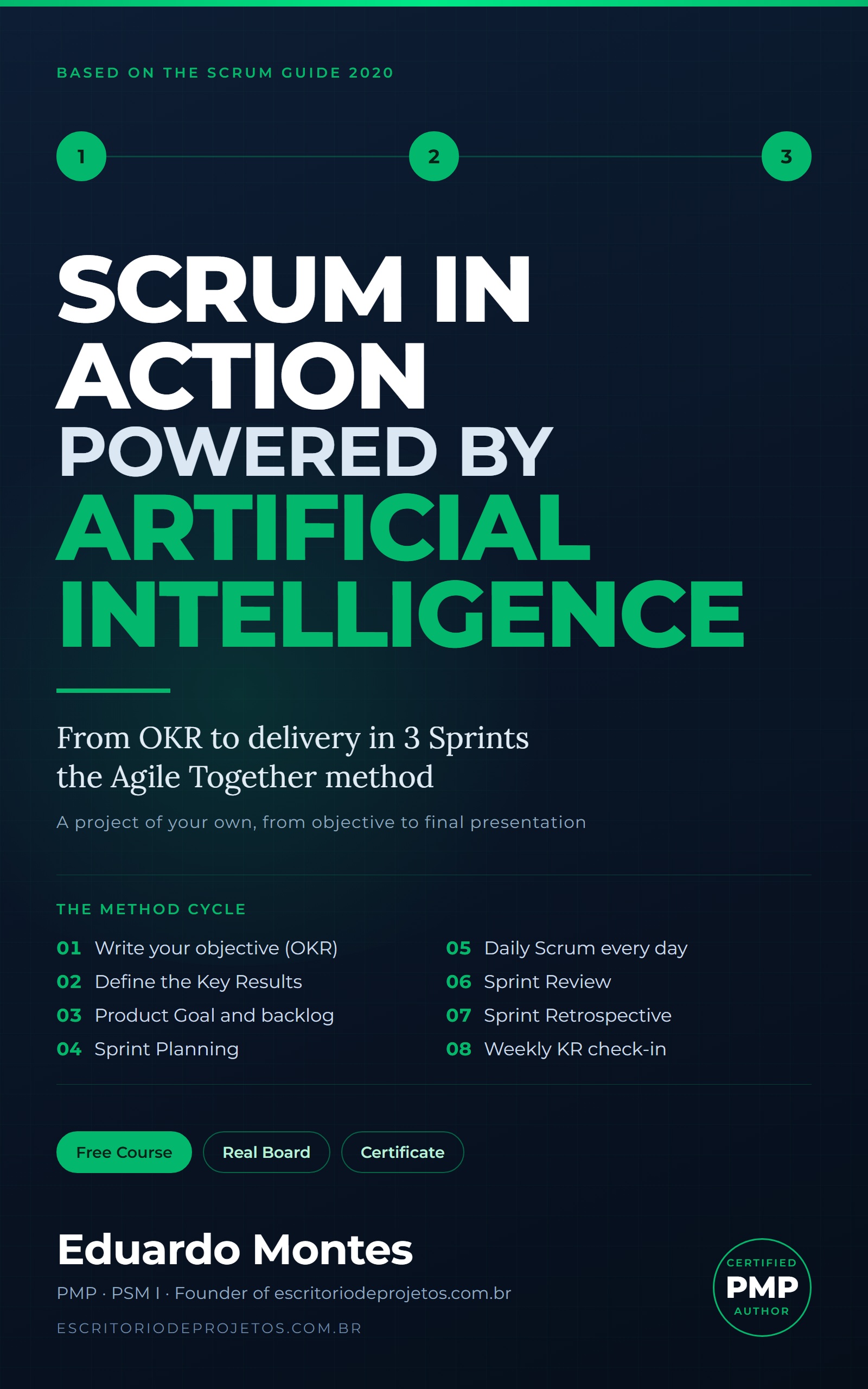
Scrum in Action
Three real Sprints on a project of your own, from the OKR to the final presentation, with the AI you already use at every event.
See the book — US$ 5.99 →

 Project Management