
Have you ever noticed that two project managers — same methodology, same tools, same PMP certification — get completely different results? One has authority to approve a budget change in an afternoon; the other spends three weeks in approval loops. One assembles a dedicated team in a week; the other borrows part-time resources from four different departments. The difference is rarely skill. It is almost always organizational structure.
PMBOK 8 treats organizational structure as one of the most influential enterprise environmental factors shaping how projects are initiated, staffed, governed, and delivered. Understanding the structure of your organization is not administrative background knowledge — it is strategic intelligence that directly determines what is and is not possible on your project.
In this guide you will find:
- What organizational structure means in the PMBOK 8 framework
- A clear breakdown of every structure type: functional, matrix (weak/balanced/strong), projectized, composite, and hybrid
- The three PMO types and how each one changes project management practice
- How structure affects authority, budget control, resource availability, and team dedication
- How to choose the right structure for your context
- A quick-reference comparison table covering all structure types
1. WHAT IS ORGANIZATIONAL STRUCTURE
The PMBOK 8 definition
Organizational structure is a component of the enterprise environmental factors that defines how an organization groups, coordinates, and governs its people, processes, and work. PMBOK 8 places it within Section 2.2.5 — Organizational Structures of The Standard for Project Management, under the broader category of the project environment.
In practical terms, organizational structure determines:
- Who has authority to make decisions on a project
- How resources are allocated and who controls them
- The degree of autonomy a project manager has
- How project teams are formed and managed
- How project information flows through the organization
- The role and influence of the project management office (PMO)
PMBOK 8 explicitly recognizes that organizational structure is not a neutral backdrop — it is an active constraint and enabler that the project manager must understand, navigate, and tailor the project approach to. A project plan that ignores the organizational structure is a plan that will fail to predict where resistance, delays, and resource conflicts will come from.
Why it matters more than ever in PMBOK 8
PMBOK 8 emphasizes value delivery across all seven performance domains. Organizational structure directly affects the project’s ability to deliver value because it governs the speed and quality of decision-making, the availability and stability of resources, the integration of work across functions, and the alignment between project objectives and organizational priorities. A project manager who understands the structure can design governance, communication, and resourcing approaches that work with the grain of the organization — rather than against it.
2. FUNCTIONAL STRUCTURE
Overview
The functional structure is the most traditional organizational model. The organization is divided into functional departments — IT, Finance, Human Resources, Marketing, Operations, Engineering — each led by a functional manager with specialized expertise in that domain. Projects are executed within or across these departments, but the departments themselves remain the primary organizing unit.
How projects work in a functional structure
In a functional organization, projects are typically assigned to a functional department that has primary ownership. The project manager — often called a project coordinator or project leader in this context — operates within that department and has limited formal authority. Team members report to their functional managers, not to the project manager. Resource decisions, performance evaluations, and priority-setting are all in the hands of the functional managers.
Key characteristics:
- Project manager has little to no formal authority
- Resources report to and are controlled by functional managers
- Project team members are part-time and divided among multiple projects
- Budget decisions require functional manager approval
- Projects that cross multiple departments face coordination challenges
- Technical expertise within the department is strong
- Career development is managed within the functional hierarchy
When it works well
Functional structures work best for organizations where most projects are contained within a single function (e.g., IT infrastructure upgrades, HR policy rollouts, finance system migrations). They preserve deep technical expertise, enable efficient resource sharing across routine work, and align well with regulatory and compliance requirements that are organized by function.
The project manager’s challenge
In a functional structure, the project manager’s primary challenge is influence without authority. Success depends on relationship-building, negotiation, and the ability to align functional managers around project priorities. The project manager must be skilled at communication and stakeholder management to compensate for the lack of formal power.
3. MATRIX STRUCTURES (WEAK, BALANCED, STRONG)
The matrix concept
Matrix structures emerged as organizations recognized that purely functional structures created silos that impeded cross-functional projects. A matrix overlays a project dimension onto the functional hierarchy, creating a dual reporting relationship: team members report to both a functional manager and a project manager simultaneously.
PMBOK 8 recognizes three matrix variants that differ in where authority is concentrated.
Weak Matrix
In a weak matrix, the functional structure remains dominant. The “project manager” is typically a coordinator or expediter who facilitates communication and tracks progress but has no independent authority over resources or budget.
- Project manager role: Coordinator or Expediter
- PM authority level: Very low to none
- Resource control: Functional managers retain full control
- Team dedication to project: Part-time, variable
- Budget control: Functional managers
- Typical outcome: PM is a facilitator, not a decision-maker
The weak matrix is structurally close to the functional organization. The main difference is the formal recognition of a project coordination role — but without authority to match.
Balanced Matrix
In a balanced matrix, authority is shared between functional managers and project managers. Neither role has clear precedence, which creates a genuine dual reporting relationship. The project manager has recognized responsibilities and some influence over resources, but significant decisions still require negotiation with functional managers.
- Project manager role: Full-time Project Manager
- PM authority level: Low to moderate
- Resource control: Shared between PM and functional managers
- Team dedication to project: Part-time to mixed
- Budget control: Shared
- Typical outcome: Ongoing negotiation; results depend heavily on PM’s influence skills
The balanced matrix is the most common — and the most challenging — structure to navigate. The inherent tension between project and functional authority creates conflict if not managed carefully.
Strong Matrix
In a strong matrix, project management has greater authority than in the balanced variant. Project managers control resources for the duration of the project, manage project budgets directly, and have formal organizational standing comparable to functional managers. Team members may be fully or primarily dedicated to projects.
- Project manager role: Full-time Project Manager with significant authority
- PM authority level: Moderate to high
- Resource control: Primarily the project manager
- Team dedication to project: Mixed to full-time
- Budget control: Project manager
- Typical outcome: Projects are more efficiently managed; PM role is more strategic
A strong matrix begins to resemble a projectized structure in many respects, but the functional hierarchy and departments continue to exist alongside project management structures.
The dual-boss dilemma
All matrix structures share one fundamental challenge: team members have two bosses. This creates ambiguity about priorities, potential for conflicting instructions, and stress for team members caught between competing demands. PMBOK 8 recognizes this as a structural reality that must be managed through clear governance, well-defined roles, and explicit protocols for conflict escalation and resolution.
4. PROJECTIZED STRUCTURE
Overview
In a projectized (or project-oriented) organization, everything is organized around projects. There are no permanent functional departments in the traditional sense — or where they exist, they play a support role. The project is the primary unit of organization, and the project manager is the most senior figure in the work hierarchy for that project.
How projects work in a projectized structure
Project managers have full authority over their projects. They control the budget, manage the team directly, make resource decisions, and are accountable for delivering project outcomes. Team members are assigned 100% to the project for its duration and report exclusively to the project manager.
Key characteristics:
- Project manager has full authority over scope, schedule, budget, and resources
- Team members are fully dedicated to the project — no split responsibilities
- Clear accountability: the PM is responsible for the project’s success
- Fast decision-making within the project
- Strong project identity and team cohesion
- At project close, team members must find new assignments (no permanent “home” department)
- Risk of duplicated functional expertise across projects
When it works well
Projectized structures are most effective in organizations whose core business is project delivery — engineering firms, construction companies, consulting firms, aerospace and defense contractors, and IT services companies. In these environments, every client engagement is a project, and the organizational model must be built around delivering projects efficiently.
The challenge of transition
The main risk in a projectized structure is what happens to people when projects end. Without permanent functional homes, team members face uncertainty at project closure. Organizations with projectized structures must invest in talent management, redeployment processes, and career development mechanisms that compensate for the lack of a stable functional hierarchy.
5. COMPOSITE AND HYBRID STRUCTURES
Why most organizations are neither pure nor simple
PMBOK 8 explicitly acknowledges that most real organizations do not fit neatly into a single structure type. As organizations grow, acquire companies, launch new divisions, and respond to market pressures, they develop structures that combine elements of functional, matrix, and projectized models. These are called composite or hybrid structures.
Composite structures
A composite structure exists when different parts of the same organization operate under different structural models simultaneously. A classic example:
- Corporate headquarters operates as a functional organization (HR, Finance, Legal are functional departments managing their own operations)
- The product development division operates as a strong matrix (PMs have significant authority, teams have dual reporting)
- A large-scale infrastructure unit operates as a projectized organization (each major infrastructure project has a fully dedicated team and autonomous PM)
In this composite organization, a project manager working in the infrastructure unit has full authority and dedicated resources. A PM working on an HR initiative at headquarters is a coordinator with minimal authority. Both are “project managers” in the same organization — but their experience and operating environment are entirely different.
Hybrid structures in PMBOK 8
PMBOK 8 uses the term hybrid in a related but slightly different sense: a hybrid structure may refer to an organization that has intentionally designed a mixed governance model to balance the benefits of functional expertise, project focus, and agile ways of working. In a hybrid structure, some teams may operate using agile methods with self-organizing characteristics, while others follow predictive approaches under traditional management hierarchies.
PMBOK 8 recognizes this reality and emphasizes that tailoring — adapting the project management approach to the specific organizational context — is essential precisely because organizational structures are so varied. A project management approach designed for a strong matrix will not work in a functional organization, and vice versa.
What this means in practice
When you join a new project or organization, one of the first things to determine is: what is the dominant structure, and where does my project sit within it? The answer shapes every subsequent decision about governance, stakeholder engagement, resource management, and communication.
6. THE PMO (PROJECT MANAGEMENT OFFICE)
The PMO in PMBOK 8
PMBOK 8 dedicates Appendix X2 to the Project Management Office, recognizing it as a critical structural element that shapes how projects are managed across an organization. The PMO is defined as an organizational structure that standardizes project-related governance processes and facilitates the sharing of resources, methodologies, tools, and techniques.
Critically, PMBOK 8 describes the PMO not just as a standards body, but as a value delivery mechanism. The primary purpose of a PMO is to help the organization achieve its strategic objectives through more effective project management — not simply to enforce compliance.
PMO Type 1: Supportive
A Supportive PMO provides guidance, best practices, templates, and tools to project teams — but does not mandate their use. It acts as a resource center and knowledge repository.
- Authority level: Low
- Primary role: Consultation and support
- Typical deliverables: Templates, training, lessons-learned repositories, methodology guidance
- Control level: Minimal — project teams can accept or decline PMO guidance
- Best suited for: Organizations where project management maturity varies widely and a prescriptive approach would be rejected
PMO Type 2: Controlling
A Controlling PMO goes beyond support to require compliance with specific frameworks, processes, and reporting standards. Project teams must use defined methodologies, submit reports in defined formats, and comply with governance requirements.
- Authority level: Moderate
- Primary role: Compliance, standards, and oversight
- Typical deliverables: Mandatory frameworks, compliance audits, standardized reporting dashboards, training requirements
- Control level: Moderate — the PMO defines the rules; projects must follow them
- Best suited for: Organizations that need consistency across multiple projects, regulatory environments requiring documented governance
PMO Type 3: Directive
A Directive PMO directly manages projects. Project managers report to the PMO rather than to business units or functional managers. The PMO has full authority over project prioritization, resourcing, budgets, and delivery.
- Authority level: High
- Primary role: Direct project management and portfolio control
- Typical deliverables: Direct project management, portfolio prioritization decisions, resource allocation across projects
- Control level: High — the PMO owns the projects
- Best suited for: Organizations where project management excellence is a core competency, or where strategic alignment of projects requires centralized control
Customer centricity and PMO maturity
PMBOK 8 introduces a forward-looking perspective on PMOs: the most effective PMOs are those that are customer-centric — meaning they focus on the needs of the project teams and business units they serve, rather than on internal process compliance. A PMO that adds bureaucracy without adding value will be circumvented or dismantled. A PMO that genuinely helps teams deliver better results will earn authority organically.
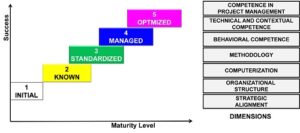
PMO maturity models (referenced in Appendix X2) describe a progression from basic administrative functions through governance and optimization, ultimately to strategic portfolio management and organizational transformation. The PMO’s role evolves as the organization’s project management capability matures.
7. HOW STRUCTURE AFFECTS PROJECT MANAGEMENT
The four key dimensions
Organizational structure affects project management through four critical dimensions: authority, budget control, resource availability, and team dedication. Understanding where your organization sits on each of these dimensions is essential for designing an effective project management approach.
Authority
Authority refers to the project manager’s formal power to make decisions, direct team members, and commit organizational resources. In functional structures, PM authority is minimal — the PM influences but does not control. In matrix structures, authority is shared and contested. In projectized structures, the PM has full authority within the project scope.
Low authority does not mean low effectiveness — but it does mean that the project manager must compensate through influence, negotiation, and stakeholder management rather than direct direction.
Budget Control
Budget control determines who approves spending decisions on the project. In functional structures, budget sits with functional managers; the PM requests resources rather than controlling them. In matrix structures, budget authority is shared — often requiring dual sign-off. In projectized structures, the PM owns the project budget directly.
The practical implication: in functional and weak matrix environments, procurement decisions, contract approvals, and resource acquisitions require more governance steps and take longer. Project planning must account for this.
Resource Availability
Resource availability refers to how reliably the project manager can count on getting the people and assets needed for the project. In functional structures, resources are shared across many priorities and may be pulled from the project with little notice. In matrix structures, resource availability is negotiated. In projectized structures, dedicated team members are fully available for the project’s duration.
Variable resource availability is one of the most common sources of schedule risk in functional and matrix organizations. Effective project managers in these environments invest heavily in resource planning, early commitment agreements, and contingency scheduling.
Team Dedication
Team dedication refers to the proportion of each team member’s working time that is committed to the project. Low dedication (common in functional and weak matrix structures) means team members are managing multiple priorities simultaneously, which reduces productivity, increases context-switching costs, and creates coordination complexity. High dedication (common in projectized and strong matrix structures) enables focused, high-velocity work and stronger team cohesion.
8. CHOOSING THE RIGHT STRUCTURE
Can a project manager choose the structure?
In most cases, the organizational structure is a given — the project manager inherits it rather than choosing it. However, there are situations where the structure can be influenced: when setting up a new program or portfolio, when proposing a PMO model to leadership, when designing governance for a large or strategic project, or when recommending organizational improvements based on project outcomes.
Even when the structure cannot be changed, understanding it allows the project manager to tailor the project approach to make the most of the existing environment.
Key questions to guide structure selection or adaptation
- How large and complex is the project? Larger, more complex projects benefit from more project-oriented authority. Small, contained projects can work well in functional structures.
- How cross-functional is the work? Projects that span many departments need at least a balanced matrix structure to ensure the PM has enough authority to coordinate across boundaries.
- How long is the project? Long-duration projects benefit from dedicated team structures (strong matrix or projectized) to preserve team knowledge and relationships.
- How critical is speed of decision-making? High-urgency projects need clear authority. Matrix structures with contested decision rights slow down in crises.
- What is the organization’s culture? A highly hierarchical culture may resist moving from functional to matrix structures even when the project benefits would be significant.
- What PMO support exists? The availability of a Controlling or Directive PMO can compensate for structural limitations by providing coordination, standards, and visibility that the structure alone does not provide.
The tailoring imperative
PMBOK 8’s emphasis on tailoring means that there is no universally “correct” organizational structure. The right structure is the one that, given the organization’s context, culture, and strategic priorities, best enables project teams to deliver value. Project managers who understand this can navigate any structure more effectively — and can make informed recommendations for structural improvement when the opportunity arises.
9. QUICK-REFERENCE COMPARISON TABLE
The following table summarizes the key characteristics of each organizational structure type across the dimensions that matter most for project management practice.
| Structure Type | PM Authority | Budget Control | Resource Availability | Team Dedication | PM Role Title |
|---|---|---|---|---|---|
| Functional | Little to none | Functional Manager | Low (shared, variable) | Part-time | Project Coordinator |
| Weak Matrix | Very low | Functional Manager | Low | Part-time | Coordinator / Expediter |
| Balanced Matrix | Low to moderate | Shared | Mixed | Part-time to mixed | Project Manager |
| Strong Matrix | Moderate to high | Project Manager | Moderate to high | Mixed to full-time | Project Manager (senior) |
| Projectized | High to total | Project Manager | High (fully dedicated) | Full-time | Project Manager / Program Manager |
| Composite / Hybrid | Varies by unit | Varies by unit | Varies by project type | Varies | Varies |
| PMO Type | Authority Level | Primary Function | Compliance Requirement | Best For |
|---|---|---|---|---|
| Supportive | Low | Templates, tools, training | Optional | Decentralized organizations, early PM maturity |
| Controlling | Moderate | Standards, compliance, reporting | Required | Regulated industries, mid-to-high PM maturity |
| Directive | High | Direct project management, portfolio control | Full ownership | Project-centric organizations, strategic portfolio management |
CONCLUSION
Organizational structure is not bureaucratic background information — it is one of the most powerful environmental factors shaping every project you manage. PMBOK 8 places it at the center of the project environment because the structure determines your authority, your resources, your decision-making speed, and your team’s capacity to focus.
The three essential takeaways for practice:
- Diagnose before you plan. Before designing any project management approach, map the organizational structure you are operating in. Know your authority level, your resource model, and the PMO type available to you.
- Tailor to the structure. There is no single “correct” project management approach. The right approach is the one that works with the grain of the organizational structure, not against it.
- Most organizations are hybrid. PMBOK 8 acknowledges that composite and hybrid structures are the norm, not the exception. Expect to navigate complexity and design governance that bridges structural differences.
Mastering organizational structures does not just make you a better project manager — it makes you a more credible organizational advisor. When you can articulate why a project is struggling (structural authority gaps, resource contention, governance ambiguity) and what structural changes would help, you move from project executor to strategic contributor.
See all PMBOK 8 articles in the Complete Index
Call to Action:
References
PMBOK Guide 8: The New Era of Value-Based Project Management. Available at: https://projectmanagement.com.br/pmbok-guide-8/
Disclaimer
This article is an independent educational interpretation of the PMBOK® Guide – Eighth Edition, developed for informational purposes by ProjectManagement.com.br. It does not reproduce or redistribute proprietary PMI content. All trademarks, including PMI, PMBOK, and Project Management Institute, are the property of the Project Management Institute, Inc. For access to the complete and official content, purchase the guide from Amazon or download it for free at https://www.pmi.org/standards/pmbok if you are a PMI member.
Free PMBOK 8 Quick Reference Card
All 7 Performance Domains, 6 Principles, and key tools on one printable page. Download it free — no payment required.
QUIZ
Want to test what you learned from this article?
One multiple-choice question + one practical reflection. Earn Project Together points!
MULTIPLE CHOICE
According to the article, how does organizational structure directly impact the LIVES of people working in projects?
REFLECTION
To share your reflection, enter your name and email:
You will earn points in the Project Together community!
Your data is protected. No spam.
PRACTICAL REFLECTION
Which part of this article do you plan to apply to generate more value in your projects or daily work?
Your reflection helps other professionals apply the content. Shared reflections are visible below.
✓
PROJECT TOGETHER
Earn points by answering quizzes and sharing reflections. Climb the ranking and earn your certificate!
Join the Course →

 Project Management