
Article updated in March 2026 for the PMBOK® Guide — Eighth Edition.
Monitor Stakeholder Engagement in PMBOK 8 — Complete Guide
Formerly known as: Monitor Stakeholder Engagement (PMBOK 6)
A project team had been executing a change management initiative for nine months. Their engagement activities had been consistent: regular status reports, monthly town halls, and an open-door policy for questions. At month ten, during a critical go-live preparation meeting, three department managers who had attended every town hall announced that they were not prepared to accept the new system and would be requesting executive intervention. The project team was blindsided. The engagement activities had been consistent, but no one had been systematically monitoring whether those activities were actually moving stakeholder engagement levels toward the desired state. The managers had been attending the meetings without their concerns being heard, and without their engagement level being assessed, the team had no early warning of the brewing resistance.
Monitor Stakeholder Engagement in PMBOK 8 is the process of monitoring project stakeholder relationships and tailoring strategies for engaging stakeholders through the modification of engagement strategies and plans. The key benefit of this process is that it maintains or increases the efficiency and effectiveness of stakeholder engagement activities as the project evolves and its environment changes. This process is performed throughout the project.
For PMP candidates, this is Stakeholders Process 4 of 7. For practitioners, it is the feedback loop that distinguishes effective stakeholder management from the illusion of stakeholder management — the mechanism that tells you whether your engagement strategies are working or need to change.
- 1. What Is the Monitor Stakeholder Engagement Process
- 2. Why Use the Monitor Stakeholder Engagement Process
- 3. Inputs, Tools & Techniques, and Outputs (ITTO)
- 4. Step-by-Step Application Guide
- 5. When to Apply This Process
- 6. Real-World Examples
- 7. Templates and Downloads
- 8. Five Common Errors
- 9. Tailoring This Process
- 10. Process Interactions
- 11. Quick-Application Checklist
1. What Is the Monitor Stakeholder Engagement Process
According to the PMBOK® Guide — Eighth Edition, Monitor Stakeholder Engagement is the process of monitoring project stakeholder relationships and tailoring strategies for engaging stakeholders through the modification of engagement strategies and plans. The key benefit of this process is that it maintains or increases the efficiency and effectiveness of stakeholder engagement activities as the project evolves and its environment changes. This process is performed throughout the project.
Monitor Stakeholder Engagement is the control-cycle counterpart to Manage Stakeholder Engagement: while Manage executes engagement activities, Monitor assesses whether those activities are achieving the intended outcomes. Together, they form a continuous improvement loop: Plan defines strategies → Manage executes strategies → Monitor assesses outcomes → Plan is updated → cycle repeats.
The process specifically involves assessing the effectiveness of stakeholder engagement efforts, identifying necessary adjustments to improve relationships, and refining strategies or plans to better meet stakeholder participation needs. This is not passive observation — it is active evaluation of engagement effectiveness with a commitment to adjusting strategies when current approaches are not producing the desired results.
2. Why Use the Monitor Stakeholder Engagement Process
Direct benefits
- Early detection of engagement failures: The systematic monitoring of stakeholder engagement levels against desired levels provides early warning of engagement strategies that are not working. A stakeholder who has been Neutral for three months when they should have moved to Supportive by now indicates a strategy that needs adjustment, not continuation.
- Adaptive strategy management: The project environment changes throughout execution: organizational priorities shift, new leadership emerges, external events affect stakeholder attitudes. Engagement strategies designed at project start may be completely inappropriate for conditions in month eight. Monitor Stakeholder Engagement provides the structured mechanism for detecting these changes and adapting strategies accordingly.
- Evidence-based plan updates: The stakeholder engagement plan should be a living document, but “we should update the plan” is not an actionable directive. Monitor Stakeholder Engagement provides the specific, evidence-based findings that justify and inform plan updates: which stakeholder’s engagement level has regressed, which strategy has proven ineffective, which new engagement approaches have produced positive results in similar situations.
- Risk management integration: Stakeholder engagement failures are project risks. A key approver who is disengaged is a risk to timeline. A powerful resistant stakeholder who is not responding to engagement strategies is a risk to scope and quality. Monitor Stakeholder Engagement converts engagement observations into risk register updates that allow these stakeholder risks to be formally managed.
3. Inputs, Tools & Techniques, and Outputs (ITTO)
| Inputs | Tools & Techniques | Outputs |
|---|---|---|
|
|
|
Tools & Techniques explained
Data analysis — Stakeholder analysis (during monitoring): Periodic re-execution of stakeholder analysis compares current engagement levels against the desired levels documented in the stakeholder engagement plan. For each stakeholder, assess: Has their engagement level changed since the last assessment? Have their interests or concerns changed? Is the current engagement strategy producing the intended movement toward the desired engagement level? This re-analysis is the core monitoring activity that converts the stakeholder register from a static document into a dynamic management tool.
Data analysis — Root cause analysis: When stakeholder engagement monitoring identifies that a strategy is not working (a stakeholder’s engagement level has not moved or has regressed), root cause analysis determines why. Is the engagement frequency insufficient? Is the content of communications not addressing the stakeholder’s actual concerns? Is there an organizational dynamic that is counteracting the engagement efforts? Is the desired engagement level actually achievable given the stakeholder’s legitimate constraints? Root cause analysis prevents the waste of trying harder with a flawed strategy when a different strategy is needed.
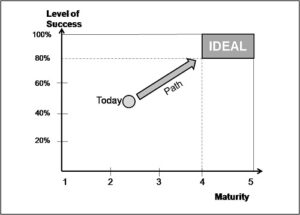
Data representation — Stakeholder engagement assessment matrix (monitoring use): The same matrix used in planning is used in monitoring, but now with three columns: Current (C), Desired (D), and Previous Assessment (P). The P column allows trend tracking: is the stakeholder moving toward D (positive trend), staying at the same level (static), or moving away from D (negative trend)? Trend information is more actionable than point-in-time data — a static stakeholder whose engagement has been unchanged for 8 weeks despite active engagement efforts requires a fundamentally different strategic response than a stakeholder who moved from Resistant to Neutral in the past 4 weeks and is trending toward Supportive.
Interpersonal skills — Active listening: The primary monitoring technique in informal contexts is active listening during stakeholder interactions. Listening for what stakeholders are saying about the project (positive indicators of engagement progress), what they are not saying (absence of concerns that were previously prominent may indicate resolution), and what they are saying in non-verbal communication (body language, participation patterns, responsiveness to requests) provides continuous engagement monitoring data that supplements formal assessment activities.
Outputs explained
Work performance information: The processed output of engagement monitoring — the stakeholder engagement status report that translates raw observations into management intelligence. Work performance information from stakeholder monitoring should address: current engagement levels vs. desired levels for each significant stakeholder; trends (improving, stable, declining); effectiveness assessment for current engagement strategies; specific issues or concerns surfaced through monitoring; and recommended adjustments to engagement strategies or plans.
Change requests: When monitoring reveals that the current engagement plan or communications plan requires significant adjustments (not minor updates, but changes that affect the project’s overall stakeholder management approach), formal change requests are raised. Major engagement strategy changes may require sponsor approval, particularly when they involve additional resources, schedule adjustments, or significant communication commitments.
4. Step-by-Step Application Guide
Step 1 — Establish a regular engagement assessment cadence
Define the frequency of formal stakeholder engagement level assessments. For high-complexity, high-risk stakeholder environments, monthly assessments may be appropriate. For simpler projects, quarterly assessments supplemented by continuous informal observation may suffice. The cadence should be sufficient to detect engagement trends early enough for effective strategy adjustment, without being so frequent as to become a bureaucratic burden.
Step 2 — Collect engagement observations systematically
Between formal assessments, build systematic engagement observation into routine project activities. Sprint reviews, steering committee meetings, stakeholder update calls, and issue resolution sessions all provide engagement data. Train team members who interact with stakeholders to report observations: “The department director seemed more positive today than last month” or “The compliance team’s representative asked for additional meeting time — seems more engaged” are valuable data points that should be captured and incorporated into monitoring assessments.
Step 3 — Update the stakeholder engagement assessment matrix
At each formal assessment, update the matrix with current engagement level observations for each stakeholder. Compare to the desired level and to the previous assessment. Identify which stakeholders have improved (engagement strategies are working), which are unchanged (may need strategy adjustment), and which have regressed (requires immediate strategy review).
Step 4 — Conduct root cause analysis for engagement gaps and regressions
For every stakeholder whose engagement level has not progressed toward desired or has regressed, conduct a root cause analysis. Is the current strategy fundamentally flawed? Are there new factors (organizational changes, project events, external circumstances) that have affected the stakeholder’s attitude? Is the desired engagement level still appropriate, or has the stakeholder’s role in the project changed enough to require a revised desired level?
Step 5 — Update engagement plans and strategies based on monitoring findings
Translate monitoring findings into concrete plan updates: revised engagement strategies for stakeholders whose current strategies are not working, new engagement activities for stakeholders whose engagement has regressed, removal or reduction of engagement activities for stakeholders who have reached and maintained their desired level, and addition of engagement activities for newly surfaced stakeholder concerns.
Step 6 — Report engagement status and raise change requests as needed
Include stakeholder engagement status in project status reports to the sponsor. Significant engagement risks — powerful stakeholders with persistent resistance, critical approvers who are chronically disengaged — should be explicitly reported as risks with recommended sponsor actions. Raise formal change requests when plan updates require resource additions, schedule adjustments, or sponsor approval.
5. When to Apply This Process
Throughout execution, on a defined assessment cadence: Monitor Stakeholder Engagement should have a defined assessment frequency (monthly, quarterly, or aligned with project milestones) that is documented in the engagement plan. Ad hoc monitoring in response to crises is necessary but insufficient; systematic scheduled monitoring provides the early warning that prevents crises.
After major project events: Significant project events — scope changes, schedule delays, team changes, budget reallocations, external developments affecting the project context — can rapidly shift stakeholder attitudes. A formal engagement assessment after any major project event ensures that engagement strategies reflect the new reality.
6. Real-World Examples
Example 1: Project Phoenix — Website Launch
Context: PM Alex Morgan, PMP. 90-day website launch for TechCorp. Budget: $72,250.
How Monitor Stakeholder Engagement was applied: Alex conducted monthly engagement assessments using the stakeholder engagement assessment matrix updated from observations made during sprint reviews, one-on-one check-ins, and the executive dashboard interaction patterns. At the sprint 6 assessment, the engagement matrix revealed an unexpected regression: the IT manager, who had moved from Resistant to Supportive after the technical briefing in sprint 2, appeared to have returned to a cautious Neutral position. Root cause investigation (a brief informal call) revealed that a new corporate security policy had been published two weeks earlier that changed the requirements for external API connections — requirements that the already-approved integration architecture might not meet under the new policy.
The early detection through monitoring allowed Alex to schedule a policy review with the IT manager and the lead developer before the integration work was complete — identifying one minor API configuration change needed to comply with the new policy. Total effort: 4 hours. If discovered at go-live: estimated 2-week delay and significant rework. The monitoring process prevented a crisis that the management process had not detected because the IT manager had not yet raised the issue through formal channels.
Example 2: Project ProjectAdm — SaaS PM Platform
Context: PM Eduardo. 18-month SaaS platform development.
How Monitor Stakeholder Engagement was applied: Eduardo’s quarterly engagement assessments tracked engagement levels across all stakeholder tiers. The most significant monitoring finding occurred at month 14: the early access community’s overall engagement score (measured through platform usage frequency, feedback submission rate, and community forum activity) had declined 23% over the previous six weeks. Root cause analysis identified three contributing factors: the sprint 12 feature release had removed a workflow element that power users depended on (replaced with a different, less familiar approach); response time to user-submitted bugs had increased from the target 48 hours to 96 hours due to a team member’s absence; and a competitor had published a product announcement that had created uncertainty among early access participants about committing further time to the ProductAdm beta program.
The response to each root cause: a feature flag that allowed users to choose between the old and new workflow approaches (addressing factor 1); a temporary reassignment of a developer to bug response coverage (factor 2); and a direct communication from Eduardo addressing the competitor announcement with a candid comparison of the platforms’ roadmaps and the ProductAdm early access community’s role in shaping the product (factor 3). The community engagement score recovered to above baseline within four weeks.
7. Templates and Downloads
- Stakeholder Engagement Plan Template — Includes engagement assessment matrix with trend tracking columns.
- Stakeholder Register — Software Development — Includes engagement level history tracking for monitoring purposes.
- Status Report Template — Includes stakeholder engagement status section for regular sponsor reporting.
8. Five Common Errors
Error 1: Monitoring engagement activities instead of engagement outcomes
Tracking whether engagement activities were executed (meetings held, reports sent, calls made) is activity monitoring, not engagement monitoring. Effective monitoring tracks whether those activities are producing the intended change in stakeholder engagement levels — the outcome, not the activity.
Error 2: Relying on self-reported engagement levels without observation-based validation
Stakeholders who report they are “fully supportive” in formal status check-ins may demonstrate through their behavior (approvals delayed, attendance declining, informal communication negative) that their actual engagement level is different. Monitoring must incorporate behavioral observation and multiple data sources, not just formal self-assessment.
Error 3: Waiting for crises to trigger engagement strategy reviews
If engagement monitoring only prompts strategy reviews when a stakeholder crisis has already occurred, the monitoring is too slow. The purpose of monitoring is early detection — identifying deteriorating engagement trends before they become crises and adjusting strategies while options are still plentiful.
Error 4: Failing to update the engagement plan based on monitoring findings
Monitoring findings that do not produce plan updates are wasted effort. The engagement plan must evolve as monitoring reveals which strategies are effective and which are not. A static plan maintained throughout an 18-month project is not a management tool — it is a historical record.
Error 5: Not involving the sponsor in engagement monitoring
The sponsor has visibility into organizational dynamics that the project manager may not have. Sharing engagement monitoring findings with the sponsor (at an appropriate level of detail) allows the sponsor to provide contextual intelligence that improves monitoring accuracy and strategic response quality.
9. Tailoring This Process
- Monitoring frequency: Scale monitoring frequency to stakeholder complexity and risk. Simple, stable stakeholder environments may need only quarterly formal assessments. Complex, dynamic, high-risk stakeholder environments may need monthly formal assessments supplemented by continuous informal monitoring.
- Measurement approach: Projects with access to quantifiable engagement data (platform usage metrics, survey response rates, meeting attendance rates) can supplement qualitative assessment with quantitative indicators. Projects without these data points rely more heavily on structured qualitative observation.
- Adaptive contexts: Sprint reviews and retrospectives provide natural monitoring data in agile projects. The retrospective is particularly valuable — it surfaces team member observations about stakeholder engagement quality that the project manager may not have direct visibility to.
10. Process Interactions
- Manage Stakeholder Engagement (Stakeholders Process 3): Monitor provides the outcome assessment for Manage’s execution activities. Together they form the execution-control cycle for stakeholder engagement.
- Plan Stakeholder Engagement (Stakeholders Process 2): Monitoring findings drive updates to the engagement plan. The two processes form a continuous plan-execute-monitor-adjust loop.
- Monitor Communications (Stakeholders Process 7): The two monitoring processes often overlap — communication effectiveness monitoring and engagement level monitoring share data and insights.
- Risk Domain: Stakeholder engagement monitoring findings that reveal persistent resistance or disengagement translate directly to risk register entries and updates.
- PMBOK 8 Process Index: Complete process map.
11. Quick-Application Checklist
- ☐ Monitoring cadence defined and scheduled in project calendar
- ☐ Stakeholder engagement assessment matrix updated with current levels
- ☐ Trend analysis completed (comparing current to previous assessment)
- ☐ Root cause analysis conducted for engagement gaps and regressions
- ☐ Engagement strategies assessed for effectiveness
- ☐ Engagement plan updated based on monitoring findings
- ☐ Stakeholder register updated with current engagement observations
- ☐ Risk register updated with stakeholder engagement risks
- ☐ Engagement status reported to sponsor
- ☐ Lessons learned recorded for significant monitoring insights
Call to Action:
References
PMBOK Guide 8: The New Era of Value-Based Project Management. Available at: https://projectmanagement.com.br/pmbok-guide-8/
Disclaimer
This article is an independent educational interpretation of the PMBOK® Guide – Eighth Edition, developed for informational purposes by ProjectManagement.com.br. It does not reproduce or redistribute proprietary PMI content. All trademarks, including PMI, PMBOK, and Project Management Institute, are the property of the Project Management Institute, Inc. For access to the complete and official content, purchase the guide from Amazon or download it for free at https://www.pmi.org/standards/pmbok if you are a PMI member.
Free PMBOK 8 Quick Reference Card
All 7 Performance Domains, 6 Principles, and key tools on one printable page. Download it free — no payment required.
QUIZ
Want to test what you learned from this article?
One multiple-choice question + one practical reflection. Earn Project Together points!
MULTIPLE CHOICE
According to the article, how do you notice that a stakeholder has disengaged before it is too late?
REFLECTION
To share your reflection, enter your name and email:
You will earn points in the Project Together community!
Your data is protected. No spam.
PRACTICAL REFLECTION
Which part of this article do you plan to apply to generate more value in your projects or daily work?
Your reflection helps other professionals apply the content. Shared reflections are visible below.
✓
PROJECT TOGETHER
Earn points by answering quizzes and sharing reflections. Climb the ranking and earn your certificate!
Join the Course →
 Project Management