
When will the people who are waiting for your project actually receive something? Once, at the very end? A few times, at milestones nobody agreed on? Every two weeks, like clockwork? Or all the time, as soon as each piece is ready? The answer is the project’s delivery cadence, and it shapes the plan, the team, the risks and the conversations with the sponsor far more than most project managers expect.
The PMBOK Guide – Eighth Edition treats delivery cadence as one of the five factors of the project life cycle, and it names four cadences. This guide explains each one with the Guide’s own examples, shows how the cadence connects to the development approach, and gives you a way to choose.
In this guide you will find:
- What delivery cadence is and where it sits in PMBOK 8
- The four cadences: single, multiple, periodic and continuous
- The difference between multiple and periodic deliveries (the one people confuse most)
- How cadence relates to predictive, adaptive and hybrid approaches
- A worked example and a short checklist for choosing
1. WHAT IS DELIVERY CADENCE
Straight to the point
Delivery cadence is the rhythm with which a project hands its outputs to the people who will use them. The Guide’s glossary defines cadence, in general, as “a rhythm of activities conducted throughout the project.” Applied to deliveries, it answers one question: how many times, and on what schedule, does value leave the project?
In the Standard for Project Management (Section 4), the project life cycle is explored through five factors: project phases, development approaches, considerations for selecting a development approach, delivery cadence, and the Project Management Focus Areas. Cadence is not a separate methodology. It is a consequence of the development approach you selected, and at the same time one of the inputs to that selection.
“Based on the selected development approach, projects can have a single delivery, multiple deliveries, periodic deliveries, or continuous deliveries.”
— PMBOK Guide, Eighth Edition, Section 4.4
2. THE FOUR DELIVERY CADENCES
Single delivery
The project produces all of its outcomes at the end. Nothing reaches the users until the work is complete. The Guide’s example is a process-reengineering project that has no deliveries until near the end, when the new process is rolled out.
Typical signs: the result only makes sense as a whole; partial versions have no use (or would be dangerous); the requirements are stable enough to be defined up front.
Multiple deliveries
The project delivers several components or elaborations at different times. The Guide gives two flavors:
- Sequential — a new drug moves through preclinical submissions, the results of Phase 1, 2 and 3 clinical trials, registration and regulatory approval, and then launch. Each delivery depends on the previous one.
- Independent — a project to update building security can deliver physical barriers, new badges and new key code pads separately. Each is a delivery of its own, and few, if any, need to follow a specific order.
In both cases, the deliveries still need to be concluded to meet or exceed the target business objectives. Multiple deliveries are not “partial success”; they are a way of sequencing the path to the whole.
Periodic deliveries
Periodic deliveries are like multiple deliveries, with one decisive difference: they follow a regular and fixed delivery schedule, such as monthly or semimonthly. The Guide notes they are commonly used in adaptive approaches, and its example is a new software application with internal deliveries every 2 weeks that are then periodically released into the market.
“Commonly used in adaptive approaches, periodic deliveries are like multiple deliveries but are on a regular and fixed delivery schedule such as monthly or semimonthly.”
— PMBOK Guide, Eighth Edition, Section 4.4
Continuous delivery
Continuous delivery is the practice of incrementally delivering value to production on an ongoing basis. The focus is on tested and validated product increments that are production-ready at all times. Automation and a continuous flow — from backlog prioritization through iterative development and testing — let the team deploy frequently while minimizing risks. The Guide highlights the payoff: responsiveness to customer feedback and to market changes, with regular updates and without unnecessary deployment overhead.
3. MULTIPLE VS. PERIODIC: THE DIFFERENCE THAT MATTERS
These two are the easiest to confuse, because both mean “more than one delivery.” The test is simple: who sets the date — the content or the calendar?
| Question | Multiple deliveries | Periodic deliveries |
|---|---|---|
| What triggers a delivery? | A component or elaboration is ready (or a dependency is met) | The date on a fixed schedule arrives |
| Interval between deliveries | Varies | Regular (for example, every 2 weeks or every month) |
| Typical approach | Predictive or hybrid | Commonly adaptive |
| Guide’s example | New drug (sequential); building security (independent) | Software with internal deliveries every 2 weeks, released periodically to the market |
A practical consequence: with periodic deliveries, the scope of each delivery flexes to fit the date. With multiple deliveries, the date flexes to fit the scope of each component. That is why periodic deliveries pair naturally with prioritized backlogs and timeboxes, and multiple deliveries pair with milestones in a schedule.
4. CADENCE AND THE DEVELOPMENT APPROACH
The Guide defines a development approach as the means used to create and evolve a product, service, or result during the project life cycle — predictive, adaptive or hybrid, usually seen as a spectrum (Section 4.2). Cadence and approach influence each other in both directions:
- The approach shapes the cadence. A predictive approach leans toward a single delivery or a few planned deliveries. An adaptive approach leans toward periodic or continuous deliveries. A hybrid approach often mixes them — for example, a predictive infrastructure track with a single cut-over and an adaptive software track with periodic releases.
- The deliverable shapes the approach. Among the variables the Guide lists for choosing a development approach is delivery options: whether the deliverables can be delivered in components or progressively elaborated. It points straight to delivery cadence for the details (Section 4.3).
So the order is not “choose the approach, then discover the cadence.” You look at what can be delivered, when it would be useful, and what it costs to deliver it — and that informs the approach you select and tailor.
5. A WORKED EXAMPLE: PROJECT PHOENIX
At Meridian Consulting Group, Alex Morgan manages Project Phoenix: relaunching the corporate website in 90 days, before the Annual Industry Summit. Riley Park, the sponsor, first pictured a single delivery — the new site goes live on launch day.
Alex walks through the four cadences with the team:
- Single delivery keeps launch day as the only moment of truth. Any surprise in content, design or integration appears when it is most expensive to fix.
- Multiple deliveries fit the parts that are independent: the new brand guidelines, the migrated case studies and the events page can each be handed over when ready.
- Periodic deliveries fit the build itself: Sam Torres’s team demos a working increment to John Chen every two weeks, on a fixed calendar, and John’s late scope requests enter the backlog instead of reopening finished pages.
- Continuous delivery is the target after launch: once the pipeline is automated, small content and code updates go live as soon as they are tested.
The result is a hybrid: periodic internal deliveries during the build, a few independent deliveries for content, one public launch, and continuous delivery afterwards. Each choice is traceable to what the deliverable allows and to the risk of finding problems late.
6. HOW TO CHOOSE A CADENCE — CHECKLIST
- Can the deliverable be used (or tested by real users) in parts? If not, a single delivery is likely.
- Are the parts independent, or does each depend on the previous one? This tells you whether multiple deliveries can run in parallel or must be sequential.
- Would a fixed rhythm help stakeholders plan their feedback? That points to periodic deliveries.
- Can you automate testing and deployment so every increment is production-ready? That is the precondition for continuous delivery.
- What does each delivery cost (deployment, training, regulatory approval)? High delivery overhead pushes toward fewer deliveries.
- How early do you need feedback to manage risk? The more uncertain the requirements, the more frequent the deliveries should be.
- Record the decision and its reasons, and revisit it when the context changes — cadence is part of tailoring, not a one-time label.
Frequently Asked Questions
What are the four delivery cadences in PMBOK 8?
Single delivery, multiple deliveries, periodic deliveries and continuous delivery (Standard for Project Management, Section 4.4).
What is the difference between multiple and periodic deliveries?
Both deliver more than once. Periodic deliveries follow a regular and fixed schedule, such as monthly or semimonthly; multiple deliveries happen when components or elaborations are ready, at intervals that vary.
Which cadence is used in agile projects?
The Guide says periodic deliveries are commonly used in adaptive approaches, and continuous delivery relies on automation and a continuous flow from backlog to tested increments. Adaptive projects can use either, depending on how production-ready each increment is.
Is delivery cadence the same as the development approach?
No. The development approach (predictive, adaptive, hybrid) is the means used to create and evolve the product. The cadence is how often the results are delivered. They influence each other, and the Guide lists delivery options among the variables for choosing an approach.
CONCLUSION
Delivery cadence is where the life cycle becomes visible to stakeholders. Choosing between single, multiple, periodic and continuous deliveries is choosing when people start receiving value — and when you start learning whether the project is on the right track. Make the choice deliberately, connect it to your development approach, and revisit it as the project evolves.
Want to check what you know about life cycles, principles and the 40 processes of the Guide? Take the free PMBOK 8 Practice Test: every topic you miss becomes a review e-mail with the article that explains it.
Project Together
Track your progress through PMBOK 8
Create your free account to save your reading progress, earn points on every quiz, and unlock certificates as you master each domain.
Create Free Account →Free forever • No credit card required
QUIZ
Want to test what you learned from this article?
One multiple-choice question + one practical reflection. Earn Project Together points!
Go deeper in the book
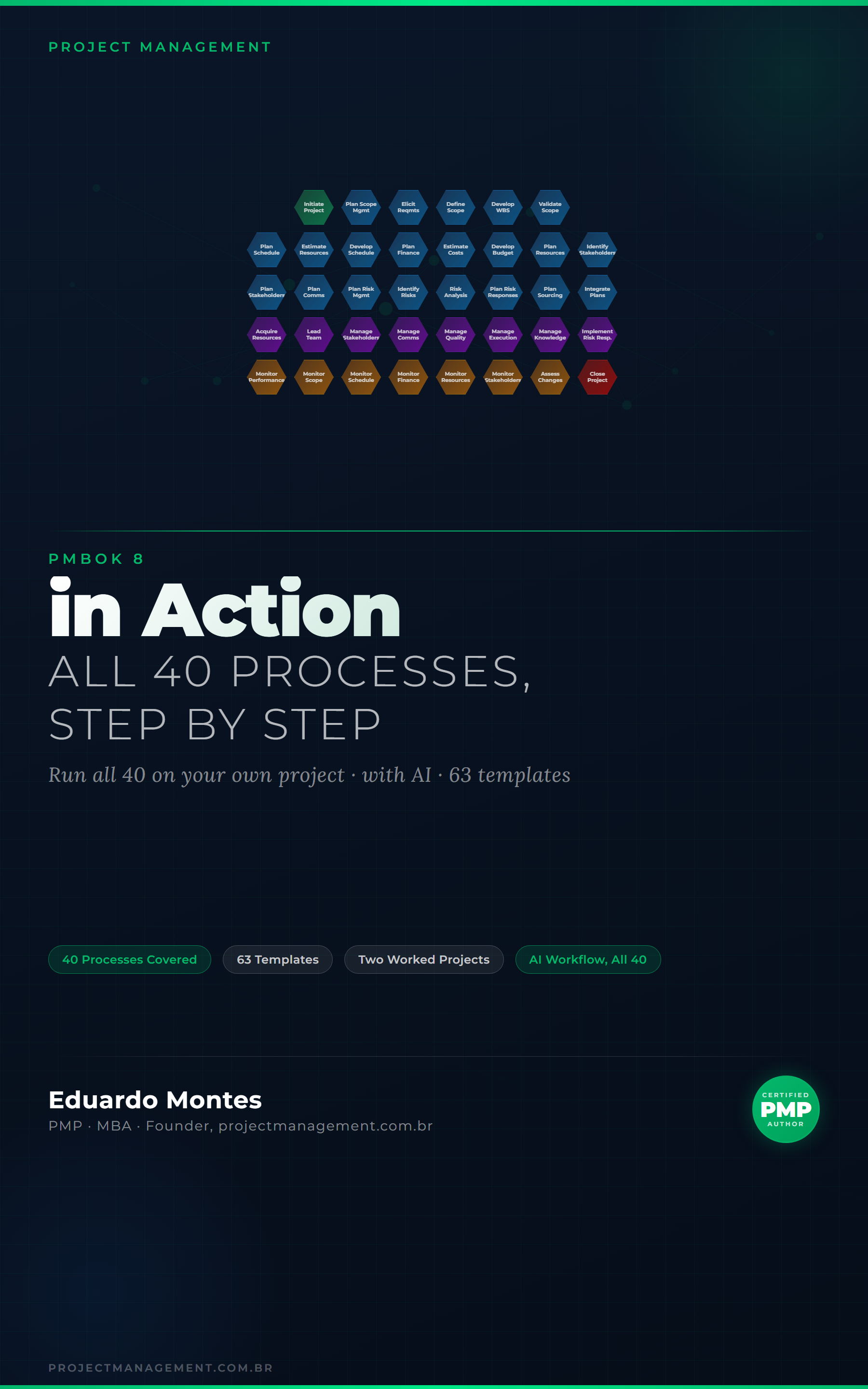
PMBOK 8 in Action
The 40 processes of the PMBOK 8 Guide applied to one real project, with the finished artefact at every step.
See the book — US$ 9.98 →
 Project Management