
Article updated in March 2026 for the PMBOK® Guide — Eighth Edition.
Plan Schedule Management in PMBOK 8 — Complete Guide
Formerly known as: Plan Schedule Management (PMBOK 6)
Two projects started in the same organization on the same day. The first team went directly from the project charter to building a Gantt chart in Microsoft Project — no documented scheduling approach, no agreed measurement units, no defined control thresholds. By week 6, the PM was receiving eight different schedule status formats from eight different team members, the client was asking for progress reports in a format no one had defined, and two team members were interpreting “30% complete” by completely different criteria. Schedule status meetings consumed more time debating measurement methodology than actually tracking progress.
The second team spent half a day at the start of the project completing Plan Schedule Management — Process 1 of PMBOK 8’s Schedule Domain. They agreed on: scheduling software and its configuration; the unit of measure for duration estimates; the format and frequency of schedule reporting; the thresholds for schedule variance that would trigger escalation; and the performance measurement rules (0/100, 25/75, or earned value). Their schedule status meetings averaged 20 minutes. Their sponsor received the same format every week. The team spent time managing the project, not debating how to measure it.
This guide covers everything you need to master Plan Schedule Management in PMBOK 8:
- What it is — definition, PMBOK 8 position, and what changed from PMBOK 6
- Why use it — direct benefits and the cost of skipping it
- Full ITTO — from the official PMBOK 8 PDF
- Step-by-step application guide
- When to apply it
- Two real-world examples — Project Phoenix and Project ProjectAdm
- Templates and downloads
- Five common errors
- Tailoring — predictive, agile, and hybrid
- Process interactions
- Quick-application checklist
1. What Is Plan Schedule Management
Plan Schedule Management is the process of establishing policies, procedures, and documentation for designing, developing, managing, performing, and maintaining the schedule. It is Process 1 of the Schedule Performance Domain in PMBOK 8, positioned in the Planning focus area. Its key benefit is that it provides guidance and direction on how the project schedule will be managed throughout the project.
The process produces the schedule management plan — the governance document that specifies how the schedule will be built, measured, updated, and controlled. It is the scheduling equivalent of the scope management plan: a lightweight but critical governance document that prevents the coordination failures, measurement inconsistencies, and control ambiguities that derail project teams during execution.
The specific output of this process is the schedule management plan, including information on: project schedule development approach; release and iteration length (for adaptive projects); level of accuracy for duration estimates; units of measurement; links to organizational procedures; project schedule maintenance procedures; control thresholds; rules of performance measurement; and reporting formats. Each element of this list is a decision that, if left undocumented, will be made inconsistently by different team members throughout execution.
What changed from PMBOK 6 to PMBOK 8
| Aspect | PMBOK 6 — Plan Schedule Management | PMBOK 8 — Plan Schedule Management |
|---|---|---|
| Process name | Plan Schedule Management | Plan Schedule Management (unchanged) |
| Structural location | Planning Process Group — Project Schedule Management Knowledge Area | Schedule Performance Domain, Planning focus area, Process 1 of 3 |
| Adaptive coverage | Limited; primarily predictive scheduling | Explicit: the schedule management plan must address release and iteration length for adaptive projects; agile scheduling approaches are explicitly tailored within this process |
| Process count in Schedule domain | 6 processes in Schedule Management Knowledge Area | 3 processes in Schedule Performance Domain (Plan Schedule Management, Develop Schedule, Monitor and Control Schedule); the domain is streamlined around essential governance and execution processes |
| Tools | Expert judgment, analytical techniques, meetings | Expert judgment, data analysis (alternative analysis), meetings; more concise toolkit reflecting the planning-level nature of the process |
2. Why Use Plan Schedule Management
Direct benefits
- Consistent schedule measurement across the team: When all team members use the same duration units, the same progress measurement rules, and the same software configuration, schedule data is comparable and aggregatable. Without this consistency, schedule roll-ups are mathematically unreliable and stakeholder reports are misleading.
- Defined control thresholds prevent micro-management and missed escalations: The schedule management plan defines the variance levels that trigger escalation. A well-designed plan allows the PM to manage normal variation (within tolerance) without escalation, while ensuring that significant variances are escalated promptly and consistently. Without defined thresholds, every variance is either ignored or escalated — both of which are dysfunctional extremes.
- Agreed-upon schedule development methodology: A project team without an agreed scheduling methodology will apply different techniques to different parts of the project, producing a schedule that is internally inconsistent. The schedule management plan specifies which scheduling technique is appropriate for this project’s context (critical path method, critical chain method, agile release planning, rolling wave planning, or a combination).
- Efficient schedule update process: The schedule management plan defines how and when the schedule will be updated, by whom, and how updates will be communicated. This prevents the common pattern of multiple team members making independent schedule updates that create version conflicts and inconsistent status reporting.
- Foundation for performance measurement: The rules of performance measurement documented in the schedule management plan (e.g., how percent complete is determined for each activity type) are the foundation for earned value analysis. Without agreed performance measurement rules, earned value calculations produce results that different stakeholders will dispute.
The cost of skipping schedule planning
- Inconsistent progress measurement: Without agreed measurement rules, “30% complete” means different things to different team members. Aggregated schedule progress reports become averages of incompatible measurements — producing a false picture of overall progress.
- Uncontrolled schedule changes: Without a defined schedule change control process, team members update the schedule independently in response to actual performance, without impact assessment or stakeholder communication. The schedule drifts from the baseline invisibly, and the PM loses the visibility needed to identify trends and intervene.
- Delayed escalation of schedule problems: Without defined thresholds, schedule variances are not consistently escalated. Minor variances that should be managed operationally are escalated unnecessarily. Significant variances that require sponsor attention are absorbed internally without escalation. Both failures damage stakeholder trust.
3. Inputs, Tools & Techniques, and Outputs (ITTO)
The following table presents the complete ITTO of Plan Schedule Management as defined in PMBOK 8 (Figure 2-21, p.154):
| Inputs | Tools & Techniques | Outputs |
|---|---|---|
|
|
|
Inputs explained
Project charter: The charter’s high-level milestone schedule, summary budget, and key constraints define the scheduling boundaries within which the schedule management plan must operate. A charter that specifies a fixed go-live date imposes scheduling constraints that must be reflected in the schedule management plan’s performance measurement and control threshold sections.
Scope management plan: The scope management plan defines how scope will be structured (WBS) and controlled. The schedule management plan must be consistent with the scope governance approach: the level of WBS decomposition determines the level of schedule activity detail; the scope change control process determines how scope changes will trigger schedule updates.
Development approach: Whether the project uses a predictive, adaptive, or hybrid development approach is the single most important input for the schedule management plan. A predictive approach requires a Gantt chart with a formal baseline and change control process. An adaptive approach requires sprint planning, iteration length definition, velocity tracking, and burnup/burndown reporting. The development approach determines the scheduling methodology, measurement rules, and reporting format documented in the plan.
Enterprise environmental factors: Organizational scheduling tools and infrastructure (project management software, collaboration platforms), scheduling standards and templates, existing calendar and holiday schedules, and the scheduling practices common in the industry or organization all shape the schedule management plan. The plan should not require tools or processes that the organization cannot support.
Organizational process assets: Templates for schedule management plans, lessons learned from previous projects about scheduling approach failures and successes, historical velocity data (for agile projects), and organizational scheduling standards all accelerate and improve the quality of the schedule management plan.
Tools & Techniques explained
Expert judgment: Experienced project managers and scheduling specialists contribute knowledge about which scheduling approaches work best for this type of project, what level of schedule granularity is appropriate, how control thresholds should be calibrated to the project’s risk profile, and how to design a performance measurement system that is both accurate and administratively practical.
Data analysis — alternative analysis: Evaluating alternative scheduling approaches, tools, and methodologies to select the most appropriate for the project context. For example: Should the project use a critical path method or a critical chain method? Should the schedule be built in a professional scheduling tool or a collaborative platform? Should the iteration length for the agile components be two weeks or four weeks? Alternative analysis frames these choices explicitly so the team selects deliberately rather than defaulting to habit.
Meetings: A schedule management planning session with the sponsor, key stakeholders, and the project team is the most effective mechanism for developing a schedule management plan that has organizational support. The session should address: the development approach; the scheduling tools to be used; the reporting format and frequency; the control thresholds; and the performance measurement rules. Stakeholder agreement on these decisions in the planning session prevents disputes about methodology during execution.
Output explained
Schedule management plan: The schedule management plan specifies: the scheduling methodology and tool(s) to be used; the level of accuracy for duration estimates (e.g., ±10%, rounded to nearest 0.5 days); the units of measure for activity duration (hours, days, weeks); the links between the project schedule and organizational accounting codes or work authorization systems; the schedule update process (frequency, responsible party, distribution list); the project schedule model maintenance procedures; the control thresholds (e.g., schedule variance ≥ 10% triggers corrective action; ≥ 20% triggers escalation to sponsor); the rules for performance measurement (0/100, 20/80, 50/50, or percent complete by hours expended); and the reporting format and frequency. For adaptive projects, it additionally specifies the iteration length, velocity measurement approach, and burnup/burndown reporting format.
4. How to Apply the Process Step by Step
Step 1 — Confirm the development approach
Before writing any schedule management plan content, confirm whether the project will use a predictive, adaptive, or hybrid development approach. This determination should already be reflected in the project charter and scope management plan. The development approach is the structural input that determines every substantive decision in the schedule management plan.
Step 2 — Select the scheduling methodology
For predictive projects, select the scheduling technique: critical path method (most common for software and construction), critical chain method (resource-constrained environments), location-based scheduling (infrastructure and construction), or Lean Last Planner® System (construction and manufacturing). For adaptive projects, define the sprint/iteration framework: sprint length (typically 1–4 weeks), sprint planning approach, and velocity measurement method. For hybrid projects, define the boundary between the predictive and adaptive scheduling layers.
Step 3 — Define measurement standards
Document the specifics that make schedule measurement consistent across the team: the units of measure for duration estimates; the precision level for estimates; the performance measurement rule for each activity type (0/100 for short tasks, percent complete by hours expended for long tasks); and the data collection method for actual duration reporting. These standards seem minor until inconsistency produces a schedule status meeting where three team members report the same activity at three different completion percentages.
Step 4 — Define control thresholds
Set the specific variance thresholds that determine PM action levels. A practical three-tier threshold structure: Tier 1 (e.g., SPI 0.90–0.95) — PM-managed corrective action with no escalation required; Tier 2 (e.g., SPI 0.80–0.90) — PM-led corrective action plan presented to sponsor; Tier 3 (e.g., SPI <0.80) — sponsor engagement and formal recovery plan required. Thresholds should be calibrated to the project’s risk tolerance and the sponsor’s escalation preferences — ask the sponsor directly: “At what point do you want to know that we have a schedule problem?”
Step 5 — Define the reporting format and frequency
Specify: the schedule status report format (what information is included, in what order); the reporting frequency (weekly, biweekly, monthly); the distribution list; and the escalation report format for threshold-triggering variances. Agree the format with the sponsor and key stakeholders before the first report is produced. Changing reporting formats mid-project creates confusion and stakeholder resistance.
Step 6 — Document and obtain approval
Document all decisions in the schedule management plan format, obtain review and approval from the sponsor, and store the approved plan in the project management information system. Brief the team on the scheduling standards they are expected to follow.
5. When to Apply Plan Schedule Management
- After the project charter is approved and before Develop Schedule: The schedule management plan is a prerequisite for schedule development. Never build the project schedule without a documented scheduling approach.
- Concurrently with Plan Scope Management: Scope and schedule planning are interdependent. The scope management plan and schedule management plan should be developed in parallel or in close sequence.
- At the start of each phase (multi-phase projects): Phase-specific scheduling requirements may differ from the overall project approach. Review and update the schedule management plan at each phase gate.
- When the development approach changes: A project that transitions from predictive to hybrid or adaptive during execution requires a schedule management plan update to reflect the new scheduling methodology.
6. Two Real-World Examples
Project Phoenix — TechCorp Website Relaunch
Alex Morgan produced the schedule management plan for Project Phoenix in a 90-minute planning session with the IT lead and the external agency’s project coordinator. The key decisions documented:
- Scheduling tool: Microsoft Project (already licensed by TechCorp), shared via SharePoint.
- Duration units: working days, rounded to 0.5-day increments.
- Performance measurement: 0/100 for tasks under 2 days; percent complete by hours expended for tasks 3+ days.
- Update frequency: every Monday by 9:00 AM; PM publishes consolidated status by noon Monday.
- Control thresholds: SPI 0.85–0.95: PM corrective action; SPI <0.85: sponsor escalation.
- Reporting format: one-page traffic-light dashboard for Sarah Chen; detailed Gantt for steering committee.
The 90-minute investment in schedule planning saved an estimated 3–4 hours per week of coordination overhead that the first project team had experienced due to inconsistent measurement and reporting practices.
Project ProjectAdm — SaaS Project Management Platform
Eduardo’s schedule management plan for ProjectAdm reflected the agile development context. Key decisions: two-week sprints; sprint commitment measured by story points; velocity calculated as the rolling 3-sprint average; burnup chart updated after each sprint review; schedule baseline defined as the quarterly roadmap commitments, not individual sprint backlogs; control threshold: if velocity falls below 80% of the rolling average for two consecutive sprints, Eduardo presents a recovery plan to the investor board. This lightweight plan provided enough structure for reliable planning and reporting without the overhead of a full predictive schedule management approach.
7. Templates & Downloads
- Schedule Management Plan Template: Download — fully structured for PMBOK 8, with sections for scheduling methodology, measurement standards, control thresholds, and reporting format.
- Project Schedule Template: Download — WBS-based schedule template for software development projects.
- Schedule Baseline Template: Download — for documenting the approved schedule baseline.
8. Five Common Errors
Error 1 — Treating the schedule management plan as an optional formality
Many project managers view the schedule management plan as bureaucratic overhead and skip it in favor of going directly to schedule development. The result is a schedule built with undocumented assumptions about measurement, reporting, and control that generate confusion and inconsistency throughout execution. The schedule management plan pays for itself in the first week of execution by eliminating coordination overhead.
Error 2 — Not tailoring to the development approach
A schedule management plan written for a predictive project is not appropriate for an adaptive project. The scheduling methodology, measurement rules, reporting format, and control mechanisms are all fundamentally different between the two approaches. The development approach must drive the schedule management plan content, not the other way around.
Error 3 — Setting control thresholds without sponsor input
Control thresholds define when the sponsor will be informed about schedule problems. Setting these thresholds without consulting the sponsor means the PM either escalates too frequently (annoying the sponsor with minor variances) or not frequently enough (failing to alert the sponsor to significant problems until they are severe). Ask the sponsor directly: “At what point do you want me to bring a schedule issue to you?”
Error 4 — Omitting the schedule update process
The schedule management plan must document not just how the schedule will be built but how it will be maintained: who updates the schedule, on what frequency, using what data sources, and through what approval process. Without a documented update process, the schedule degrades into an outdated artifact that no longer reflects project reality within weeks of execution start.
Error 5 — Using the same performance measurement rule for all activity types
Applying 0/100 measurement to a 40-day activity produces no meaningful progress data for 39 days and then 100% on day 40 — regardless of actual progress. Applying percent complete by hours expended to a 1-hour task creates administrative overhead that exceeds the value. Calibrate the performance measurement rule to the activity duration and type: 0/100 for short tasks, 20/80 or 50/50 for medium tasks, percent complete by hours expended for long tasks.
9. Tailoring Considerations
| Approach | Tailoring for Plan Schedule Management |
|---|---|
| Predictive | Full schedule management plan with critical path methodology, formal baseline, change control procedures, earned value performance measurement rules, and formal reporting format. Thresholds calibrated to project risk tolerance. Schedule updates through formal change control when baseline impact exceeds thresholds. |
| Agile | Lightweight plan (1–2 pages) defining sprint length, velocity measurement method, burnup/burndown chart format and update frequency, sprint ceremony schedule, and backlog health metrics. Quarterly roadmap as the high-level schedule baseline; sprint backlogs as the detailed execution schedule. |
| Hybrid | Two-layer plan: predictive scheduling for the overall project milestones and contractual deliverables; agile sprint planning for iterative development components. Defines the interface between the two layers: how sprint velocity data translates to Gantt milestone progress; how sprint scope changes are evaluated for impact on the predictive milestone baseline. |
10. Process Interactions
Inputs from: Initiate Project or Phase (project charter); Plan Scope Management (scope management plan, development approach); organizational context (EEFs, OPAs).
Feeds into: Develop Schedule uses the schedule management plan to govern schedule development. Monitor and Control Schedule applies the control thresholds, measurement rules, and reporting format defined in the plan.
Interactions with other domains: Finance Domain (schedule management plan must be consistent with the financial management plan’s reporting and control approach; schedule baseline feeds into the performance measurement baseline used in financial monitoring); Scope Domain (schedule planning is constrained by and aligned with scope planning); Risk Domain (schedule control thresholds should reflect the project’s risk profile assessed in Risk Domain planning).
11. Quick-Application Checklist
- Development approach confirmed (predictive, adaptive, or hybrid)?
- Scheduling methodology selected and documented?
- Scheduling tool selected and team access confirmed?
- Duration units and precision level defined?
- Performance measurement rules defined for each activity type?
- Schedule update frequency and process documented?
- Control thresholds defined and agreed with sponsor?
- Reporting format and distribution list agreed with key stakeholders?
- Schedule management plan reviewed and approved?
- Team briefed on scheduling standards and reporting expectations?
Call to Action:
12. Do It Now with AI
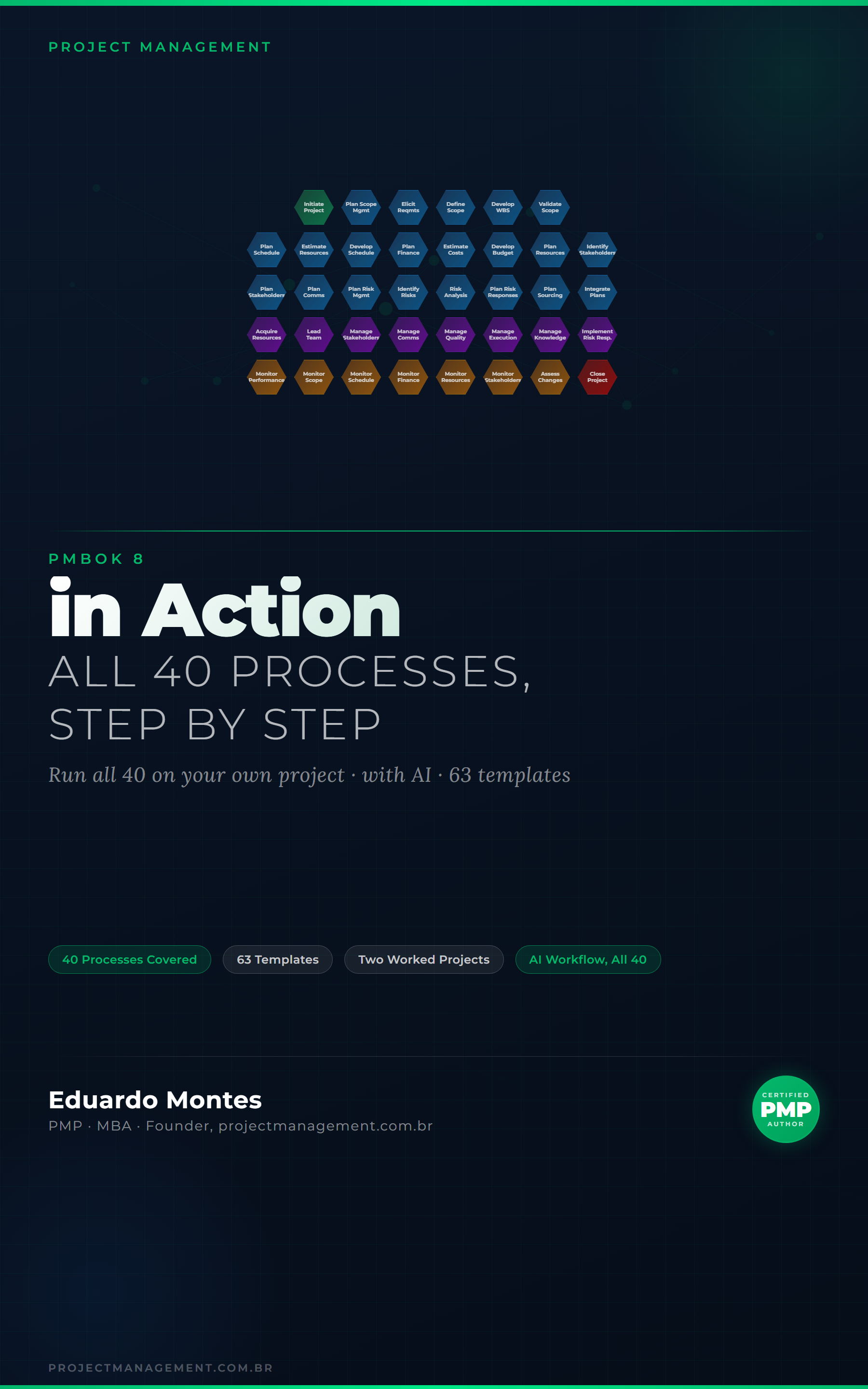
In PMBOK 8 Together this is Process 7 of 40. Your project lives on a board in ProjectAdm; the process reads that board, hands you a prompt with your own data already in it, and — once you paste the answer back — writes the finished document into your folder. The course is free.
What it reads from your project
- Project charter
- Project management plan
- Development approach
- Enterprise environmental factors
- Organizational process assets
What it hands back
- Schedule management plan
How to run it
- Answer on your board. Stakeholders, scope, risks, budget — everything is read from there.
- Run the process. Type its number and it hands you a prompt carrying your project’s data.
- Paste it into your AI. ChatGPT, Claude, Gemini — whichever you use. It proposes; you decide what to accept.
- Paste the answer into the board’s Inbox card and run the process again. This time it writes the document.
Where the Guide asks for something you have not supplied, the cell comes out empty with a label saying where it would come from, and decisions that are yours come out marked ► YOU DECIDE. The machine does not invent numbers.
Start here: download the package at projectmanagement.com.br/download/pmbok8-together-course-package/ and follow the standard installation — four steps, about five minutes, once. The full method is Appendix F of PMBOK 8 in Action.
References
PMBOK Guide 8: The New Era of Value-Based Project Management. Available at: https://projectmanagement.com.br/pmbok-guide-8/
Disclaimer
This article is an independent educational interpretation of the PMBOK® Guide – Eighth Edition, developed for informational purposes by ProjectManagement.com.br. It does not reproduce or redistribute proprietary PMI content. All trademarks, including PMI, PMBOK, and Project Management Institute, are the property of the Project Management Institute, Inc. For access to the complete and official content, purchase the guide from Amazon or download it for free at https://www.pmi.org/standards/pmbok if you are a PMI member.
Free PMBOK 8 Quick Reference Card
All 7 Performance Domains, 6 Principles, and key tools on one printable page. Download it free — no payment required.
Free Template
Schedule Management Plan — PMBOK 8

Schedule Management Plan Template — Free Download (PMBOK 8)
As an Amazon Associate, ProjectManagement.com.br earns from qualifying purchases. Links to Amazon on this page are affiliate links; the price you pay is unchanged.
Frequently Asked Questions
What is the Plan Schedule Management process in PMBOK 8?
It establishes the policies, procedures, and documentation for planning, developing, managing, and controlling the project schedule. It is part of the Schedule Performance Domain.
What is the output of Plan Schedule Management?
The output is the schedule management plan, which defines the scheduling methodology, measurement units, level of accuracy, control thresholds, and reporting formats.
Why does Plan Schedule Management matter?
Without an agreed scheduling approach, teams report progress inconsistently and “percent complete” means different things to different people — making schedule control unreliable.
Project Together
Track your progress through PMBOK 8
Create your free account to save your reading progress, earn points on every quiz, and unlock certificates as you master each domain.
Create Free Account →Free forever • No credit card required
QUIZ
Want to test what you learned from this article?
One multiple-choice question + one practical reflection. Earn Project Together points!
Go deeper in the book
PMBOK 8 in Action
The 40 processes of the PMBOK 8 Guide applied to one real project, with the finished artefact at every step.
See the book — US$ 9.98 →
 Project Management