
Article updated in March 2026 for the PMBOK® Guide — Eighth Edition.
Monitor and Control Resourcing in PMBOK 8 — Complete Guide
Formerly known as: Control Resources (PMBOK 6)
A project manager reported to the steering committee in month eight that the project was on schedule and within budget. The committee approved continued funding. Two months later, the same PM reported a crisis: the project was six weeks behind and $85,000 over budget. What happened? The PM had been tracking completion percentages reported by team members without verifying them against actual work products. Work that was “80% complete” in week six was still “80% complete” in week ten — a classic symptom of resource utilization that was not being monitored against plan. The schedule variance and cost variance had been accumulating silently for months. By the time they surfaced, the remediation options were limited and expensive. If the PM had been monitoring actual resource usage against the resource baseline on a weekly basis, the deviation would have been visible in week eight — not week eighteen.
In PMBOK 8, Monitor and Control Resourcing is Process 5 of the Resources Domain, and it is the process that ensures the resources assigned and allocated to the project are available as planned and that the planned versus actual use of resources is continuously tracked with corrective actions applied as necessary. Without this process, the resource management plan is a plan that is executed without feedback — and any deviation from plan goes undetected until it becomes a crisis.
This complete guide covers every dimension of Monitor and Control Resourcing as defined in PMBOK 8:
- What it is — definition, position in PMBOK 8, and what changed from PMBOK 6
- Why use it — direct benefits and the cost of skipping it
- Full ITTO — every input, tool, technique, and output explained
- Step-by-step application guide — practical monitoring framework
- When to apply it — triggers and monitoring cadence
- Two real-world examples — Project Phoenix (website launch) and Project ProjectAdm (SaaS PM platform)
- Templates and tools — with free downloads
- Five common errors — and how to avoid each one
- Tailoring — predictive, agile, and hybrid approaches
- Process interactions — what feeds into resource monitoring and what depends on it
- Quick-application checklist — 10 items you can use today
1. What Is Monitor and Control Resourcing
Monitor and Control Resourcing is the process of ensuring that the physical or virtual resources assigned and allocated to the project are available as planned. This process also monitors the planned versus actual utilization of resources and performs corrective actions as necessary. The key benefit of this process is ensuring that assigned resources are available to the project at the right time and in the right place, and that resources are released when no longer needed.
In PMBOK 8, this is Process 5 of the Resources Domain. It is a monitoring and controlling process, performed throughout the project lifecycle. Unlike planning processes that are performed once, resource monitoring is continuous — every resource deviation from plan is an early warning signal that requires analysis and a response decision.
What changed from PMBOK 6 to PMBOK 8
| Aspect | PMBOK 6 — Control Resources | PMBOK 8 — Monitor and Control Resourcing |
|---|---|---|
| Process name | Control Resources | Monitor and Control Resourcing (name expanded to reflect both monitoring and control activities) |
| Structural location | Monitoring and Controlling Process Group — Project Resource Management Knowledge Area | Resources Domain, Process 5 of 5 (final process in the domain) |
| Advanced tools | Problem-solving, interpersonal skills, PMIS | Significant additions: value stream mapping, theory of constraints, control charts, branch and bound, continuous improvement — reflecting lean and systems thinking approaches to resource optimization |
| Scope of monitoring | Primarily physical resources focus | Both physical/virtual resources and team resources explicitly covered |
| Outputs | Work performance information, change requests, project management plan updates, project document updates | Same outputs; stronger connection to value stream and continuous improvement concepts |
2. Why Use Monitor and Control Resourcing
Direct benefits
- Early detection of resource deviations: Regular monitoring of actual vs. planned resource utilization reveals deviations while they are still manageable. A 15% utilization overrun identified in week three can be corrected with a schedule adjustment. The same overrun identified in month four requires expensive corrective action or scope reduction.
- Prevention of resource over-commitment crises: Without monitoring, resources are over-committed gradually — one activity at a time. By the time the over-commitment becomes visible, multiple work streams are blocked simultaneously. Monitoring prevents this accumulation by identifying individual resource constraint signals early.
- Timely release of resources: Resources that are no longer needed should be released promptly — reducing project costs, freeing resources for other organizational priorities, and improving the organization’s resource management efficiency. Monitoring enables timely release; without it, resources continue to be billed to the project after their work is complete.
- Proactive management of resource shortages: When monitoring reveals that a planned resource will not be available as scheduled, the PM has lead time to identify alternatives — a substitute resource, a schedule adjustment, or a scope change — before the shortage creates a delivery crisis.
- Informed decision-making for resource reallocation: Monitoring data (actual vs. planned utilization, resource performance metrics) provides the PM with the evidence needed to justify resource reallocation decisions to the sponsor, functional managers, or procurement team.
- Continuous improvement of resource utilization: The monitoring data accumulated during the project is a valuable organizational asset for future project resource planning. Organizations that systematically analyze their resource utilization patterns produce increasingly accurate resource estimates on future projects.
The cost of skipping resource monitoring
- Budget overruns from undetected resource variances: Resource costs that exceed plan accumulate silently until they become a budget crisis. By the time the overrun is reported, the options for correction are limited.
- Schedule delays from resource unavailability: Resources that are supposed to be available are not. Without monitoring, the PM discovers the unavailability when the activity is scheduled to start — too late to implement a prevention strategy.
- Idle resource costs: Resources that are retained beyond their project need continue to consume budget. Without monitoring, resource release is reactive rather than planned, and idle time accumulates as a direct cost.
- Procurement failures for physical resources: Equipment or materials that are not arriving on schedule are a supply chain risk. Without monitoring, the delivery delay is discovered when the resource is needed — not when there is still time to expedite or find an alternative.
3. Inputs, Tools & Techniques, and Outputs (ITTO)
The following table presents the complete ITTO of the Monitor and Control Resourcing process as defined in PMBOK 8 (p. 192):
| Inputs | Tools & Techniques | Outputs |
|---|---|---|
|
|
|
Inputs explained
Resource management plan: The baseline document against which actual resource performance is measured. The resource management plan defines the expected utilization rates, acquisition timelines, and performance metrics that form the standard for monitoring.
Physical or virtual resource assignments: Documentation of which physical and virtual resources have been assigned to which project activities, including quantities, specifications, and commitment periods. This is the plan-level baseline for physical resource monitoring.
Project schedule: Defines when resources are needed. The monitoring process compares actual resource availability and utilization against the schedule’s resource demand timeline.
Resource breakdown structure: Provides the framework for organizing and reporting resource monitoring data by category and type, enabling analysis of utilization patterns at multiple levels of granularity.
Work performance data: Raw data on resource utilization collected through the PMIS, time-tracking systems, procurement tracking, and direct team reporting. This is the actual data against which the resource management plan baseline is measured.
Risk register: Identified resource risks provide the risk-based monitoring agenda: resources on the risk register should be monitored more frequently and with lower tolerance for deviation than non-risk-flagged resources.
Tools & Techniques explained
Performance reviews: Structured assessment of actual resource utilization against planned utilization. Metrics reviewed include: planned vs. actual hours by resource and activity; cost variance (actual resource cost vs. budgeted); schedule variance (planned vs. actual resource availability); resource allocation efficiency (are resources being used on value-adding activities or on waste?); and physical resource delivery status vs. procurement schedule.
Trend analysis: Analysis of resource utilization data over time to identify patterns that indicate emerging problems before they become critical. A resource that is consistently at 95–105% utilization is a leading indicator of over-commitment that will materialize as a delivery shortfall within weeks. Trend analysis provides the PM with the data to act before the shortfall occurs.
Alternative analysis: Systematic evaluation of options when a resource deviation requires a corrective response. Options may include: acquiring an additional or substitute resource; adjusting the project schedule to redistribute resource demand; reducing scope to reduce resource requirements; or accepting the deviation and updating the baseline.
Value stream mapping: A lean management technique that maps the flow of resources through the project process to identify waste, bottlenecks, and non-value-adding activities. When applied to resource monitoring, value stream mapping identifies where resources are being consumed without contributing to project deliverables — enabling targeted efficiency improvements.
Theory of constraints: A management philosophy that identifies the single most constraining factor in a system and focuses improvement efforts on that constraint rather than optimizing non-constraining elements. When applied to project resource management, the theory of constraints directs the PM to identify the project’s critical resource constraint (the resource that is most severely limiting project throughput) and focus all resource optimization efforts on that constraint.
Control charts: Statistical process control tools that plot resource utilization metrics over time, with upper and lower control limits defined. When a data point falls outside the control limits, it signals a statistically significant deviation that requires investigation. Control charts distinguish between normal variation (within control limits — no action needed) and special cause variation (outside control limits — investigation and correction required), preventing both overreaction to normal variation and underreaction to genuine deviations.
Negotiation: When a resource deviation requires acquiring an additional resource or adjusting resource commitments, negotiation with functional managers, procurement officers, or vendors is the primary mechanism for securing the required resources. Effective negotiation requires clear data (the monitoring results), a defined acceptable range of alternatives, and an understanding of the other party’s constraints and interests.
Influencing: When the PM does not have direct authority over the resources required for corrective action (which is the common case in matrix organizations), influencing skills — building coalitions, demonstrating the business impact of the resource deviation, leveraging organizational relationships — are the primary mechanism for securing corrective resources.
Outputs explained
Work performance information: Analyzed and contextualized resource performance data — the output of comparing work performance data (actual) against the resource management plan (planned). Work performance information includes: resource utilization variance (planned vs. actual hours and costs by category), resource availability status (which planned resources are confirmed available, which are at risk), physical resource delivery status, and forecast resource requirements for the remainder of the project.
Change requests: When monitoring reveals that the current resource plan cannot be maintained without a change to scope, schedule, cost, or quality, a formal change request is initiated through the change control process. Change requests generated by resource monitoring are among the most common and most impactful in a project’s change log.
Project management plan updates: If monitoring reveals that the resource management plan baseline is no longer achievable (due to resource availability changes, productivity variance, or scope changes), the baseline must be updated to reflect the new reality. Updates to the schedule baseline and cost baseline may also be required if the resource changes have timeline or financial implications.
4. Step-by-Step Application Guide
Step 1 — Establish the resource monitoring baseline
Define the specific metrics that will be monitored, the frequency of monitoring, the data collection method, and the variance thresholds that trigger corrective action. Document these parameters in the resource management plan. Without a defined monitoring baseline, “monitoring” is simply observation without the reference point needed to identify deviations.
Step 2 — Collect work performance data systematically
Implement a reliable, consistent mechanism for collecting actual resource utilization data: time tracking for human resources (integrated with the PMIS if possible), procurement status reports for physical resources, and delivery confirmations for contracted resources. Data quality is the foundation of effective monitoring — monitoring based on incomplete or inaccurate data produces false confidence.
Step 3 — Analyze planned vs. actual resource utilization
At each monitoring cycle, compare actual resource utilization against the resource management plan baseline. Calculate variances for each significant resource category. Apply trend analysis to identify directional patterns. Use control charts for resources where statistical process control is appropriate. Document findings in work performance information.
Step 4 — Identify root causes of significant variances
For variances that exceed the defined threshold, conduct a root cause analysis before selecting a corrective response. Common root causes: resource availability was lower than planned (the functional manager committed a resource who could not be released from other projects); resource productivity was lower than planned (the work was more complex than estimated); physical resource procurement was delayed (supply chain disruption); or the resource requirement itself was underestimated in planning. The corrective response depends on the root cause — treating the symptom without diagnosing the cause produces a temporary fix and a recurring problem.
Step 5 — Evaluate and select corrective or preventive actions
Conduct an alternative analysis for each significant variance: what options are available, what are the cost/schedule/scope trade-offs of each option, and which option optimizes the project’s value within its constraints? For resource shortages: can a substitute resource be acquired? Can the work sequence be adjusted to reduce the concurrent demand? Does the scope need to be adjusted? Document the decision rationale in the issue log.
Step 6 — Implement corrective actions and update project documents
Execute the selected corrective response. If the response requires a change to the project baseline (scope, schedule, or budget), initiate a formal change request through the change control process. Update the resource breakdown structure, project schedule, and any other affected project documents. Communicate the change and its rationale to affected stakeholders through the communications plan.
5. When to Apply the Process
Standard monitoring cadence
- Weekly: For human resource utilization on active work packages; physical resource delivery status for items on the critical path.
- Bi-weekly (per sprint): In agile contexts, resource utilization is reviewed at each sprint review against the sprint resource plan.
- Monthly: Comprehensive resource performance review for the steering committee; trend analysis across all resource categories.
- At milestones: Full resource audit at each project milestone or phase gate — confirming that resources committed for the next phase are available as planned.
Event-triggered monitoring
- When a key resource becomes unavailable: Immediate assessment of impact and corrective options.
- When a significant scope change is approved: Updated resource requirements from the change must be assessed against current resource availability.
- When a physical resource procurement timeline is at risk: Supply chain disruptions require immediate assessment of alternative procurement sources or schedule adjustments.
- When performance metrics indicate resource efficiency decline: Productivity drops are a leading indicator of resource constraint or motivation issues that require investigation before they compound.
6. Practical Examples
Example 1 — Website Launch: Project Phoenix
Context: TechCorp PM Alex Morgan PMP managing Project Phoenix for CEO Sarah Chen. Budget: $72,250. Duration: 90 days. Team: PM, two developers, one designer, one inbound analyst.
How Monitor and Control Resourcing was applied:
Alex established a weekly resource monitoring cadence using a simple resource utilization tracker in a shared spreadsheet (synchronized with the project management system). Each team member logged their hours against specific work packages at the end of each week. Alex reviewed the data every Monday morning, comparing actual vs. planned hours by work package and by resource.
In Sprint 3 (week 5–6), the monitoring data revealed a significant variance: the senior developer was at 115% utilization over two consecutive weeks. Root cause analysis (a one-on-one conversation with the developer) revealed that the HubSpot API documentation had significant gaps requiring the developer to reverse-engineer integration behaviors through trial and error — a task that had not been in the estimation assumptions. The issue was logged immediately.
Alternative analysis produced three options: (1) extend the sprint by 3 days; (2) bring in external HubSpot consulting hours for 6 hours to accelerate the API discovery; (3) accept reduced functionality for the HubSpot integration and add a post-launch enhancement sprint. Alex selected option 2: $650 in external consulting hours resolved the technical ambiguity in a single afternoon session, the developer’s utilization returned to plan in Sprint 4, and the sprint delivered on schedule.
Result: The $650 consulting intervention, identified and implemented through proactive resource monitoring, prevented a $4,500+ schedule extension (the cost of a 3-day sprint extension for the full team). The resource monitoring system’s ROI was demonstrated in week six of a 13-week project.
Example 2 — SaaS PM Platform: Project ProjectAdm (Software Development)
Context: Eduardo Montes (CEO/PM) managing ProjectAdm — 18 months, 10 team members, complex technical stack.
How Monitor and Control Resourcing was applied:
Eduardo implemented resource monitoring directly within ProjectAdm, using the platform’s time-tracking and sprint velocity features as the primary data source. The monitoring dashboard tracked four key metrics for each sprint: planned story points vs. delivered; planned developer hours vs. actual; QA hours planned vs. actual; and infrastructure cost (AWS, GitHub, tooling) planned vs. actual.
In month 11, the QA monitoring data triggered a critical alert: the QA engineer’s actual hours were running at 140% of plan for three consecutive sprints — a direct consequence of the growing automated test suite requiring more maintenance than had been estimated. The trend analysis confirmed the pattern was directional: without intervention, the QA engineer would be at 165% utilization by month 14.
Eduardo applied the theory of constraints: QA was the system’s binding constraint. The corrective action was not to hire another QA engineer (too expensive and too slow) but to optimize the QA process itself: Eduardo brought in a 3-day external QA automation consultant to refactor the test suite’s maintenance architecture, reducing ongoing maintenance overhead by 35%. The consultant cost $2,400; the alternative (160 hours of QA engineer overtime over four months) would have cost $8,000 and risked the QA engineer’s wellbeing and retention.
Eduardo also implemented value stream mapping on the deployment pipeline in month 13 after monitoring revealed that the time between code completion and deployment to staging averaged 3.2 days — creating a resource idle time problem where developers were waiting for their completed work to be testable. The mapping identified a bottleneck in the manual staging environment configuration process. Automating the configuration reduced deployment time to 4 hours and recovered approximately 120 hours of developer productivity over the remaining project duration.
Result: Resource monitoring at ProjectAdm identified two systemic inefficiencies (QA overload and deployment bottleneck) that, left unaddressed, would have cost an estimated $28,000 in overtime and productivity loss. Total corrective investment: $2,400 (QA automation consultant) + 16 hours of lead developer time (deployment automation). Net savings: approximately $25,600.
7. Free and Recommended Templates
| Document | Free download |
|---|---|
| Resource Management Plan Template Resource plan, monitoring metrics, variance thresholds, corrective action framework |
Download free template |
| Resource Calendars (Software Development) Resource availability calendar with planned vs. actual utilization tracking |
Download free template |
| Resource Breakdown Structure Hierarchical resource structure for utilization analysis and reporting |
Download free template |
8. Five Common Errors — and How to Avoid Each One
Error 1 — Monitoring activity completion instead of resource utilization
Why it happens: PMs track whether activities are “complete” or “in progress” without measuring the actual resource hours consumed. A task that is “90% complete” for two consecutive weeks has zero resource information content.
How to avoid it: Monitor actual resource hours against planned resource hours, not subjective completion percentages. Use earned value techniques (actual cost vs. earned value vs. planned value) for quantified resource performance measurement. Require time-tracking data at the work package level, not the activity completion level.
Error 2 — Responding to resource variances with scope changes instead of resource corrections
Why it happens: When a resource shortage is identified, the PM reduces scope rather than investigating resource alternatives. Scope reduction is sometimes the correct response, but it should be the last option — after alternative resource acquisition, schedule adjustment, and efficiency improvement have been evaluated.
How to avoid it: Require alternative analysis before any scope reduction in response to a resource variance. Document the options evaluated and the rationale for the selected response. Scope reduction that is not the result of a deliberate trade-off analysis is a symptom of insufficient resource monitoring and planning.
Error 3 — Ignoring physical resource monitoring in technology projects
Why it happens: Technology PMs focus resource monitoring almost exclusively on human resources (developer hours, sprint velocity) and neglect physical and virtual resource monitoring (cloud infrastructure costs, software license utilization, hardware procurement timelines).
How to avoid it: Include physical and virtual resource monitoring in every resource monitoring cycle. In cloud-based technology projects, infrastructure cost monitoring is particularly critical — cloud costs can escalate rapidly without planned capacity limits and usage alerts. Set up automated cost alerts for cloud infrastructure from day one of the project.
Error 4 — Not escalating resource issues to the sponsor
Why it happens: PMs attempt to resolve resource constraints independently to avoid appearing unable to manage the project. Some resource constraints require sponsor authority (additional budget, organizational priority changes) that the PM cannot secure alone.
How to avoid it: The escalation threshold for resource issues should be documented in the resource management plan and the communications management plan. When a resource variance exceeds the documented threshold, escalation is not a sign of failure — it is the correct execution of the governance structure. A resource issue resolved with sponsor involvement in week three costs a fraction of the same issue resolved in month six.
Error 5 — Releasing resources prematurely to reduce costs
Why it happens: Under budget pressure, PMs release resources before their work is fully complete, assuming that the remaining work can be absorbed by the remaining team. The remaining work cannot be absorbed, the project falls behind, and the released resources must be re-engaged at higher cost (or replaced).
How to avoid it: Resource releases must be governed by the resource management plan, not by budget pressure alone. The release decision should be based on verified completion of the resource’s deliverables (not planned completion), consideration of rework risk, and a documented transition plan for any residual responsibilities.
9. Tailoring: Predictive, Agile, and Hybrid
| Aspect | Predictive | Agile | Hybrid (ProjectAdm model) |
|---|---|---|---|
| Monitoring cadence | Weekly for active work packages; monthly comprehensive review; milestone-triggered audits | Sprint-by-sprint (bi-weekly); velocity is the primary resource utilization metric | Sprint velocity for development work + weekly for infrastructure and compliance resources |
| Primary metrics | Planned vs. actual hours; cost variance; earned value metrics | Sprint velocity; team capacity vs. commitment; cycle time | Both: EVM for predictive components + velocity for sprint components |
| Corrective action authority | PM within defined thresholds; sponsor approval for baseline changes | Team adjusts in sprint planning; PM facilitates; sprint review surfaces systemic issues | Team for sprint-level corrections; PM for baseline changes; sponsor for budget impacts |
| Physical resource monitoring | Formal procurement tracking; delivery milestone tracking in PMIS | Minimal physical resources in software agile contexts; informal tracking | Formal tracking for infrastructure; agile for software tools and licenses |
| Efficiency tools | Earned value analysis; control charts; trend analysis | Burndown/burnup charts; cumulative flow diagrams; retrospectives | EVM + burndown + control charts for QA/infrastructure |
10. Process Interactions
| Process | Domain | Relationship to Monitor and Control Resourcing |
|---|---|---|
| Plan Resource Management | Resources | Provides the resource management plan baseline against which actual utilization is measured. |
| Acquire Resources | Resources | Resource acquisition decisions are informed by monitoring data. When monitoring reveals a resource gap, acquisition is the primary corrective action. |
| Lead the Team | Resources | Team performance issues identified through resource monitoring trigger leadership interventions. Conversely, team performance improvements from leadership activities appear as positive variances in resource monitoring data. |
| Monitor Costs | Finance | Resource cost variances identified in resource monitoring are a primary input to cost monitoring. The two processes share data and generate integrated variance analysis. |
| Monitor Risks | Risk | Resource availability issues identified through monitoring become active risk events in the risk monitoring process. Conversely, risk events can trigger resource availability changes that require monitoring response. |
| Integrated Change Control | Governance | Change requests generated by resource monitoring (baseline changes, scope changes, schedule changes) are processed through the integrated change control process. |
11. Quick-Application Checklist
- ☐ Resource monitoring baseline (metrics, frequency, variance thresholds) is documented in the resource management plan
- ☐ Time-tracking data is collected at the work package level, not just the activity completion level
- ☐ Weekly monitoring compares actual vs. planned resource hours for all active work packages
- ☐ Physical and virtual resource monitoring is included alongside human resource monitoring
- ☐ Trend analysis is applied to identify directional patterns in resource utilization
- ☐ Root cause analysis is conducted before selecting corrective actions for significant variances
- ☐ Alternative analysis is conducted before recommending scope reduction in response to resource constraints
- ☐ Escalation threshold is defined and followed: resource issues above the threshold are escalated to the sponsor
- ☐ Resource releases are based on verified deliverable completion, not budget pressure
- ☐ Monitoring data and corrective actions are documented in work performance information and the lessons learned register
Call to Action:
12. Do It Now with AI
In PMBOK 8 Together this is Process 35 of 40. Your project lives on a board in ProjectAdm; the process reads that board, hands you a prompt with your own data already in it, and — once you paste the answer back — writes the finished document into your folder. The course is free.
What it reads from your project
- Project management plan
- Project documents
- Work performance data
- Agreements
- Organizational process assets
What it hands back
- Work performance information
- Change requests
How to run it
- Answer on your board. Stakeholders, scope, risks, budget — everything is read from there.
- Run the process. Type its number and it hands you a prompt carrying your project’s data.
- Paste it into your AI. ChatGPT, Claude, Gemini — whichever you use. It proposes; you decide what to accept.
- Paste the answer into the board’s Inbox card and run the process again. This time it writes the document.
Where the Guide asks for something you have not supplied, the cell comes out empty with a label saying where it would come from, and decisions that are yours come out marked ► YOU DECIDE. The machine does not invent numbers.
Start here: download the package at projectmanagement.com.br/download/pmbok8-together-course-package/ and follow the standard installation — four steps, about five minutes, once. The full method is Appendix F of PMBOK 8 in Action.
References
PMBOK Guide 8: The New Era of Value-Based Project Management. Available at: https://projectmanagement.com.br/pmbok-guide-8/
Disclaimer
This article is an independent educational interpretation of the PMBOK® Guide – Eighth Edition, developed for informational purposes by ProjectManagement.com.br. It does not reproduce or redistribute proprietary PMI content. All trademarks, including PMI, PMBOK, and Project Management Institute, are the property of the Project Management Institute, Inc. For access to the complete and official content, purchase the guide from Amazon or download it for free at https://www.pmi.org/standards/pmbok if you are a PMI member.
Free PMBOK 8 Quick Reference Card
All 7 Performance Domains, 6 Principles, and key tools on one printable page. Download it free — no payment required.
As an Amazon Associate, ProjectManagement.com.br earns from qualifying purchases. Links to Amazon on this page are affiliate links; the price you pay is unchanged.
Frequently Asked Questions
What is the Monitor and Control Resourcing process in PMBOK 8?
It is the process of ensuring that the physical and team resources assigned to the project are available as planned, and managing the difference between planned and actual use. In PMBOK 8 it is the renamed successor to PMBOK 6’s Control Resources, within the Resources Performance Domain.
Why was Control Resources renamed?
PMBOK 8 frames the work as monitoring and controlling all resourcing — both people and physical resources — rather than controlling resources in isolation.
How is it performed?
By comparing planned versus actual resource utilization, finding the root causes of significant variances, and selecting corrective or preventive actions before shortages derail the schedule or budget.
Project Together
Track your progress through PMBOK 8
Create your free account to save your reading progress, earn points on every quiz, and unlock certificates as you master each domain.
Create Free Account →Free forever • No credit card required
QUIZ
Want to test what you learned from this article?
One multiple-choice question + one practical reflection. Earn Project Together points!
Go deeper in the book
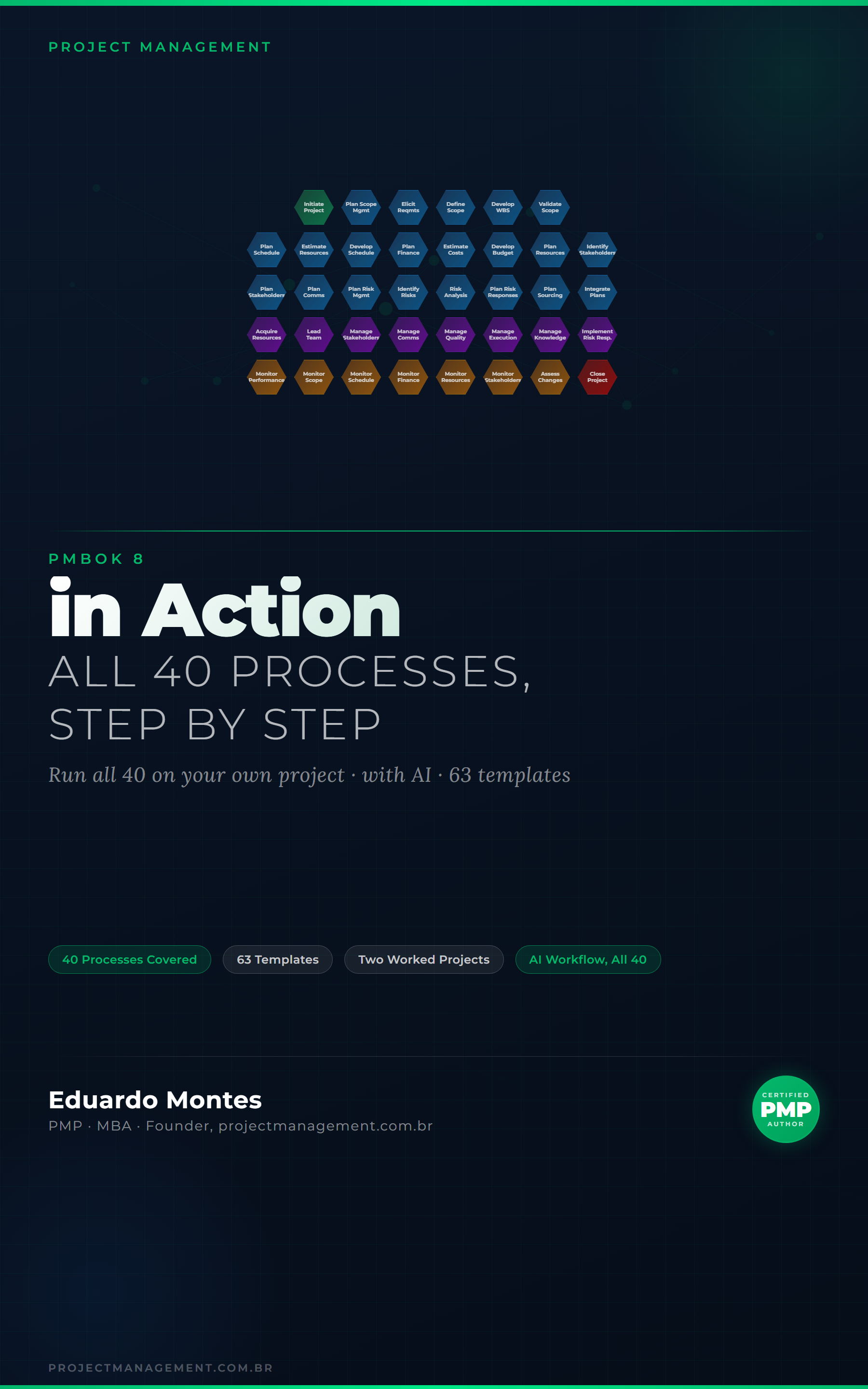
PMBOK 8 in Action
The 40 processes of the PMBOK 8 Guide applied to one real project, with the finished artefact at every step.
See the book — US$ 9.98 →

 Project Management