
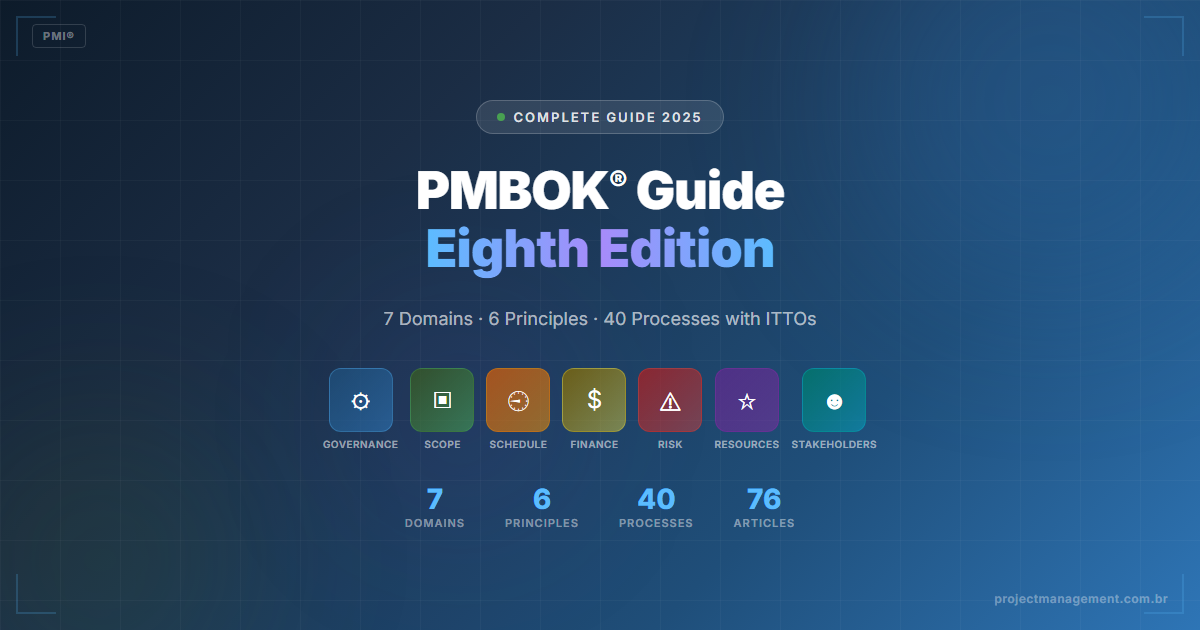
The PMBOK has changed again — and this time, the change is radical. If you are still trying to make sense of the 7th Edition (the one that removed processes and confused half the profession), brace yourself: the 8th Edition brought processes back, reduced the principles from twelve to six, restructured the performance domains, and placed sustainability at the center of project management. For practitioners who manage projects every day, the question is no longer “what changed” — it is “how do I apply this tomorrow.”
By the end of this guide, you will understand the complete structure of the PMBOK 8 (2025), know exactly what changed from previous editions, explore the 7 Performance Domains, the 6 Principles, and the 40 processes with ITTOs — and, most importantly, you will know how to tailor all of this to your real-world context.
In this guide you will find:
- The history and evolution of the PMBOK Guide — from the 1st to the 8th Edition
- A detailed PMBOK 7 vs PMBOK 8 comparison (complete table)
- The 7 Performance Domains of PMBOK 8
- The 6 Principles of PMBOK 8
- The 40 processes with ITTOs — the big comeback
- Tailoring: how to adapt for predictive, agile, and hybrid projects
- The 5 most common mistakes in the transition to PMBOK 8 — and how to avoid them
- A quick-application checklist
1. WHAT IS THE PMBOK GUIDE — PMBOK Guide 8
Straight to the point
The PMBOK — Project Management Body of Knowledge — is the global reference guide published by PMI (Project Management Institute) that consolidates the practices, principles, processes, tools, and techniques recognized as good practices in project management.
Since its first edition in 1996, the PMBOK has served as the foundation for:
- Organizations that need to build project management methodologies, policies, and procedures
- Professionals who want to apply internationally recognized practices
- Candidates for the PMP, CAPM, and other PMI credentials
- Teams seeking a common language for managing projects of any size or industry
The PMBOK is not a methodology — it is a body of knowledge. It does not say “do it exactly this way.” It says: “these are the practices that work — adapt them to your context.” This philosophy of adaptation (called tailoring) is even stronger in the 8th Edition.
What the PMBOK is NOT
Before we move forward, let us clear up three common misconceptions:
- It is not a methodology. The PMBOK does not prescribe a single method. It provides practices that can be combined and adapted. Methodologies like PRINCE2, Scrum, or SAFe are specific approaches; the PMBOK is the body of knowledge that underpins them.
- It is not a certification manual. Although it is the primary reference for the PMP exam, the PMBOK was written to be applied on real projects — not merely to pass tests.
- It is not static. The PMBOK evolves with each edition to reflect changes in professional practice. The 8th Edition is the latest proof of that.
2. HISTORY AND EVOLUTION OF THE PMBOK GUIDE
To understand PMBOK 8, it is essential to understand where it came from. Each edition responded to a specific need within the profession.
| Edition | Year | Key Milestone |
|---|---|---|
| 1st Edition | 1996 | First formal publication. Established the fundamentals: 6 knowledge areas and basic project management processes. |
| 2nd Edition | 2000 | Expanded to 9 knowledge areas. Consolidated the 5 process groups (Initiating, Planning, Executing, Monitoring and Controlling, Closing). |
| 3rd Edition | 2004 | Greater process detail. Introduced 44 processes and strengthened the relationships between knowledge areas. |
| 4th Edition | 2008 | Reorganization and simplification. Reduced to 42 processes and improved consistency across input and output flows. |
| 5th Edition | 2013 | Added the 10th knowledge area: Stakeholder Management. Total of 47 processes — the historical peak. |
| 6th Edition | 2017 | Inclusion of agile and adaptive considerations. Each knowledge area gained a section on adaptive environments. Maintained 49 processes. |
| 7th Edition | 2021 | Radical departure: eliminated processes and knowledge areas. Introduced 8 Performance Domains, 12 Principles, and a value-driven approach. Generated enormous controversy in the community. |
| 8th Edition | 2025 | The balance: brought processes back (40 processes with ITTOs), reduced to 7 Domains and 6 Principles, and integrated sustainability as a central pillar. The “reconciliation” edition. |
The arc of evolution: from processes to principles — and back to processes
The history of the PMBOK can be summarized in three phases:
- Phase 1 (1996–2017): The Process Era. The PMBOK grew in processes, knowledge areas, and detail with each edition. Every new release added more structure. The peak was the 49 processes in the 6th Edition.
- Phase 2 (2021): The Disruption. The 7th Edition removed all processes and knowledge areas, replacing them with principles and performance domains. The goal was to provide more flexibility — but the community was split. Many practitioners felt they had lost the practical structure they relied on daily.
- Phase 3 (2025): The Reconciliation. The 8th Edition listened to the market. It maintained the value-driven and principles-based approach from the 7th Edition, but brought back processes with ITTOs. The result is a framework that delivers both strategic vision and practical guidance. It is, arguably, the most balanced edition in PMBOK history.
3. COMPLETE COMPARISON: PMBOK 7 VS PMBOK 8
This is the section that matters most for anyone who already knows PMBOK 7 and needs to understand what changed. The table below is the most comprehensive comparison between the two editions.
| Aspect | PMBOK 7 (2021) | PMBOK 8 (2025) |
|---|---|---|
| Overall approach | Based on principles and performance domains. No prescriptive processes. | Based on principles, performance domains AND processes with ITTOs. Hybrid structure. |
| Principles | 12 project management principles | 6 principles — more concise and integrated |
| Performance Domains | 8 domains: Stakeholders, Team, Development Approach and Life Cycle, Planning, Project Work, Delivery, Measurement, Uncertainty | 7 domains: Governance, Scope, Schedule, Finance, Risk, Resources, Stakeholders |
| Processes | Completely eliminated. Replaced by “Models, Methods, and Artifacts” as an appendix. | 40 processes reintroduced with full Inputs, Tools and Techniques, and Outputs (ITTOs). |
| Knowledge Areas | Eliminated (replaced by domains) | Did not return as a formal concept, but the domains cover the same disciplines in a reorganized manner |
| Process Groups | Eliminated from the main body. Moved to a separate “Process Groups: A Practice Guide.” | Integrated back. The 40 processes are organized within the performance domains. |
| Sustainability | Mentioned briefly as a trend | Central principle: “Integrate sustainability across all areas of the project” |
| Tailoring | Encouraged, with general guidance | Structured and detailed: specific guidance for predictive, agile, and hybrid within each domain |
| Focus on value | Declared principle, but without direct connection to processes | Principle integrated into processes — each process must demonstrate how it contributes to value delivery |
| PMP certification alignment | Primary reference, but supplemented by the Process Groups Practice Guide | Complete and self-contained reference — processes, principles, and domains in a single guide |
| Target audience | Experienced professionals with the ability to adapt | Professionals at all levels — offers both strategic vision and tactical guidance |
| Adoption complexity | High — requires maturity to apply principles without prescriptive structure | Moderate — processes provide a clear path; principles provide the flexibility |
Summary of the change: PMBOK 7 was a conceptual revolution that prioritized flexibility over structure. PMBOK 8 is a pragmatic evolution that combines the best of both approaches: the strategic vision of principles with the practicality of processes.
4. THE 7 PERFORMANCE DOMAINS OF PMBOK 8
Performance Domains are the major areas that a project manager must manage so the project delivers value. In PMBOK 8, they were reorganized from 8 (in the 7th Edition) to 7 domains, with a structure more aligned to the traditional project management disciplines — but now with specific processes inside each one.
Overview of the 7 Domains
| # | Domain | Primary Focus | Related Processes (examples) |
|---|---|---|---|
| 1 | Governance | Decision structures, strategic alignment, compliance, and accountability. Ensures the project is aligned with organizational strategy. | Develop Project Charter, Develop Project Management Plan, Manage Changes, Close Project |
| 2 | Scope | Defining, structuring, and controlling what the project will (and will not) deliver. Includes requirements gathering and WBS creation. | Collect Requirements, Define Scope, Create WBS, Validate Scope, Control Scope |
| 3 | Schedule | Planning, sequencing, estimating, and controlling project time. | Define Activities, Sequence Activities, Estimate Durations, Develop Schedule, Control Schedule |
| 4 | Finance | Cost estimating, budgeting, and financial control. Focus on ensuring the project delivers value within financial constraints. | Estimate Costs, Determine Budget, Control Costs |
| 5 | Risk | Identification, analysis, response planning, and monitoring of risks and opportunities. | Identify Risks, Perform Qualitative Analysis, Perform Quantitative Analysis, Plan Responses, Monitor Risks |
| 6 | Resources | Planning, acquiring, developing, and managing people, equipment, and materials. | Plan Resources, Estimate Activity Resources, Acquire Resources, Develop Team, Manage Team |
| 7 | Stakeholders | Identification, analysis, engagement, and management of expectations of all those involved in and affected by the project. | Identify Stakeholders, Plan Engagement, Manage Engagement, Monitor Engagement |
What changed in the Domains compared to PMBOK 7?
The most significant change was the reorganization of domains to reflect the classic project management disciplines. Compare:
| PMBOK 7 (8 Domains) | PMBOK 8 (7 Domains) | What happened |
|---|---|---|
| Stakeholders | Stakeholders | Retained with specific processes added |
| Team | Resources | Expanded to include all resources (not just the team) |
| Development Approach and Life Cycle | — | Absorbed into the tailoring concept integrated across all domains |
| Planning | — | Distributed across specific domains (each domain has its own planning processes) |
| Project Work | Governance | Reframed as Governance, with a focus on decision structures and strategic alignment |
| Delivery | Scope | Reframed as Scope, integrating requirements gathering, WBS, and validation |
| Measurement | — | Distributed across domains (each has its own control and monitoring processes) |
| Uncertainty | Risk | Reframed as Risk, with detailed analysis and response processes |
| — | Schedule | New as an independent domain (previously part of Planning) |
| — | Finance | New as an independent domain (previously part of Planning) |
What this means in practice: The PMBOK 8 domains are more concrete and operational than those in PMBOK 7. Instead of “Uncertainty” (an abstract concept), you have “Risk” (with clear processes). Instead of “Planning” (generic), you have specific planning processes within each domain. The structure is more intuitive and easier to apply.
For an in-depth look at each domain, visit the Complete Guide to PMBOK 8 Performance Domains.
Explore each of the 7 Performance Domains in depth:
5. THE 6 PRINCIPLES OF PMBOK 8
The PMBOK 8 principles are the foundational beliefs that guide the behavior of project management professionals. They do not tell you what to do — they tell you how to think when making decisions.
The most significant change from PMBOK 7 is the reduction from 12 to 6 principles. PMI condensed and integrated the previous concepts into more powerful and comprehensive statements. And, for the first time, sustainability appears as a formal principle.
Overview of the 6 Principles
| # | PMBOK 8 Principle | What it means in practice | Origin in PMBOK 7 |
|---|---|---|---|
| 1 | Adopt a Holistic View | See the project as part of a larger system. Consider interdependencies, organizational context, and systemic impact before making decisions. | Evolution of Principle 5 (Systems Thinking) — now the foundational principle |
| 2 | Focus on Value | Every decision, deliverable, and process should be evaluated by its ability to generate real value for stakeholders and the organization. | Evolution of Principle 1 (Focus on Value) — retained and strengthened |
| 3 | Build Quality into Processes and Deliverables | Quality is not a final inspection — it is built into every stage. Define clear criteria and integrate continuous verification. | Evolution of Principle 8 (Quality) — expanded to include processes, not just deliverables |
| 4 | Be a Diligent Leader | Lead with responsibility, transparency, and ethics. Make informed decisions and take accountability for results. | Consolidation of Principles 2 (Stewardship), 3 (Team), and 9 (Complexity) |
| 5 | Integrate Sustainability Across All Areas of the Project | Consider long-term environmental, social, and economic impacts in every project decision. | New — did not exist as a principle in PMBOK 7 |
| 6 | Build a Culture of Empowerment | Create an environment where the team has the autonomy, trust, and responsibility to make decisions aligned with project goals. | Consolidation of Principles 3 (Team), 6 (Leadership), and 10 (Risk Responses) |
From 12 to 6: What happened to the PMBOK 7 principles?
The 12 principles of PMBOK 7 did not disappear — they were consolidated. Here is how each one was absorbed:
| PMBOK 7 Principle | Destination in PMBOK 8 |
|---|---|
| 1. Be a diligent, respectful, and caring steward | Absorbed into “Be a Diligent Leader” |
| 2. Create a collaborative project team environment | Absorbed into “Build a Culture of Empowerment” |
| 3. Effectively engage with stakeholders | Absorbed into “Adopt a Holistic View” and “Be a Diligent Leader” |
| 4. Focus on value | Retained as “Focus on Value” |
| 5. Recognize, evaluate, and respond to system interactions | Elevated to “Adopt a Holistic View” (Principle 1) |
| 6. Demonstrate leadership behaviors | Absorbed into “Be a Diligent Leader” |
| 7. Tailor based on context | Integrated into the tailoring concept that cuts across all principles and domains |
| 8. Build quality into processes and outcomes | Retained as “Build Quality into Processes and Deliverables” |
| 9. Navigate complexity | Absorbed into “Adopt a Holistic View” and “Be a Diligent Leader” |
| 10. Optimize risk responses | Absorbed into the Risk Domain processes and the principle “Build a Culture of Empowerment” |
| 11. Embrace adaptability and resiliency | Integrated into the tailoring concept and the principle “Adopt a Holistic View” |
| 12. Enable change to achieve the envisioned future state | Absorbed into “Focus on Value” and “Build a Culture of Empowerment” |
What this means in practice: If you have already internalized the 12 principles from PMBOK 7, you are well positioned. PMBOK 8 did not eliminate those concepts — it reorganized them into 6 more powerful and easier-to-apply statements. The major addition is sustainability as a formal principle.
For an in-depth look at each principle, start with Principle 1: Adopt a Holistic View.
Explore each of the 6 Principles in depth:
- Holistic view
- Focus on value
- Embed quality
- Be an accountable, diligent leader
- Sustainability
- Culture of empowerment
6. THE 40 PROCESSES OF PMBOK 8 — THE BIG COMEBACK
In PMBOK 8, the five process groups make a comeback under a new name: the Project Management Focus Areas — Initiating, Planning, Executing, Monitoring & Controlling, and Closing. They describe the core activities that occur across any project, complementing the 7 Performance Domains.
The most talked-about decision in PMBOK 8 is the return of processes with ITTOs (Inputs, Tools & Techniques, Outputs). When the 7th Edition eliminated processes in 2021, the project management community was divided: some celebrated the flexibility; many felt they had lost the practical guidance they relied on daily.
PMBOK 8 listened and responded. Now, each performance domain has specific processes with clearly defined inputs, tools and techniques, and outputs. But — and this is the crucial point — the processes are not prescriptive. They are adaptive. The project manager uses tailoring to decide which processes to apply, at what depth, and in what sequence.
Structure of the 40 processes by domain
| Domain | Processes | Count |
|---|---|---|
| Governance | Develop Project Charter, Develop Project Management Plan, Direct and Manage Project Work, Manage Project Knowledge, Monitor and Control Project Work, Perform Integrated Change Control, Close Project or Phase | 7 |
| Scope | Plan Scope Management, Collect Requirements, Define Scope, Create WBS, Validate Scope, Control Scope | 6 |
| Schedule | Plan Schedule Management, Define Activities, Sequence Activities, Estimate Activity Durations, Develop Schedule, Control Schedule | 6 |
| Finance | Plan Cost Management, Estimate Costs, Determine Budget, Control Costs | 4 |
| Risk | Plan Risk Management, Identify Risks, Perform Qualitative Risk Analysis, Perform Quantitative Risk Analysis, Plan Risk Responses, Implement Risk Responses, Monitor Risks | 7 |
| Resources | Plan Resource Management, Estimate Activity Resources, Acquire Resources, Develop Team, Manage Team, Control Resources | 6 |
| Stakeholders | Identify Stakeholders, Plan Stakeholder Engagement, Manage Stakeholder Engagement, Monitor Stakeholder Engagement | 4 |
Total: 40 processes distributed across 7 domains.
What is an ITTO?
Each PMBOK 8 process is structured in three parts:
- Inputs: The information, documents, and artifacts needed to start the process. Example: for “Identify Risks,” one input is the Risk Management Plan.
- Tools and Techniques: The methods and practices used to transform inputs into outputs. Example: for “Identify Risks,” one tool is SWOT Analysis.
- Outputs: The results produced by the process. Example: for “Identify Risks,” the primary output is the Risk Register.
Why the return of processes matters
Three practical reasons:
- Guidance for less experienced professionals. Without processes, the 7th Edition demanded maturity to know “what to do.” With processes, PMBOK 8 offers a clear path — one that can be tailored, but that exists as a reference.
- Alignment with certifications. The PMP exam has always needed processes as a reference. PMBOK 8 reintegrates that foundation, eliminating the need for a supplementary guide (like the Process Groups Practice Guide from the 7th Edition).
- Organizational standardization. Organizations that need documented processes for their PMOs now have, once again, an official PMI reference.
7. SUSTAINABILITY IN PMBOK 8
The inclusion of sustainability as a central principle is one of the biggest innovations in PMBOK 8. This is not a superficial mention — it is Principle 5: “Integrate sustainability across all areas of the project.”
In practice, this means the project manager must consider, in every decision:
- Environmental impact: Natural resource consumption, emissions, waste, energy efficiency.
- Social impact: Effects on communities, working conditions, diversity, inclusion.
- Long-term economic impact: Sustainable viability, life-cycle costs (not just project costs), value generated for future generations.
How sustainability manifests across the domains
| Domain | Sustainability Application |
|---|---|
| Governance | Include sustainability criteria in governance decisions and feasibility analyses. |
| Scope | Consider sustainability requirements when defining scope and collecting requirements. |
| Schedule | Plan time for environmental and social compliance activities. |
| Finance | Include sustainability costs in the budget and evaluate total life-cycle cost. |
| Risk | Identify environmental, social, and regulatory risks related to sustainability. |
| Resources | Prioritize sustainable resources, consider team well-being and ethical working conditions. |
| Stakeholders | Engage impacted communities and consider sustainability perspectives in stakeholder mapping. |
Why this matters for you: Even if your current project has no formal sustainability requirements, PMBOK 8 is signaling a clear direction. Professionals who incorporate this dimension now will be better prepared for the growing demands of regulators, clients, and society at large.
8. TAILORING — HOW TO ADAPT PMBOK 8 TO YOUR CONTEXT
Tailoring (adaptation) has always been part of the PMBOK, but in PMBOK 8 it gets special emphasis. The premise is simple: no project should apply all 40 processes at the same depth. The project manager must select, adapt, and calibrate the processes, tools, and techniques to the specific project context.
In predictive (traditional) projects
In predictive environments — such as construction, engineering, or regulated projects — tailoring focuses on process selection and the level of formality of artifacts.
- Typical approach: Apply the majority of the 40 processes, with complete formal documentation.
- Key tailoring focus: Adjust the level of detail in management plans based on project complexity and risk. A low-complexity project can simplify plans; a regulated project requires every artifact.
- Key moments: Phase gates, planning reviews, formal change analyses.
- Example: In a bridge construction project, all Scope, Schedule, and Finance processes are applied formally. However, Stakeholder processes may be simplified if the number of stakeholders is small and stable.
- Watch out: Do not eliminate critical processes due to time pressure. Elimination should be deliberate and documented, not accidental.
In agile projects
In agile environments — such as software development, digital products, or innovation — tailoring focuses on application frequency and artifact format.
- Typical approach: Apply processes iteratively, with lightweight and adaptable artifacts.
- Key tailoring focus: Replace formal documents with equivalent agile artifacts. The Project Management Plan becomes the Product Roadmap + Definition of Done. The Risk Register becomes the sprint impediment board.
- Key moments: Sprint Planning (planning), Sprint Review (validation), Retrospective (continuous improvement).
- Example: In a mobile app development project, Scope processes are applied every sprint (not once at the beginning). Collect Requirements becomes backlog prioritization. Validate Scope becomes the Sprint Review with the client.
- Watch out: Agile projects do not mean “no process.” They mean adapted processes. Ignoring Risk and Stakeholder processes on agile projects is a frequent mistake.
In hybrid projects
Hybrid projects combine predictive and agile elements — and they are the most challenging for tailoring. PMBOK 8 provides specific guidance for this scenario.
- Typical approach: Predictive processes for structural phases (Governance, Finance) and agile processes for execution phases (Scope, iterative deliveries).
- Key tailoring focus: Create clear integration points between the predictive and agile parts. Define which artifact serves as the “contract” between the two worlds.
- Key moments: Synchronization points between agile sprints and predictive milestones.
- Example: In an ERP implementation project, the procurement and configuration phase follows a predictive schedule. The customization and training phase follows agile sprints. The integration point is the delivery of configured modules to the customization team.
- Watch out: The biggest risk in hybrid projects is the lack of communication between the predictive and agile teams. Without explicit integration processes, decisions made on one side create unmapped impacts on the other.
For a practical application of tailoring, use the Project Canvas (PMBOK 8) — it helps you visualize which processes and artifacts are needed for your context.
9. THE 5 MOST COMMON MISTAKES IN THE TRANSITION TO PMBOK 8 — AND HOW TO AVOID THEM
The transition between PMBOK editions always generates confusion. The transition to PMBOK 8 is especially challenging because it involves significant structural changes. These are the mistakes we see most often in practice:
Mistake 1 — Treating PMBOK 8 as “PMBOK 6 with a new name”
Why it happens: The return of processes with ITTOs leads many professionals to think PMBOK 8 is merely an update of the 6th Edition. They ignore the principles, the performance domains, and the value-driven approach — which are the true essence of the new edition.
How to avoid it: Start with the principles, not the processes. The 6 principles of PMBOK 8 are the filter that guides how and when to apply the 40 processes. Without them, you fall back into mechanical process application — exactly what PMBOK 8 aims to prevent. Read the principles chapter first, then move on to the domains and processes.
Mistake 2 — Trying to apply all 40 processes on every project
Why it happens: The newly certified professional (or someone who just migrated from the 6th Edition) believes they need to apply every process with its full set of ITTOs on any project. The result is excessive bureaucracy, an overloaded team, and execution delays.
How to avoid it: Use tailoring from the very start of the project. Ask the question: “Given the context, complexity, and risks of this project, which processes generate value and which only generate documentation?” PMBOK 8 itself encourages this conscious selection. A small, low-risk project can function perfectly well with 15 to 20 processes, not 40.
Mistake 3 — Dismissing sustainability as a “passing trend”
Why it happens: Professionals with decades of experience tend to view sustainability as an unnecessary addition, something “politically correct” that does not affect project outcomes. This view is increasingly risky.
How to avoid it: Start with the basics: include a simplified environmental and social impact assessment at the beginning of each project. It does not need to be a comprehensive study — a list of 5 questions (“Does this project generate waste? Does it affect communities? Does it have environmental regulatory implications? Does it consider life-cycle cost? Does it prioritize sustainable suppliers?”) is sufficient for most projects. Sustainability is a growing requirement from clients, regulators, and investors — it is not a fad.
Mistake 4 — Skipping PMBOK 7 and going straight from 6 to 8
Why it happens: Because PMBOK 7 was controversial, many professionals simply ignored it and now want to jump directly to PMBOK 8. The problem is that the concepts of principles, performance domains, and value orientation were introduced in the 7th Edition — and PMBOK 8 takes them as its foundation.
How to avoid it: You do not need to read the 7th Edition cover to cover, but it is important to understand its fundamental concepts. Read at least the principles and performance domains sections from PMBOK 7 before diving into PMBOK 8. Alternatively, use this guide and the complementary articles on our site as a bridge between editions.
Mistake 5 — Separating “processes” and “principles” as if they were different worlds
Why it happens: The professional studies processes on one side and principles on the other, without integrating them. In practice, this produces a mechanical application of processes (as in the 6th Edition) without the critical thinking that the principles demand.
How to avoid it: For every process you apply, perform a cross-check against the principles: “Is this process generating value (Principle 2)? Am I considering the systemic impact (Principle 1)? Is quality integrated (Principle 3)? Is the team empowered to execute (Principle 6)?” This integration is what distinguishes a project manager who uses PMBOK 8 superficially from one who truly applies the philosophy of the new edition.
10. HOW PMBOK 8 RELATES TO PMI CERTIFICATIONS
If you hold a PMP, CAPM, or are preparing for a PMI certification, it is natural to ask: how does PMBOK 8 affect the exam?
- PMP (Project Management Professional): PMBOK 8 will be gradually incorporated into the PMP exam content. PMI typically updates the ECO (Examination Content Outline) within 12 to 18 months after the release of a new edition. If you are preparing for the PMP in 2025 or 2026, study the 8th Edition as your primary reference — you will be ahead of the curve.
- CAPM (Certified Associate in Project Management): The CAPM tends to align more quickly with the current PMBOK. With the return of processes and ITTOs, the CAPM exam will likely place even greater emphasis on process knowledge.
- PMI-ACP (Agile Certified Practitioner): PMBOK 8 integrates agile practices more effectively within the domains. For the PMI-ACP, this means the concepts of agile tailoring and process adaptations for iterative environments gain greater relevance.
Practical tip: Regardless of which certification you are pursuing, read PMBOK 8 with an application mindset, not a memorization mindset. PMI has been moving its exams toward situational questions — and the ability to apply principles and processes to context is more important than memorizing ITTOs.
11. MODELS, METHODS, AND ARTIFACTS
Beyond the principles, domains, and processes, PMBOK 8 retains the section on Models, Methods, and Artifacts — a collection of tools that professionals can use flexibly.
- Models: Conceptual representations that explain how something works. Examples: Sender-Receiver Communication Model, Situational Leadership Model, Cynefin Complexity Model, PDCA Cycle.
- Methods: Ways to achieve a result. Examples: Earned Value Analysis (EVA), Critical Path Method (CPM), Program Evaluation and Review Technique (PERT), Monte Carlo Analysis.
- Artifacts: Documents, templates, and records produced during the project. Examples: Project Charter, WBS, Risk Register, Lessons Learned Register, Project Canvas.
The difference from PMBOK 7 is that these models, methods, and artifacts are now linked to the processes. Each process identifies which tools are most appropriate as part of its ITTOs — providing more practical guidance than the generic list in the previous edition.
Artificial Intelligence (AI) in PMBOK 8
One of the most talked-about additions in the 8th edition is its explicit treatment of Artificial Intelligence. PMBOK 8 dedicates an entire appendix to the topic — Appendix X3, Artificial Intelligence — recognizing AI and emerging technologies as part of the modern project environment.
The Guide frames AI as a set of tools that, when used responsibly, can support the project team across the life cycle. Among the primary use cases it highlights:
- Predictive insights — analyzing historical and current data to anticipate risks and likely outcomes.
- Better decisions — surfacing actionable recommendations to support (not replace) the project manager’s judgment.
- Automation — handling routine tasks so the team can focus on higher-value work.
- Resource and schedule optimization — using data to allocate people and time more effectively.
PMBOK 8 lists AI alongside other emerging technologies — automation, blockchain, and the Internet of Things (IoT) — as environmental factors that increasingly shape how projects are run.
The central message is one of responsible use: AI augments the project manager, but accountability and judgment remain human. This ties directly to the principle of being an accountable, diligent leader.
— PMBOK Guide, Eighth Edition, Appendix X3
12. WHO IS PMBOK 8 FOR
PMBOK 8 was written for a broad audience, but with different levels of benefit:
- Experienced project managers: Use the principles and tailoring to calibrate process application to the context. PMBOK 8 is a refinement tool — not a basic learning resource.
- Early-career professionals: Use the processes as a map of “what I need to do.” The ITTOs provide a clear structure of inputs, actions, and expected deliverables.
- PMOs and project management offices: Use PMBOK 8 as the foundation for building organizational methodologies, templates, and internal standards.
- Agilists and Scrum Masters: Use the tailoring section and principles to integrate agile practices within the organizational framework. PMBOK 8 provides the common language that allows agile and predictive approaches to coexist.
- Certification candidates: Use PMBOK 8 as a complete and self-contained study reference — something the 7th Edition did not offer without a supplementary guide.
- Executives and sponsors: Use the performance domains and principles to understand what to expect from project management in their organizations.
13. HOW TO START STUDYING PMBOK 8
If you are looking at PMBOK 8 for the first time (or migrating from a previous edition), follow this sequence:
- Start with the 6 Principles. They are the philosophical foundation of everything. Read each one and ask: “How do I apply this to my current project?”
- Understand the 7 Performance Domains. Each domain represents a major area of attention. Identify which domains are most critical in your context.
- Study the processes of the most relevant domain for you. If you work in software, start with Scope. If you work in infrastructure, start with Schedule and Finance. Do not try to absorb all 40 processes at once.
- Practice tailoring. Take a real project (current or past) and identify: which processes would you apply? At what depth? Which would you eliminate?
- Integrate sustainability. On every project you manage, ask the question: “What is the long-term environmental, social, and economic impact of the decisions I am making?”
Recommended resources:
- PMBOK 8 Performance Domains: The Definitive Guide
- Principle 1: Adopt a Holistic View
- Scope Domain in PMBOK 8
- Governance Domain in PMBOK 8
14. FREQUENTLY ASKED QUESTIONS ABOUT PMBOK 8
Does PMBOK 8 replace PMBOK 7?
Yes. PMBOK 8 (2025) is the current edition of the guide. It replaces the 7th Edition as PMI’s primary reference. However, the concepts introduced in the 7th Edition (principles, domains, value orientation) were retained and deepened.
Do I need to forget everything I learned from PMBOK 6?
No. In fact, if you know the 6th Edition well, PMBOK 8 will feel familiar in several respects — especially regarding processes and ITTOs. The difference is that now the processes are organized by domains (not by knowledge areas) and are complemented by principles that guide their application.
Does PMBOK 8 favor predictive or agile approaches?
Neither. PMBOK 8 is deliberately agnostic about approach. It offers processes that can be applied in both predictive and agile environments — and includes specific tailoring guidance for each context. The message is clear: use what works for your project.
How many processes does PMBOK 8 have?
40 processes, organized across 7 performance domains. Each process has defined inputs, tools and techniques, and outputs (ITTOs).
Has the PMP exam already been updated for PMBOK 8?
PMI updates the PMP exam content gradually. The ECO (Examination Content Outline) is expected to be updated between 2025 and 2026 to reflect the 8th Edition. If you are preparing now, studying PMBOK 8 is the best strategy.
What is the main innovation in PMBOK 8?
The main innovation is the return of processes with ITTOs, combined with the retention of principles and performance domains. This creates a structure that offers both strategic guidance (principles) and practical guidance (processes). Additionally, the inclusion of sustainability as a formal principle is a significant milestone.
15. WHAT CHANGED: PMBOK 6/7 VS PMBOK 8
For a quick reference, here is a consolidated view of the most critical changes across all three recent editions:
| Aspect | PMBOK 6 (2017) | PMBOK 7 (2021) | PMBOK 8 (2025) |
|---|---|---|---|
| Structure | 10 Knowledge Areas, 5 Process Groups, 49 Processes | 12 Principles, 8 Performance Domains, 0 Processes | 6 Principles, 7 Performance Domains, 40 Processes with ITTOs |
| Processes | 49 processes with full ITTOs | Eliminated entirely | 40 processes with ITTOs reintroduced |
| Principles | Not explicitly defined | 12 principles | 6 principles (consolidated) |
| Sustainability | Not addressed | Brief mention as a trend | Central principle (Principle 5) |
| Tailoring | Mentioned in each knowledge area | General guidance provided | Structured guidance per domain for predictive, agile, and hybrid |
| Agile integration | Agile considerations appendix per knowledge area | Approach-agnostic by design | Approach-agnostic with explicit tailoring guidance for agile and hybrid |
| Self-sufficiency | Self-contained | Requires Process Groups Practice Guide supplement | Self-contained — all content in one guide |
16. QUICK-APPLICATION CHECKLIST
Use these 7 items as a quick reference to start applying PMBOK 8 on your next project:
- Have I reviewed the 6 Principles of PMBOK 8 and identified which are most critical for this project’s context?
- Have I identified which of the 7 Performance Domains is the most critical (highest risk or highest value impact) and prioritized it accordingly?
- Have I selected the relevant processes using tailoring — rather than attempting to apply all 40?
- Have I defined the approach (predictive, agile, or hybrid) and adapted artifacts to the context — without unnecessary bureaucracy?
- Have I included at least a basic sustainability assessment (environmental, social, and long-term economic impact)?
- Am I using the principles as a filter for decisions — and not merely treating the processes as a mechanical checklist?
- Have I shared the project vision (Canvas, roadmap, or domain map) with the entire team — and not just leadership?
CONCLUSION
PMBOK 8 (2025) is, arguably, the most balanced edition in the guide’s history. It corrected the radical disruption of the 7th Edition by bringing processes back, without abandoning the conceptual evolution of principles and value orientation. For the project management professional, this means more tools, more flexibility, and more clarity.
The three essential takeaways for practice:
- Principles before processes. The 6 principles of PMBOK 8 are the filter that determines how, when, and at what depth to apply the 40 processes. Without principles, you fall back into mechanical application.
- Tailoring is mandatory, not optional. PMBOK 8 was not designed to be applied in its entirety on every project. Select, adapt, and calibrate. A low-complexity agile project does not need the same processes as a regulated infrastructure program.
- Sustainability is here to stay. The inclusion of sustainability as a central principle reflects an irreversible shift in the profession. The sooner you integrate this dimension into your work, the better positioned you will be.
Next step: Download the Project Canvas (link below) and use it to map your current project using the PMBOK 8 structure. Identify the priority domains, select the relevant processes, and share the vision with your team.
Free resources to apply now
- Template: Project Canvas (PMBOK 8) — map the holistic view of your project on a single page
- Complete Guide: PMBOK 8 Performance Domains
- Principle 1: Adopt a Holistic View — Complete Guide
This PMBOK Guide 8 covers everything you need to know. See all PMBOK 8 articles in the Complete Index
🇧🇷 Leia este artigo em português
Leia em Portugues: Versao em Portugues deste artigo
Call to Action:
New on Amazon
PMBOK 8 in Action
All 40 project management processes, step by step — with 63 templates, two worked examples, and an AI prompt for every process you can run on your own project.
Free templates from the book: the Starter Kit.
References
PMBOK Guide 8: The New Era of Value-Based Project Management. Available at: https://projectmanagement.com.br/pmbok-guide-8/
Disclaimer
This article is an independent educational interpretation of the PMBOK® Guide – Eighth Edition, developed for informational purposes by ProjectManagement.com.br. It does not reproduce or redistribute proprietary PMI content. All trademarks, including PMI, PMBOK, and Project Management Institute, are the property of the Project Management Institute, Inc. For access to the complete and official content, purchase the guide from Amazon or download it for free at https://www.pmi.org/standards/pmbok if you are a PMI member.
Free PMBOK 8 Quick Reference Card
All 7 Performance Domains, 6 Principles, and key tools on one printable page. Download it free — no payment required.
As an Amazon Associate, ProjectManagement.com.br earns from qualifying purchases. Links to Amazon on this page are affiliate links; the price you pay is unchanged.
Project Together
Track your progress through PMBOK 8
Create your free account to save your reading progress, earn points on every quiz, and unlock certificates as you master each domain.
Create Free Account →Free forever • No credit card required
QUIZ
Want to test what you learned from this article?
One multiple-choice question + one practical reflection. Earn Project Together points!

 Project Management