
You have walked the 10 steps. You authorized the project, planned it, executed it, monitored it, controlled the changes and closed it. The product was finished, the deliverables were accepted, the team celebrated. The end?
Almost. One question is missing — the one most projects never answer: did the value you promised at the beginning actually arrive?
Delivering the product is not delivering value
This is the quietest mistake in project management. A project delivers an output (a product, a service, a result) — but what the organization really wanted was the business outcome: less cost, more revenue, a happier customer, a team that grows. The output is what you build; the outcome is what it causes in the world afterwards.
And the two almost never happen on the same day. You launched the new purchasing process on a Tuesday — but the $200k a year in savings will only show up over the next 12 months. The project is over; the value is still on its way. If nobody comes back to measure it, nobody will ever know whether the project was worth it.
What the PMBOK® Guide, 8th Edition says about this
The Guide treats value as a central principle — Focus on Value — and it is explicit about timing: value realization “may occur during the project, immediately after, or long after”. In other words, the moment the benefit appears does not, most of the time, coincide with closing.
That is why the Guide speaks of benefits realization and sustainment after the deliverables are finalized, and lists among the sponsor’s responsibilities “ensuring the realization of long-term benefits from the project deliverables”. The benefit is somebody’s responsibility after the project ends.
The most direct point is in the closing report the Guide describes. Among the items it should contain:
“…whether the outcomes achieved the benefits the project set out to generate. If the benefits are not achieved at project closure, indicate the degree to which they were achieved and an estimate for the future realization of the benefits.“
Read that again: the PMBOK® Guide itself assumes that, on closing day, the benefit often has not arrived yet — and it tells you to record how much has come and when the rest will come. Closing well is not pretending the value is already here; it is leaving it written down who will measure, and when.
How this shows up on your board
In Step 10 of this course you compare the actuals against the Key Results (OKR) you defined back in Step 1. For each KR you record the number that actually happened — and, when the result only appears later (the annual saving, customer retention, the satisfaction score three months from now), you record when it will be measured and who will measure it.
That is where almost every project fails. Not for lack of a plan — for lack of a return trip. The closing meeting happens, the team disperses, and that “measure the saving in 12 months” never makes it onto anyone’s calendar. The project was a delivery success and a value mystery.
The habit that separates delivering from creating value
The practice is simple to say and rare to do: at closing, schedule the review of your OKRs for the date each benefit is due to appear. A calendar reminder. An owner with a name. One single question: “did the KR we promised happen?”.
When that review happens, three things change:
- You learn for real. Only whoever measures the outcome knows whether the project was good — and takes that lesson to the next one.
- You prove your value. “I delivered the system” is a weak sentence next to “the system cut response time from 5 days to 2, exactly as promised”.
- You correct course. If the benefit did not arrive, there is still time to act — instead of finding out by accident a year later.
💡 In the course: at any moment, run Check my OKRs (the K key in the menu) or Check my project (the P key). They read your board and show whether each Key Result still has a deliverable that reaches it and how much has already been delivered — without guessing the number only you can measure in the real world.
And when the benefit takes months?
That is the most common case — and the easiest to forget. It is exactly what Project Together Guardian exists for: besides the weekly group mentoring with Professor Eduardo Montes, the OKR Guardian measures your Key Results every day from the data you already have, warns you when an indicator turns critical and reviews the results with you. It comes back — on the date each benefit is due to appear — to record whether the promised result arrived, next to the project that produced it. That way your portfolio stops being a list of things delivered and becomes a history of proven value.
Discover Project Together Guardian →
Your project is over. The question that matters now is not “what did I deliver?” — it is “what did it change?”. Whoever answers that question, project after project, stops running tasks and starts creating value.
Project Together
Track your progress through PMBOK 8
Create your free account to save your reading progress, earn points on every quiz, and unlock certificates as you master each domain.
Create Free Account →Free forever • No credit card required
Go deeper in the book
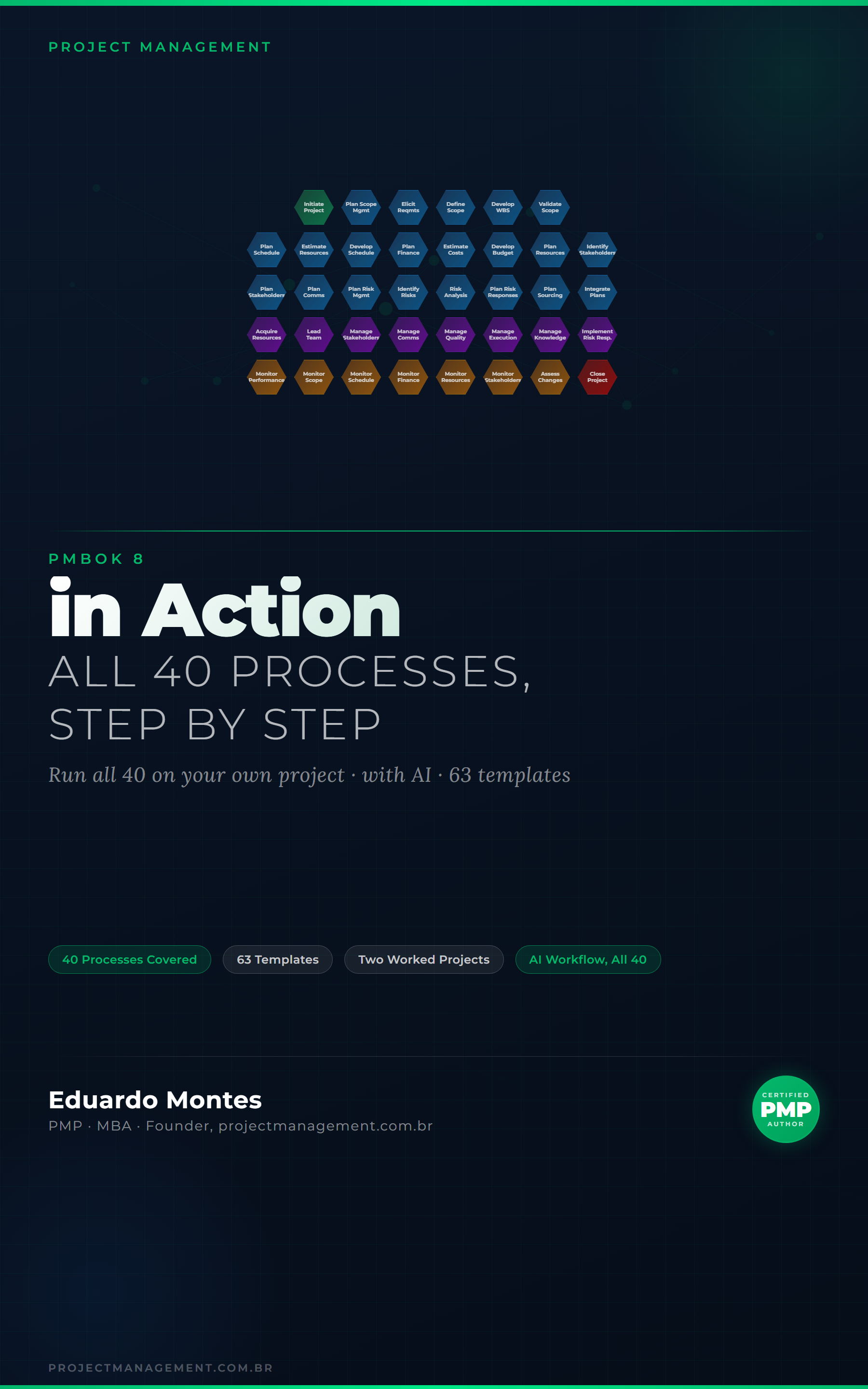
PMBOK 8 in Action
The 40 processes of the PMBOK 8 Guide applied to one real project, with the finished artefact at every step.
See the book — US$ 9.98 →
 Project Management