
New on Amazon · Kindle
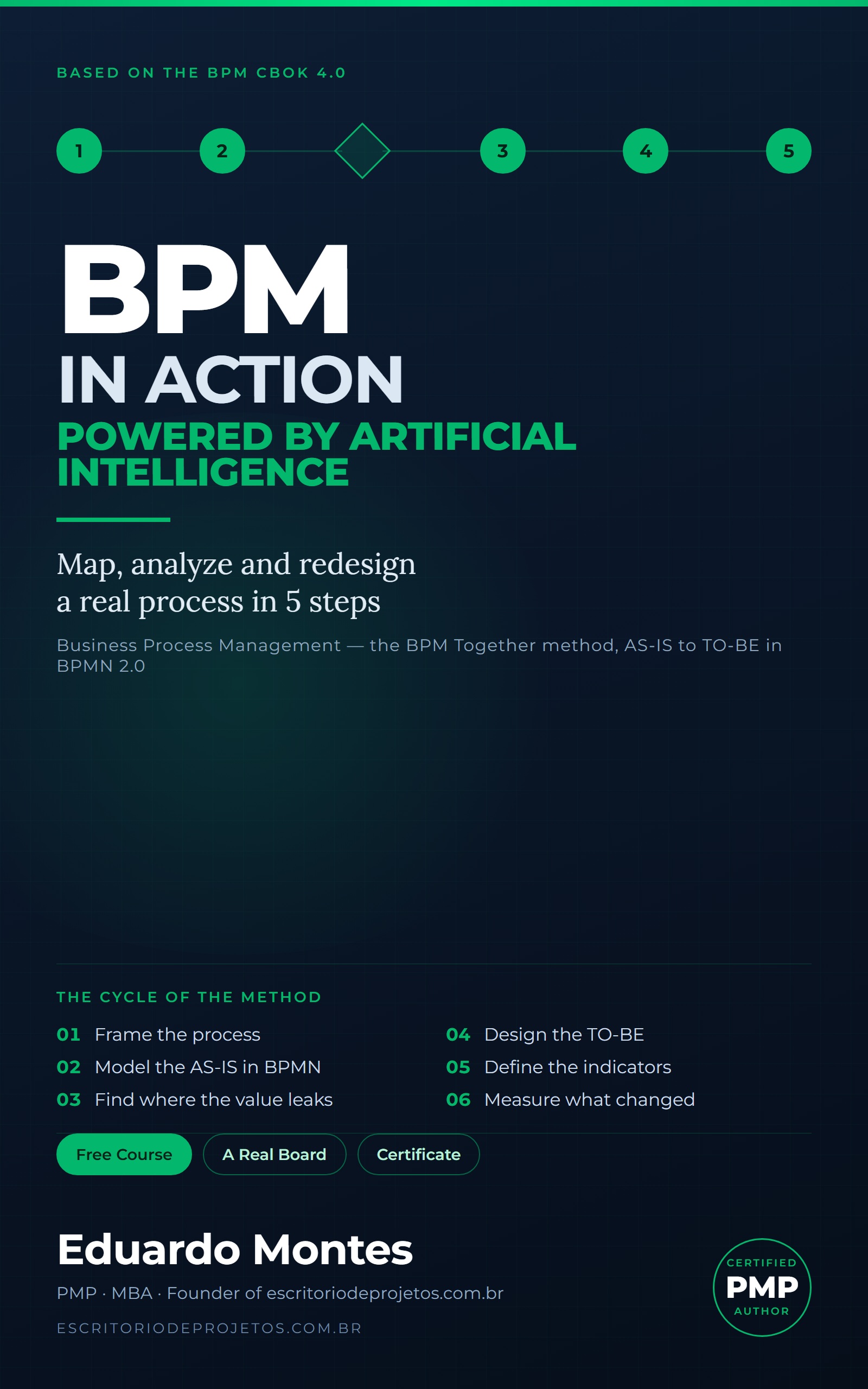
BPM in Action
Business Process Management in 5 steps — map, analyze and redesign a real process, with the BPM Together method
One process from your own work, taken through the whole BPM lifecycle: you describe how it really runs today, find where it breaks, redesign it, and finish with indicators that prove what changed.
Included with Kindle Unlimited. 114 pages.
Most BPM books explain the discipline. Then you close the book and the process is exactly as it was.
I have taught process management long enough to know where it stalls. Not in the definitions — those are fine, and the CBOK covers them better than any summary of mine could. It stalls on Monday, in front of a process that everybody complains about and nobody has ever written down.
So this book runs the other way round. You pick one process that hurts today and take it through the five phases of the BPM lifecycle: you frame it, model the AS-IS as a real BPMN 2.0 diagram, analyze where the value leaks, design the TO-BE, and define the indicators that will say whether the change worked. The theory enters where it is needed — in the middle of the work.
The AI you already use (ChatGPT, Gemini, Claude, any of them) helps at every step: I hand you the prompt already carrying your data, it proposes, and you decide. No decision about your process belongs to the machine.
5
phases of the BPM lifecycle, start to finish
1
real process of yours — not a case study
4
indicator dimensions: time, cost, capacity, quality
114
pages · 1 BPMN figure
What you will have done by the last page
- A process chosen and framed: who owns it, who its customer is, what it costs you today and what you expect to gain.
- The AS-IS modeled — one card per activity and a real BPMN 2.0 diagram, with lanes, gateways and the rework loop, which you open and refine in bpmn.io.
- The analysis of the current state: risky handoffs, bottlenecks, activities that add no value, and the opportunities you can actually act on.
- The TO-BE designed by applying the good-design principles — redesign first, automate afterwards, in that order and for a reason.
- Indicators with a formula, a data source and a target, one per dimension: time, cost, capacity and quality.
- A final deliverable assembled from what is on your board, and assessed against four measures read from the real artefacts rather than from what you say you did.
Why the board is the source of truth
Every activity of your process is a card. Correcting a card changes what the next step sends to the AI — which sounds like a detail and is the whole difference between a method and a pile of loose conversations.
What counts is what is written on your board and reviewed by you. Never an old copy sitting in some file, and never the AI’s memory of a conversation you had last week.
What is inside
9 chapters and appendices · about 18,488 words · one sitting to read, a few weeks to apply.
- Chapter 0 — Setup (getting your environment ready)
- Chapter 1 — Fundamentals of Process Management and the BPM Lifecycle
- Chapter 2 — Process Modeling (and BPMN)
- Chapter 3 — Process Analysis [AS-IS]
- Chapter 4 — Process Design [TO-BE]
- Chapter 5 — Measuring Value: Performance Indicators
- Chapter 6 — Transformation, Technology and Enterprise Architecture
- Chapter 7 — Final Assignment, Presentation and Assessment
- Appendix A — Mapping in Practice (from a structured draft to the BPMN 2.0 diagram)
Free · the course this book came from
BPM Together — ten lessons and a certificate
The method in this book is the method of the BPM Together course, which is free: ten lessons published here as articles, a graded question at the end of each one, a package you download and run, and a certificate when you have answered them all. The book is the route for anyone who would rather read the whole thing at once, in order, with the reasoning behind each decision.
Your process lives on a real board in ProjectAdm. Each step hands you a prompt already carrying your data; you paste it into whichever AI you use, read what comes back, cut what does not exist in your process and bring in the rest. The package carries its own Python, so there is nothing to install.
New here? start the free course (it takes a free account here), read how it works, or open What is Business Process Management — the first lesson, free and complete.
The course is free. The book is paid. The ten lessons, the package, the board and the certificate cost nothing and are complete without the book. The book is $5.99 on Kindle, and it exists for people who prefer one continuous read to ten separate lessons.
Who I wrote it for
- Anyone who has been told to map a process and does not know where to start.
- Process and business analysts who want to move from a pretty diagram to a change that actually happens.
- Anyone leading an area who knows something is stuck and cannot yet show where.
- Anyone who wants to use AI at work in a structured way, instead of in scattered conversations.
- Anyone studying for a BPM certification who wants to practise the whole cycle on a small scale first.
The AI proposes. You decide.
Every step of the method comes with the prompt ready to paste into the AI you already use. I never choose one for you, and I never let the machine decide what belongs to your process: it drafts, organises and suggests, and the decision stays yours. That is why the result holds up in a meeting with the people who actually run the work.
About the author
Eduardo Montes is PMP and PSM I, a project management consultant, professor and author, and the founder of projectmanagement.com.br. He has spent more than twenty years training project professionals in Brazil, Mozambique and other countries.
Map your first process this week
$5.99 on Kindle — included if you already have Kindle Unlimited.
The course is free either way: get the package →
Questions
Do I need to know BPM already?
No. Chapter 1 builds the vocabulary from zero — what a process is, the types, the five phases of the lifecycle — and the rest of the book uses it on your process. No certification and no prior course is assumed.
Do I have to buy the book to take the course?
No. The BPM Together course is free and complete on its own: the ten lessons, the package, the board and the certificate. The book gathers the same journey into one place, in order, for anyone who prefers to read it all at once.
Do I need a BPMN tool?
Nothing you have to buy or install. The method produces a real .bpmn file that you open in demo.bpmn.io in the browser, free, and refine there. Appendix A shows the whole path, and it is also a free article here.
Which AI do I need?
Whichever you already use. The prompts are plain text and are tied to no provider. You paste, you read, and you decide what to keep — and where you have not supplied something, the step leaves the field empty and says so instead of inventing a number.
Do I need to install anything?
The course package carries its own Python: you download it, extract it and double-click Start. You will also need a free ProjectAdm account, where your board lives. The setup article walks through it.
What kind of process can I use?
One that is yours, that runs often enough for you to know it, and that you can describe end to end — hiring, purchasing, onboarding, reimbursement, support, invoicing. Chapter 0 helps you cut it to a size that fits the five phases.
Is there a print edition?
The Kindle edition is out now. The paperback is in preparation.
Is it in Portuguese too?
Yes — this is the English edition of Gestão de Processos na Prática com Inteligência Artificial, sold on escritoriodeprojetos.com.br.
The other three books
Scrum in Action
Three real Sprints on a project of your own, from the Objective to the final presentation, with the whole of Scrum along the way and the AI you already use at every event. See the book →
Project Management in 10 Steps
Ten steps from an idea to a formal close, in the order you actually run them, with twelve free templates and two projects worked end to end. The place to start if you have never run a project. See the book →
PMBOK 8 in Action
All 40 processes of the PMBOK Guide, Eighth Edition, one chapter each, with their inputs, outputs, tools and techniques, and two projects carried end to end. The reference volume of the family. See the book →
BPM CBOK® is a registered trademark of the ABPMP and BPMN® of the OMG. This is an independent practitioner's guide: it is not an official ABPMP publication, it is not certification preparation material, and it has not been endorsed by the association.
As an Amazon Associate, ProjectManagement.com.br earns from qualifying purchases. Links to Amazon on this page are affiliate links; the price you pay is unchanged.
 Project Management