
The Objective is the first practical decision of the course — and the one the whole backlog is ordered against. How to write one that holds.
An OKR has two halves. The Objective says where you want to get to. The
Key Results say how you will know you got there. This lesson is about the first
half, because it is the one you write — the four Key Results of this course are fixed,
and the next lesson explains why.
What an Objective is
One sentence. Qualitative, memorable, and pointing somewhere you are not yet.
- Launch the first version of my podcast
- Get back into shape without giving up my evenings
- Turn my consulting notes into a course I can sell
Each one is a direction, not a number. That is deliberate.
Three tests
- Can you remember it without reading it? If it needs a slide, it is too long.
- Would someone who knows you say “yes, that is what you are up to”?
An Objective nobody recognises is a wish, not a direction. - Does it fit in three Sprints? This course runs three cycles. An Objective
that needs a year will leave you measuring a fragment of it.
Why the backlog depends on it
From the next lessons on, every item in your Product Backlog is ordered against
the Objective. That is the whole point of writing it first: an item that does not
help you reach it is not a priority, and quite often is not an item at all.
Without an Objective, a backlog is a wish list. There is nothing to order it against,
so it gets ordered by whatever felt urgent the day you wrote it.
Where you write it
You do not open a file. Step 1 of the menu asks you — first for the name of
your project (and it renames your board with it), then for your Objective. It saves
both for you.
Next
Lesson 7 explains the four Key Results — why they are fixed, identical for everyone, and read from your board rather than from your judgement.
Agile Together is a free course. The package — scripts plus a portable Python — is a single download: get the course package. You install nothing.
Project Together
Track your progress through PMBOK 8
Create your free account to save your reading progress, earn points on every quiz, and unlock certificates as you master each domain.
Create Free Account →Free forever • No credit card required
QUIZ
Want to test what you learned from this article?
One multiple-choice question + one practical reflection. Earn Project Together points!
Go deeper in the book
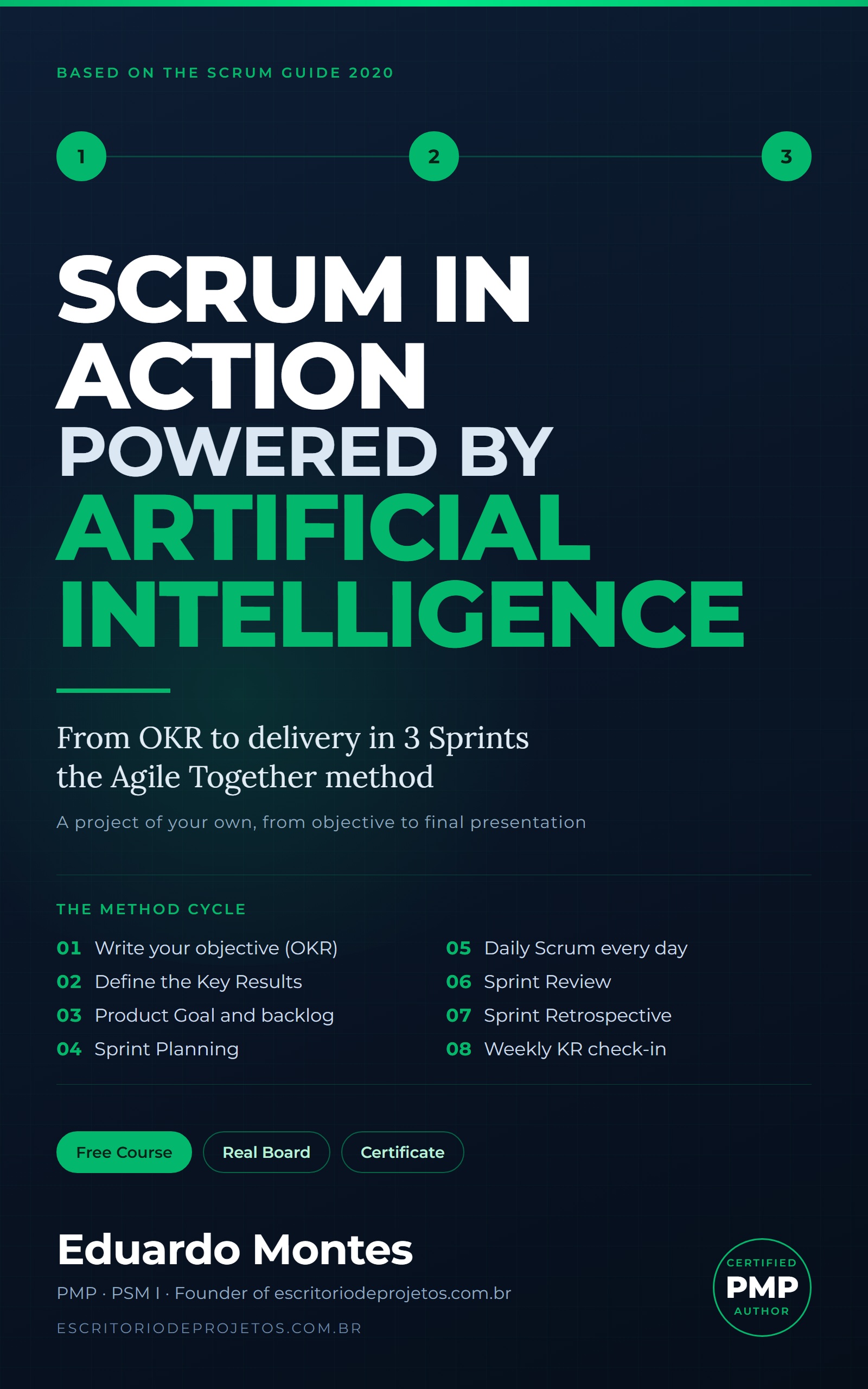
Scrum in Action
Three real Sprints on a project of your own, from the OKR to the final presentation, with the AI you already use at every event.
See the book — US$ 5.99 →
 Project Management