
Two project managers can follow the same processes, fill in the same templates and still get very different results. The difference is rarely in the mechanics. It is in how they think about the project: what they anticipate, what they take ownership of, and what they consider a success. The PMBOK Guide – Eighth Edition gives that difference a name — the project management mindset — and describes it with three dimensions.
This guide explains the mindset as the Standard for Project Management presents it (Section 3.1), shows which of the six principles sits behind each dimension, and clarifies a term that appears in the value-driven dimension and confuses many readers: the triple bottom line.
In this guide you will find:
- What the PMBOK 8 project management mindset is
- The three dimensions: proactive, ownership and value-driven
- Which two principles form each dimension
- What the triple bottom line (people, profit and planet) means for a project
- How the mindset connects to the mechanics — the performance domains
1. WHAT IS THE PROJECT MANAGEMENT MINDSET
Straight to the point
The Guide states that project management is much more than a collection of performance domains, processes and methods: it represents a mindset, sometimes called a “growth mindset,” that is fundamental for executing strategy, fostering adaptability, driving change and generating value. It defines a mindset as a set of beliefs, ways of thinking and habits that help make sense of the behaviors and views of others, and a way to interpret and deal with situations.
“The project management mindset is composed of three dimensions: proactive, ownership, and value-driven.”
— PMBOK Guide, Eighth Edition, Section 3.1
The six principles of PMBOK 8 are grouped two by two into these dimensions. Collectively, the principles describe the mindset, and the mindset guides the mechanics of project management — the performance domains, processes and methods.
2. THE THREE DIMENSIONS AT A GLANCE
| Dimension | Principles it integrates | What it emphasizes |
|---|---|---|
| Proactive | Adopt a Holistic View + Embed Quality Into Processes and Deliverables | Systems thinking, appropriate planning, quality thresholds embedded in every phase, continuous improvement |
| Ownership | Be an Accountable Leader + Build an Empowered Culture | Accountability of leaders and a high-performance team culture with shared ownership |
| Value-driven | Focus on Value + Integrate Sustainability Within All Project Areas | Maximum value, sustainability across the life cycle, the triple bottom line |
3. THE PROACTIVE DIMENSION
Being proactive is described as a key habit that drives the team toward strategic objectives. In the Guide, the proactive mindset emphasizes systems thinking and appropriate levels of planning, so that target quality thresholds are embedded within every phase of the project. It integrates Adopt a Holistic View and Embed Quality Into Processes and Deliverables, fostering continuous improvement and forward-thinking action.
In practice, the proactive project manager anticipates challenges, addresses them promptly and keeps processes aligned with the evolving needs of the project and its stakeholders — which, according to the Guide, enhances the project’s resilience and success.
What it looks like: mapping interdependencies before they become conflicts; agreeing on acceptance criteria and the definition of done before the work starts; treating a recurring defect as a process signal, not a one-off.
4. THE OWNERSHIP DIMENSION
The ownership dimension focuses on the accountability of leaders and the development of a high-performance team culture. It integrates Be an Accountable Leader and Build an Empowered Culture. The Guide is explicit that leadership is not only about making decisions, but about fostering a culture of accountability and collaboration — one that supports strong, self-reliant teams driving success through shared ownership and commitment.
What it looks like: the leader takes responsibility for the project’s target business objectives and for the decisions made; roles, responsibilities and team agreements are clear; people closest to the work are trusted to decide within those agreements.
5. THE VALUE-DRIVEN DIMENSION AND THE TRIPLE BOTTOM LINE
The value-driven dimension emphasizes delivering maximum value by integrating sustainability throughout the project life cycle. It incorporates Focus on Value and Integrate Sustainability Within All Project Areas, aligning projects with organizational strategic objectives and with contributions to the broader community and the environment.
“(i.e., achieving the triple bottom line of people, profit, and planet)”
— PMBOK Guide, Eighth Edition, Section 3.1
What is the triple bottom line?
The Guide’s glossary defines the triple bottom line as a framework for considering the full cost of doing business by evaluating a company’s bottom line from the perspective of profit, people and the planet. In the sustainability principle (Section 3.7), the same idea appears as balancing social equity, environmental stewardship and economic prosperity.
For a project, this means a result is not judged only by its financial return. A project that pays back but harms the community or the environment has not fully delivered value under this dimension. The Guide summarizes the balance: the value-driven dimension promotes a balance between achieving measurable success and advancing broader sustainability goals.
A common trap: confusing the triple bottom line with the old “triple constraint” of scope, schedule and cost. They answer different questions. The triple constraint is about managing the project’s own limits; the triple bottom line is about the full impact of what the project delivers.
6. MINDSET AND MECHANICS
The Guide separates the mindset (the principles, grouped in the three dimensions) from the mechanics: the performance domains — Governance, Scope (including quality), Schedule, Finance, Stakeholders, Resources and Risk — with their knowledge, processes and methods (Section 3.2). The performance domains are designed to make the principles practical, so that the mindset becomes effective practices and outcomes.
Put together, the Guide describes projects that meet or exceed target business objectives (proactive), are led with accountability and empowerment (ownership), and move forward with a focus on value and sustainability (value-driven).
7. A QUICK SELF-CHECK FOR YOUR PROJECT
- Proactive: Do we know the main interdependencies of the project? Are quality thresholds defined before the work, or discovered at inspection?
- Ownership: Who owns the target business objectives? Are roles, responsibilities and team agreements written down and known by everyone?
- Value-driven: How will we know the project created value? Have we considered its effects on people and on the planet, and not only on profit?
Frequently Asked Questions
What are the three dimensions of the PMBOK 8 mindset?
Proactive, ownership and value-driven (Standard for Project Management, Section 3.1).
Which principles form the ownership dimension?
Be an Accountable Leader and Build an Empowered Culture. The proactive dimension combines Adopt a Holistic View and Embed Quality; the value-driven dimension combines Focus on Value and Integrate Sustainability.
What does the triple bottom line balance?
People, profit and planet — the full cost of doing business, seen from social, economic and environmental perspectives.
Is the mindset a new process I have to run?
No. The mindset is how you think; the performance domains and their processes are what you do. The Guide presents the domains as the way the principles become practice.
CONCLUSION
The three dimensions are a compact way to remember the six principles — and a useful mirror. A project can be technically well managed and still fail the mindset: reactive instead of proactive, with nobody really owning the objectives, or measuring success only in money. Checking the three dimensions regularly is a simple habit that keeps the mechanics pointed at what matters.
Want to see how well you know the principles, the domains and the 40 processes? Take the free PMBOK 8 Practice Test: every topic you miss becomes a review e-mail with the article that explains it.
Project Together
Track your progress through PMBOK 8
Create your free account to save your reading progress, earn points on every quiz, and unlock certificates as you master each domain.
Create Free Account →Free forever • No credit card required
QUIZ
Want to test what you learned from this article?
One multiple-choice question + one practical reflection. Earn Project Together points!
Go deeper in the book
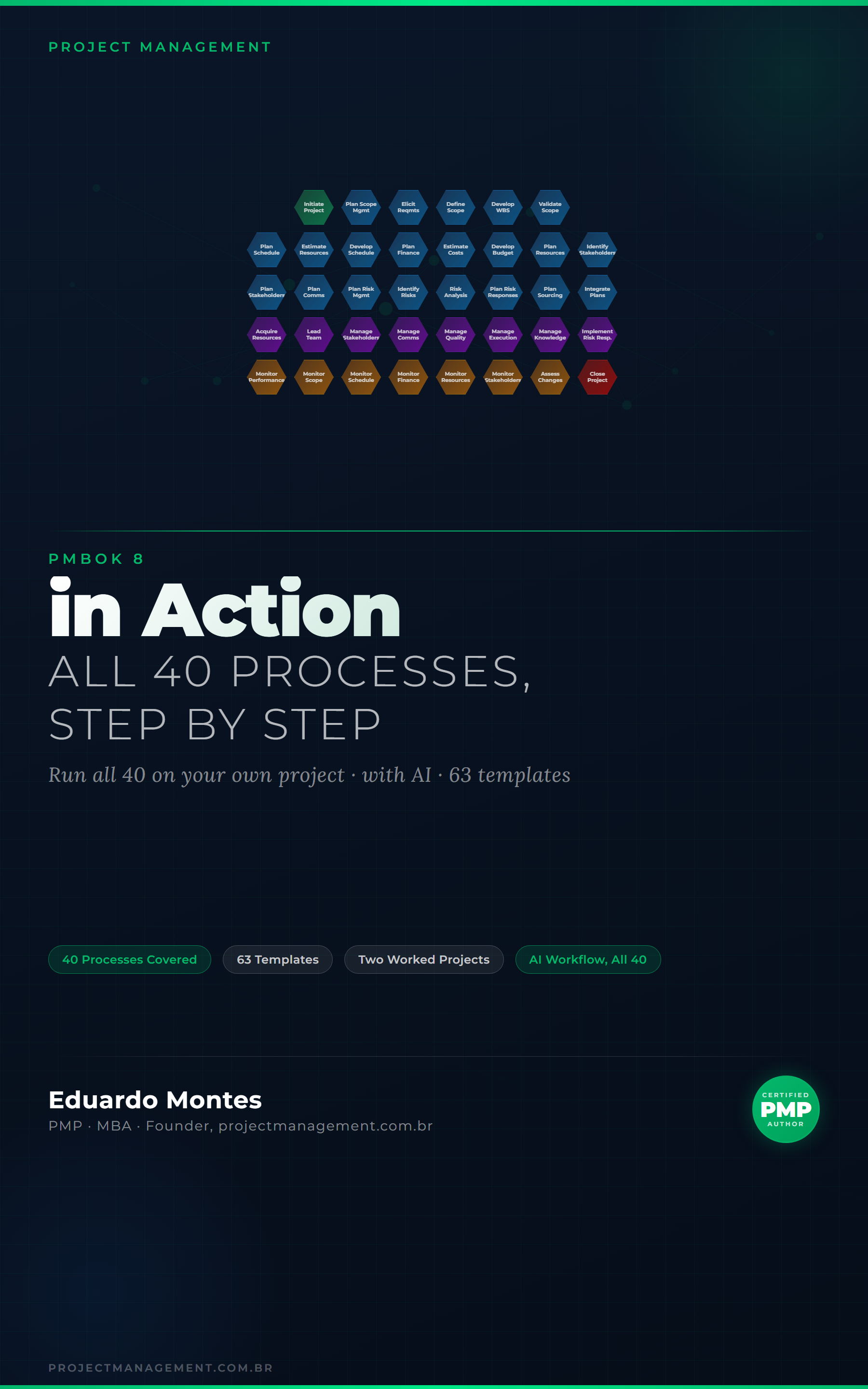
PMBOK 8 in Action
The 40 processes of the PMBOK 8 Guide applied to one real project, with the finished artefact at every step.
See the book — US$ 9.98 →
 Project Management