
From here on the project comes off the page. Until now we were preparing and documenting — and paper accepts anything, including a plan full of holes. Now you test, in practice, your ability to make things happen. And a project is made of people: the first step of execution is to secure the engagement of the stakeholders, starting with your team.
For your career: executing and engaging people is where leadership proves itself. The skills in this step — communication, negotiation and conflict management — are among the most asked about in interviews and promotions.
Start with the team because that is where you have the most influence — and because, if the other stakeholders do not recognize you as a good leader, they tend to question your ability to run the project and to create resistance. The reverse is also true: a leader who engages the team gains credibility with everyone.
Strategies to engage the team
No strategy works with everyone all the time — adapt it to your style and to your team. The ones that work best:
- Lead by example and build credibility. Consistency between what you say and what you do is the condition for trust — which takes a long time to earn and is lost in one small lie.
- Provide the necessary conditions (training, tools, equipment) and highlight the importance of each person’s work. You cannot demand a deadline without providing the conditions.
- Whoever executes should estimate. People commit more to deadlines they estimated themselves — when someone else estimates, excuses are left over.
- Motivate and bring the team together with simple actions (meetings, get-togethers) and show that you care about them as people.
- Get to know each individual and what motivates them — one formula for everybody creates resistance.
- In rare cases, the only way out is replacing the member whose interests are incompatible with the project — act fast so the team is not “contaminated”.
Worst practices (avoid these)
- Thinking more resources shorten the schedule. Training someone consumes your time and can create rework — “you cannot produce a baby in one month by getting nine women pregnant”.
- Thinking fear and pressure solve things. They bring results in the short term and grievances in the long term. “Drive out fear, so that everyone may work effectively” (Deming) — when people are afraid, they lie.
- Not looking for the cause of problems. Fixing the symptom without attacking the cause makes the problem come back (Pareto: 80% of the problems come from 20% of the sources).
- Not caring about the stakeholders’ interests. People are the most important asset in your project — value them.
On your board (ProjectAdm)
In the Stakeholders [WHO] list, record in each card’s description the current engagement level (supportive, neutral or resistant), the strategies chosen for the most critical ones, and who is responsible for engaging each one (as a card member). Watch for signs of resistance throughout execution.
Predictive × Agile
In the Agile approach, engaging starts by making the roles and the cadence explicit: beyond the Product Owner (the owner of value), you have the Scrum Master — who serves the team, facilitates the events and removes impediments — and the Development Team, self-organized, which decides how the work gets done. Stakeholder engagement happens naturally in the fixed cadence of ceremonies, especially at the Sprint Review.
📢 Horizonte in Scrum — Step 6. Ana Silveira (previously the project manager) became Product Owner; Diego Carvalho, the internal Scrum Master; and the Team brought together the ProjectAdm consultant and the PMO analysts. Sponsor Roberto Campos takes part in the monthly Sprint Reviews.
🎯 Your turn — Engage the stakeholders
🎯 Objective: win the complicity of the team and of the other stakeholders, so the project can be executed and adapt to change.
✅ Before you start: the plan approved (Step 5); read the strategies for engaging the team above.
🗃️ On your board: work in the Stakeholders [WHO] list.
📋 Checklist:
- Record the engagement level of each stakeholder (supportive, neutral, resistant).
- Choose the most suitable strategies for the most critical ones.
- Define who is responsible for engaging each one.
- Watch for signs of resistance throughout execution and adapt.
🎁 Your deliverable: the engagement plan recorded on the cards. ⏱️ Time: continuous, throughout execution. 🛠️ Tools: ProjectAdm + the strategies and worst practices from this step.
💡 Accelerate with AI: run Step 6 in the course menu. It reads your Stakeholders list and hands you the prompt already filled in with the people you registered in Step 1 — it asks the AI for the likely engagement level and the best strategy for each one. Paste the answer into the “0. Inbox” card and run Step 6 again: the engagement plan is written into each stakeholder’s card, without touching the text you wrote.
💬 Tip: more important than adopting the strategies is monitoring engagement, staying alert to resistance and adapting.
With the people engaged, it is time to make it happen: Step 7.
The book behind these ten steps
Project Management in 10 Steps
The whole method in one place: all ten steps in the order you run them, the templates of every step, and two projects worked end to end — one personal, one corporate. Based on the PMBOK Guide, Eighth Edition.
Included with Kindle Unlimited. What is inside →
As an Amazon Associate, ProjectManagement.com.br earns from qualifying purchases.
Project Together
Track your progress through PMBOK 8
Create your free account to save your reading progress, earn points on every quiz, and unlock certificates as you master each domain.
Create Free Account →Free forever • No credit card required
QUIZ
Want to test what you learned from this article?
One multiple-choice question + one practical reflection. Earn Project Together points!
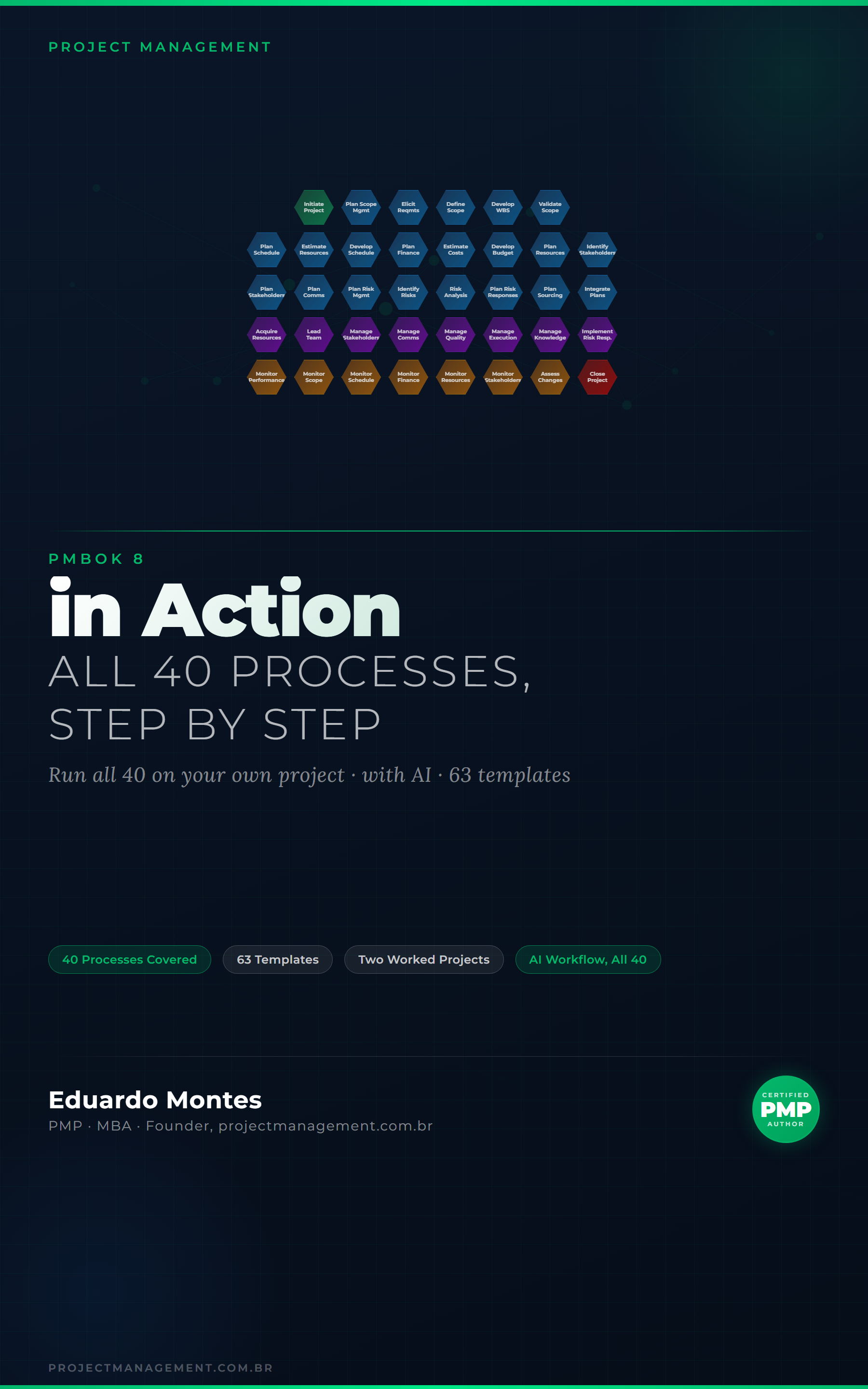
Go deeper in the book
PMBOK 8 in Action
The 40 processes of the PMBOK 8 Guide applied to one real project, with the finished artefact at every step.
See the book — US$ 9.98 →
 Project Management