
PMBOK 8 agile integration marks a turning point: the eighth edition officially embraces agile, adaptive, and hybrid delivery as equal partners to predictive approaches, giving practitioners a unified framework for any project context.
For years, project managers faced a false choice: follow PMBOK’s structured processes or embrace Agile’s flexibility. The two felt like competing philosophies — one demanding documentation, change control boards, and baselines; the other celebrating working software over comprehensive plans.
That tension has dissolved in the 8th edition of the PMBOK® Guide.
Unlike earlier editions that treated Agile as a separate track — most notably the Agile Practice Guide bundled alongside PMBOK 6 — PMBOK 8 natively embraces agile thinking. Agile is no longer an annex, an afterthought, or a companion document. It is woven into the framework’s principles, processes, tools, and techniques from the ground up.
This guide breaks down exactly how PMBOK 8 and Agile relate, where they overlap, and what it means for you as a practitioner.
In this guide you will find:
- What changed from PMBOK 7 to PMBOK 8 regarding Agile
- How PMBOK 8 defines Agile as a mindset and set of practices
- Where Agile appears across the 40 PMBOK 8 Processes
- How the 6 PMBOK 8 Principles align with the Agile Manifesto values
- Agile tools and techniques explicitly referenced in PMBOK 8
- When PMBOK 8 recommends using an Agile or Hybrid approach
- Common misconceptions about PMBOK and Agile — corrected
1. What Changed from PMBOK 7 to PMBOK 8 Regarding Agile
To understand PMBOK 8’s relationship with Agile, it helps to trace the evolution across editions.
PMBOK 6 was process-heavy: 49 processes, 10 knowledge areas, and a separate Agile Practice Guide included as a companion document. Agile was acknowledged but kept at arm’s length — it lived outside the core framework.
PMBOK 7 made a significant structural shift. It moved away from prescriptive process lists and toward 12 Project Management Principles and 8 Performance Domains. This principles-based approach was inherently more methodology-agnostic, making it much easier to apply agile thinking without it feeling forced. However, PMBOK 7 removed the detailed process guidance many practitioners relied on, which caused confusion.
PMBOK 8 achieves the best of both worlds. It reintegrates the process view — restoring ITTOs (Inputs, Tools & Techniques, Outputs) through 40 defined processes — while keeping the methodology-agnostic spirit of PMBOK 7. The result is a framework where:
- Processes are described as what needs to happen, not how it must happen
- Each process can be executed predictively, adaptively, or as a hybrid
- Agile practices are embedded within process descriptions, not relegated to an appendix
- The 6 Principles provide the philosophical backbone that aligns directly with Agile values
In short: PMBOK 8 treats agile not as an alternative to project management, but as one of several valid approaches within it. The framework is now a container large enough to hold both.
2. How PMBOK 8 Defines Agile
PMBOK 8 does not define Agile as a single methodology. Instead, it treats agile as a mindset and a collection of practices that can be applied across different contexts and at different levels of formality.
This distinction matters. Saying “we’re doing Agile” is like saying “we’re doing management” — it describes a philosophy, not a specific set of steps. PMBOK 8 recognizes this, explicitly referencing multiple agile methodologies without prescribing any one of them:
- Scrum — referenced for iterative delivery, Sprint cycles, and the Scrum Master role as a model of servant leadership
- Kanban — referenced for flow-based work management, WIP limits, and visual task boards
- Extreme Programming (XP) — referenced for engineering practices including test-driven development and continuous integration
- SAFe (Scaled Agile Framework) — referenced for scaling agile practices across programs and portfolios
The Agile Manifesto and PMBOK 8 Principles
The four values of the Agile Manifesto — individuals over processes, working software over documentation, customer collaboration over contract negotiation, and responding to change over following a plan — find clear echoes in the PMBOK 8 Principles. This is not coincidental. PMI has explicitly aligned the framework’s philosophical underpinnings with the values that have guided agile practitioners since 2001.
PMBOK 8 treats the Manifesto not as a competing standard but as a complementary set of values that informed the framework’s design. The 12 Agile Manifesto principles — from delivering working software frequently to building projects around motivated individuals — map to specific PMBOK 8 principles and process guidance.
The practical takeaway: if you understand the Agile Manifesto, you already understand a significant portion of the thinking behind PMBOK 8. The two are not in tension — they are aligned.
3. Where Agile Appears in the 40 PMBOK 8 Processes
PMBOK 8 organizes project management work into 40 processes grouped across 5 Focus Areas: Initiating, Planning, Executing, Monitoring & Controlling, and Closing. Within each process, PMBOK 8 acknowledges that the work can be carried out using predictive, agile, or hybrid approaches.
Below is a mapping of key PMBOK 8 processes to their most common Agile equivalents:
| PMBOK 8 Process | Agile Equivalent / Adaptive Practice |
|---|---|
| Develop Project Charter | Project Vision / Product Goal definition |
| Identify Stakeholders | Stakeholder mapping in Sprint 0 / inception phase |
| Elicit and Analyze Requirements | Backlog Refinement / User Story Mapping |
| Create WBS | Product Backlog decomposition / Story splitting |
| Develop Schedule | Sprint Planning / Release Planning |
| Estimate Costs | Story Point estimation / Planning Poker |
| Determine Budget | Rolling wave budget / Agile financial governance |
| Plan Quality Management | Definition of Done (DoD) / Acceptance Criteria |
| Plan Resource Management | Self-organizing team formation / T-shaped skills |
| Plan Communications Management | Information radiators / Daily Standup cadence |
| Plan Risk Management | Risk-adjusted backlog / Risk burndown charts |
| Plan Procurement Management | Agile contracts / Time & material with capped scope |
| Direct and Manage Project Work | Sprint Execution / Kanban flow management |
| Manage Project Knowledge | Sprint Retrospectives / Communities of Practice |
| Manage Quality | Continuous testing / Test-Driven Development (TDD) |
| Acquire Resources | Team assembly with agile role profiles |
| Develop Team | Team health checks / Agile coaching |
| Lead the Team | Servant Leadership / Scrum Master facilitation |
| Manage Stakeholder Engagement | Sprint Reviews / Customer demos |
| Monitor and Control Project Work | Burndown/burnup charts / Velocity tracking |
| Perform Integrated Change Control | Backlog reprioritization / Change-friendly contracts |
| Validate Scope | Sprint Review acceptance / User acceptance testing |
| Control Schedule | Sprint velocity analysis / Release forecast updates |
| Control Costs | Earned Value in agile / Cost per story point |
| Close Project or Phase | Final Retrospective / Product retirement ceremony |
This mapping illustrates a core insight of PMBOK 8: the processes describe the intent; the methodology determines the mechanism. Whether you use a Gantt chart or a Sprint board to manage schedule, you are still performing “Develop Schedule” — the process outcome is the same; the tool differs.
4. How PMBOK 8 Principles Align with Agile Values
PMBOK 8 is built on 6 Project Management Principles. These are not prescriptive rules but philosophical commitments that guide practitioner behavior. They align closely — though not perfectly — with the Agile Manifesto’s 4 values and 12 principles.
See also: PMBOK 8 Principles — Complete Guide
| PMBOK 8 Principle | Agile Manifesto Alignment |
|---|---|
| Stewardship — Act with diligence, respect, and integrity | Manifesto Principle 5: Build projects around motivated individuals; give them the environment and trust they need |
| Team — Create a collaborative environment | Manifesto Value 1: Individuals and interactions over processes and tools; Principle 11: Self-organizing teams |
| Stakeholders — Engage stakeholders proactively | Manifesto Value 3: Customer collaboration over contract negotiation; Principle 1: Satisfy customer through early delivery |
| Value — Focus on value delivery | Manifesto Value 2: Working software over comprehensive documentation; Principle 3: Deliver working software frequently |
| Systems Thinking — Recognize and respond to system interactions | Manifesto Principle 12: Regularly reflect on how to become more effective; Principle 10: Simplicity — maximize work not done |
| Adaptability and Resilience — Build adaptability and resilience into project approaches | Manifesto Value 4: Responding to change over following a plan; Principle 2: Welcome changing requirements |
The most important overlap is around value delivery and adaptability. Both PMBOK 8 and the Agile Manifesto reject the idea that following a plan is an end in itself — the goal is to deliver outcomes that matter to stakeholders, and both frameworks insist on maintaining the flexibility to adapt when circumstances change.
Where they differ: PMBOK 8 is broader in scope. It governs not just software projects but infrastructure, product development, organizational change, and more. The Agile Manifesto was written specifically for software development. PMBOK 8 generalizes Agile values into principles applicable to any project context.
5. Agile Tools and Techniques in PMBOK 8
PMBOK 8 catalogs an extensive set of tools and techniques — approximately 110 in total — spread across its processes and focus areas. Of these, roughly 30% are agile-native or agile-friendly, meaning they either originated in agile contexts or are predominantly used in adaptive delivery environments.
PMBOK 8 explicitly identifies a category of Agile & Iterative Tools — a set of 15 techniques specifically associated with adaptive and iterative project delivery. These include:
- Backlog Management — maintaining and prioritizing the product backlog as the single source of work
- Burndown / Burnup Charts — visual tracking of work remaining or completed against time
- Daily Standup — time-boxed daily synchronization for team coordination
- Definition of Done (DoD) — shared agreement on completion criteria for backlog items
- Iteration Planning — Sprint-level planning to commit to a set of backlog items
- Kanban Board — visual workflow management with WIP limits
- Planning Poker — consensus-based estimation using story points
- Product Roadmap — high-level visualization of planned product evolution
- Retrospective — structured team reflection at the end of each iteration
- Sprint Review — demonstration of completed work to stakeholders for feedback
- Story Mapping — visual technique to organize user stories by user journey
- User Stories — lightweight requirement format from the user’s perspective
- Velocity — measure of team throughput per iteration, used for forecasting
- WIP Limits — constraints on work-in-progress to improve flow and reduce multitasking
- Continuous Integration / Continuous Delivery (CI/CD) — engineering practices for frequent, automated delivery
For a deep dive into all 15, see: Agile & Iterative Tools in PMBOK 8 — Complete Guide
Beyond these 15 agile-specific tools, many of the remaining 95 tools in PMBOK 8 are used equally well in agile and predictive contexts — for example, stakeholder analysis, risk registers, and communication plans are not inherently predictive; they are applied differently depending on the delivery approach.
6. When PMBOK 8 Recommends Agile
PMBOK 8 does not prescribe a delivery approach. Instead, it provides guidance for selecting the right approach based on project characteristics. The framework recognizes three primary delivery approaches:
- Predictive (Waterfall) — used when requirements are stable, the solution is well-understood, and changes are costly or risky
- Adaptive (Agile) — used when requirements are uncertain or evolving, feedback loops are valuable, and the team can deliver incrementally
- Hybrid — a blend of both, where some components follow a predictive approach (e.g., procurement, regulatory compliance) while others follow an adaptive approach (e.g., feature development)
See: Predictive vs Agile vs Hybrid in PMBOK 8 — How to Choose
The key decision factors PMBOK 8 references include:
| Factor | Points Toward Agile | Points Toward Predictive |
|---|---|---|
| Requirement clarity | Uncertain, evolving | Stable, well-defined |
| Solution complexity | High complexity, novel | Low complexity, proven |
| Stakeholder availability | High — frequent feedback | Low — infrequent reviews |
| Team experience with agile | High proficiency | Low proficiency or regulated environment |
| Tolerance for change | High — change is expected | Low — change is costly |
| Delivery urgency | Early partial delivery acceptable | Full delivery required at once |
PMBOK 8 uses the concept of a complexity/uncertainty spectrum to describe this decision. Projects on the right side of the spectrum — high uncertainty, high complexity, rapidly changing stakeholder needs — benefit most from agile approaches. Projects on the left — well-understood deliverables, fixed regulatory requirements, physical construction — often remain predictive. Most real-world projects sit somewhere in the middle, making hybrid the most common practical choice.
7. Common Misconceptions About PMBOK 8 and Agile
Despite the clear alignment between PMBOK 8 and Agile, several myths persist in the practitioner community. Let’s address them directly.
Misconception 1: “PMBOK is waterfall”
False. This was arguably true of PMBOK 4 and 5, which were heavily process-oriented and implicitly sequential. It became less true with PMBOK 6 (which added the companion Agile Practice Guide) and is definitively false with PMBOK 8. The current edition is methodology-agnostic by design. Its 40 processes describe what needs to happen on a project — not when or in what order. A team using Scrum is still performing scheduling, risk management, and quality control — they’re just doing it iteratively and continuously rather than up-front.
Misconception 2: “Agile doesn’t need documentation”
False — especially in the context of PMBOK 8. The Agile Manifesto values “working software over comprehensive documentation” — but that’s a statement about priority, not a prohibition. PMBOK 8 maintains that documentation serves the project, not the other way around. Agile projects still produce project charters, risk logs, stakeholder registers, and lessons learned. They produce them in lighter-weight, living forms — but they produce them. PMBOK 8 enforces this by embedding documentation-generating outputs within the very processes that agile teams execute.
Misconception 3: “PMP certification doesn’t cover Agile”
False. This misconception is years out of date. As of the current PMP Exam Content Outline, approximately 50% of PMP exam questions are based on agile or hybrid approaches. PMI has explicitly restructured the exam to reflect the reality that most projects today are agile or hybrid. Candidates who focus only on predictive knowledge will fail the exam. PMBOK 8 as the primary reference guide reflects this reality by treating agile as a first-class citizen throughout — not as optional reading.
Misconception 4: “You need to choose between PMBOK and Agile”
False. This is perhaps the most damaging misconception because it leads practitioners to dismiss one or the other. PMBOK 8 is a framework that includes agile. Scrum, Kanban, and SAFe are methodologies that operate within the framework. They answer different questions: PMBOK 8 tells you what needs to be managed; agile methodologies tell you one way to manage it. They are not alternatives — they are complementary layers.
Frequently Asked Questions
Does PMBOK 8 support agile?
Yes. PMBOK 8 officially embraces agile, adaptive, and hybrid delivery as equal partners to predictive approaches, giving practitioners one unified framework for any project context.
What changed from PMBOK 7 to PMBOK 8 regarding agile?
PMBOK 7 was principle-based with no processes; PMBOK 8 reintroduces 40 processes designed to work across predictive, agile, and hybrid approaches, and weaves agile tools and concepts throughout.
Is PMBOK just waterfall?
No — that is a common misconception. PMBOK 8’s principles and performance domains apply regardless of delivery approach, and the standard explicitly accommodates agile and hybrid methods.
Conclusion
PMBOK 8 represents the most agile-friendly version of the PMBOK® Guide in PMI’s history. The 8th edition does not merely acknowledge Agile — it embeds agile thinking into its principles, processes, tools, and decision frameworks at every level.
For practitioners, this shift carries a liberating implication: you no longer need to choose between rigor and adaptability. PMBOK 8 provides the structure to manage stakeholders, risks, costs, and quality — and leaves the delivery mechanism to you. Whether your team runs two-week Sprints, manages a Kanban flow, or follows a hybrid approach with predictive milestones and adaptive feature delivery, PMBOK 8 has a process for what you’re doing and a principle for why it matters.
The organizations and practitioners that internalize this are the ones who will thrive — not because they picked the “right” methodology, but because they understand that the goal was never the methodology. It was always delivering value.
For a complete view of the framework, start here: PMBOK 8 Guide — Complete Index and Navigation
Call to Action:
References
PMBOK Guide 8: The New Era of Value-Based Project Management. Available at: https://projectmanagement.com.br/pmbok-guide-8/
Disclaimer
This article is an independent educational interpretation of the PMBOK® Guide – Eighth Edition, developed for informational purposes by ProjectManagement.com.br. It does not reproduce or redistribute proprietary PMI content. All trademarks, including PMI, PMBOK, and Project Management Institute, are the property of the Project Management Institute, Inc. For access to the complete and official content, purchase the guide from Amazon or download it for free at https://www.pmi.org/standards/pmbok if you are a PMI member.
Free PMBOK 8 Quick Reference Card
All 7 Performance Domains, 6 Principles, and key tools on one printable page. Download it free — no payment required.
As an Amazon Associate, ProjectManagement.com.br earns from qualifying purchases. Links to Amazon on this page are affiliate links; the price you pay is unchanged.
PMBOK 8 Agile: Key Takeaways
PMBOK 8 agile alignment goes beyond adding a few sprints to a waterfall schedule. The standard defines 40 processes that apply across predictive, adaptive, and hybrid environments — practitioners tailor the application intensity, not the fundamental process logic.
One of the most important PMBOK 8 agile distinctions from earlier editions is the explicit acknowledgment that high-performing teams regularly combine agile principles with structured governance, producing hybrid approaches that neither pure agile nor pure waterfall can achieve alone.
As you apply PMBOK 8 agile guidance in practice, focus on tailoring: the standard encourages selecting and adapting methods based on context, stakeholder expectations, regulatory requirements, and team experience — rather than defaulting to any single framework.
The PMBOK 8 agile chapter represents one of the most significant contributions of the eighth edition: providing a principled, evidence-based rationale for hybrid delivery that practitioners can reference when defending their tailoring decisions to sponsors and governance boards.
Project Together
Track your progress through PMBOK 8
Create your free account to save your reading progress, earn points on every quiz, and unlock certificates as you master each domain.
Create Free Account →Free forever • No credit card required
QUIZ
Want to test what you learned from this article?
One multiple-choice question + one practical reflection. Earn Project Together points!
Go deeper in the book
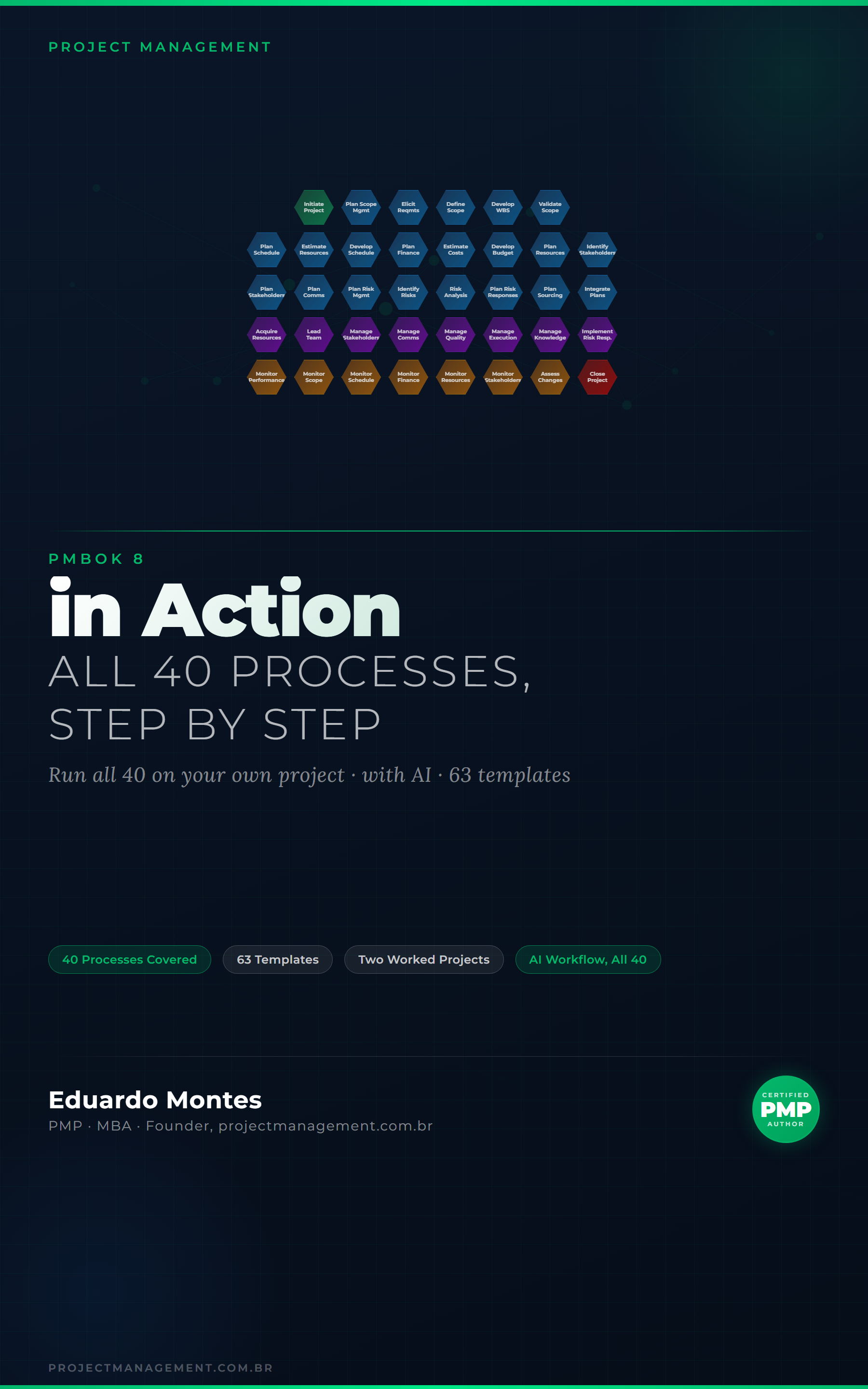
PMBOK 8 in Action
The 40 processes of the PMBOK 8 Guide applied to one real project, with the finished artefact at every step.
See the book — US$ 9.98 →
 Project Management