
Have you ever managed a team where every small decision had to pass through you first — where team members waited for approval before acting, hesitated to raise problems, and defaulted to “doing what they were told” even when they could clearly see a better way? That is the opposite of what PMBOK 8 Principle 6 demands. And it is one of the most common failure modes in modern project management.
A team that cannot act without being told to act is not a team — it is a set of execution units. The project manager becomes the bottleneck. Speed slows down. Quality depends on one person’s availability. And talent walks out the door, quietly, because capable people do not stay in environments where they are not trusted to contribute.
PMBOK 8 Principle 6 — Build a Culture of Empowerment — addresses this at the root. It is not about giving everyone free rein. It is about creating the structural, cultural, and behavioral conditions under which people can take ownership, exercise judgment, and contribute meaningfully — within a framework that is clear, accountable, and aligned with the project’s objectives.
In this guide you will find:
- What “Build a Culture of Empowerment” means in PMBOK 8 — and what changed from PMBOK 7
- Why this principle matters and what it demands from leaders
- The three pillars: Trust, Autonomy, and Accountability
- A step-by-step approach to applying it in real projects
- How to tailor it for predictive, agile, and hybrid environments
- The most common mistakes — and how to avoid them
- A quick-application checklist you can use today
1. WHAT IS “BUILD A CULTURE OF EMPOWERMENT”
Straight to the point
Building a culture of empowerment means creating an environment where team members have the authority, resources, skills, and psychological safety to make decisions, take ownership of their work, and contribute their full capabilities to the project.
Empowerment is not the same as delegation. Delegation transfers a task. Empowerment transfers ownership — and with it, the authority, the information, and the support needed to exercise that ownership responsibly. An empowered team member does not ask “Can I?” before acting on something within their domain. They ask “What is the best way to do this?” and proceed with confidence, knowing they have the trust of their leader and the clarity to act.
PMBOK 8 frames this as a cultural principle, not a structural one. The emphasis on “culture” is deliberate. You cannot empower a team through a policy document or an org chart change. Empowerment is built through consistent behaviors, repeated over time, that signal trust, support autonomy, and demand accountability. Culture is what the team experiences every day — in how decisions get made, in how mistakes are handled, in how contributions are recognized.
This principle calls project managers and leaders to:
- Delegate decision-making to the people closest to the work
- Create psychological safety for experimentation and honest communication
- Provide the information and resources people need to exercise their authority
- Celebrate learning from failure, not just success
- Recognize contributions publicly and specifically
- Hold people accountable without micromanaging how they deliver
What changed from PMBOK 7?
In PMBOK 7 (2021), the concept closest to empowerment was embedded in Principle 5: “Enable Change” and Principle 6: “Demonstrate Leadership Behaviors.” Leadership and change enablement were important, but they addressed behavior at the individual leader level, not at the cultural and environmental level.
In PMBOK 8 (2025), the focus shifted. The new Principle 6 — Build a Culture of Empowerment — makes an explicit distinction: it is not enough for the leader to lead well. The leader must actively build the conditions in which the entire team can lead. The principle moves from “how the PM should behave” to “what kind of environment the PM must create.”
| Aspect | PMBOK 7 (2021) | PMBOK 8 (2025) |
|---|---|---|
| Name | Demonstrate Leadership Behaviors / Enable Change | Build a Culture of Empowerment |
| Focus | Individual leader’s behaviors and adaptability | Cultural and environmental conditions enabling the entire team |
| Ownership level | Distributed leadership among key roles | Broad ownership at every level of the team |
| Psychological safety | Implied in leadership behaviors | Explicit requirement — must be actively constructed |
| Accountability | Embedded in governance and role definition | One of three explicit pillars — inseparable from empowerment |
| Connection to team performance | Indirect, through leadership effectiveness | Direct — empowerment is a prerequisite for high performance |
What this means in practice: If you were applying PMBOK 7’s leadership principles well, you have a foundation. But PMBOK 8 asks you to go further: to evaluate your project environment not just by how you lead, but by how much your team can lead in your absence. The ultimate test of this principle is not “Am I a good leader?” but “Does my team perform well when I am not in the room?”
2. WHY IT MATTERS
This principle matters because the pace of modern projects exceeds the bandwidth of any single decision-maker.
When all decisions flow through the project manager, the team’s execution speed is limited by the PM’s availability. In fast-moving environments — whether agile sprints, crisis response, or multi-workstream programs — this bottleneck is not just inefficient; it is organizationally dangerous. Decisions that should take minutes take days. Opportunities are missed. Team members disengage because they learn that initiative is not rewarded.
A culture of empowerment solves this by distributing decision-making to the level where knowledge lives. The engineer who knows the codebase makes the technical call. The stakeholder relationship manager who knows the client makes the communication call. The risk owner who monitors the external environment makes the escalation call. The project manager’s job shifts from making decisions to creating the conditions in which the right decisions get made by the right people at the right time.
Beyond speed, empowerment matters because:
- It unlocks talent. Capable people have more to give than their job descriptions specify. Empowerment creates the channel through which that additional capability flows into the project.
- It increases engagement. Autonomy is one of the most reliable drivers of intrinsic motivation. People who own their work care more about it.
- It improves quality. Decisions made by people with direct knowledge of the context are usually better than decisions made at a remove. The person doing the work sees things the manager cannot.
- It builds organizational resilience. An empowered team adapts when plans change. A dependent team freezes.
- It develops the next generation of leaders. Empowerment is not just good for the project — it builds the judgment, confidence, and accountability skills that define leadership at every level.
Research consistently confirms these effects. Teams with high psychological safety — the foundation of genuine empowerment — outperform their peers on innovation, quality, and retention. Google’s Project Aristotle, one of the most cited studies of team performance, identified psychological safety as the number one predictor of team effectiveness. PMBOK 8 formalizes what organizational science has known for years: the environment in which people work determines what they can achieve.
The failure to build this culture has a cost that is easy to underestimate because it is invisible. The decisions never made, the problems never raised, the ideas never contributed, the talent never applied — these are silent losses that never appear in a risk register but quietly undermine every project they inhabit.
3. WHAT CHANGED FROM PMBOK 7
The transition from PMBOK 7 to PMBOK 8 on this topic reflects a broader maturation in how the project management profession understands leadership and team dynamics.
PMBOK 7 addressed leadership through the lens of the individual project manager: what behaviors should the PM model? How should the PM adapt to different situations? How should the PM facilitate change? These are important questions, but they place the weight of team performance primarily on the leader’s shoulders. The implicit assumption is that good leadership produces good teams — and that the leader’s behaviors are the primary lever.
PMBOK 8 challenges this assumption. It recognizes that even exceptional individual leaders cannot consistently produce high-performing teams if the organizational and project culture does not support empowerment. You can have the most self-aware, emotionally intelligent, servant-leader PM on the planet — and still have a team that is afraid to speak up, unwilling to take ownership, and dependent on the leader for every decision. Because the culture is shaped by more than one person.
This is why PMBOK 8 frames it as a cultural principle. Culture is collective. It is shaped by norms, habits, incentives, stories, and structures — all of which the PM can influence, but none of which the PM controls alone. Building a culture of empowerment requires working at the level of the team’s shared environment, not just at the level of one leader’s behaviors.
In concrete terms, the shift from PMBOK 7 to PMBOK 8 means:
- Moving from “I should demonstrate leadership” to “I should build leadership capacity in others”
- Moving from “I should enable change” to “I should enable the team to lead change”
- Moving from “distributed leadership” as a structural concept to “empowerment” as a cultural reality
- Moving from addressing psychological safety implicitly to requiring it explicitly
- Moving from accountability as a governance mechanism to accountability as one of three core pillars of empowerment itself
This is not a rejection of PMBOK 7’s insights — it is an evolution. The behaviors PMBOK 7 prescribed remain valid. PMBOK 8 adds the environmental and cultural layer that makes those behaviors sustainable at scale.
4. THE THREE PILLARS: TRUST, AUTONOMY, ACCOUNTABILITY
PMBOK 8’s culture of empowerment rests on three interconnected pillars. Remove any one of them and empowerment collapses — either into chaos (if accountability is absent) or into managed delegation (if autonomy is absent) or into fear (if trust is absent). Together, the three pillars create the conditions for genuine, sustainable team empowerment.
Pillar 1 — Trust
Trust is the foundation. Without trust, neither autonomy nor accountability can function as intended. Trust in the context of empowerment has two dimensions: the project manager’s trust in the team, and the team’s trust in the organization.
The PM’s trust in the team is expressed through behaviors:
- Delegating decisions without requiring approval for every step
- Assuming positive intent when mistakes happen
- Listening to dissenting perspectives without dismissing them
- Following through on commitments made to the team
- Advocating for the team in organizational settings
The team’s trust in the organization — often called psychological safety — is what allows people to speak up, take risks, and acknowledge failures without fear of punishment. Psychological safety does not mean comfort without challenge. It means the team knows that honest communication, well-intentioned mistakes, and constructive disagreement will be received with respect rather than retaliation.
Building psychological safety is not a one-time act. It requires consistent reinforcement: how the leader responds when someone raises a problem, how mistakes are discussed in retrospectives, how dissenting opinions are handled in planning sessions. Each of these moments either builds or erodes the trust that makes empowerment possible.
Pillar 2 — Autonomy
Autonomy means giving people the authority to make decisions within their domain. It is the operational expression of trust. But autonomy without boundaries is chaos. The key to productive autonomy is defining the decision space clearly: “Within this scope, you have the authority to decide. These are the constraints. These are the escalation criteria. Everything else is yours.”
In practice, building autonomy means:
- Delegating decision-making to the people closest to the work
- Defining decision rights explicitly — who decides what, with what information, within what constraints
- Avoiding micromanagement (asking “how” when you should only be asking “what” and “when”)
- Tolerating different approaches to problems — the team’s method does not need to be your method
- Providing the information and resources people need to exercise their authority effectively
The most common barrier to genuine autonomy is the leader’s own discomfort with relinquishing control. Many project managers intellectually support empowerment but instinctively re-involve themselves whenever they see the team moving in a direction they would not have chosen. This is the “empowerment trap”: the leader says they are empowering the team but then reclaims authority whenever the team exercises it. The result is worse than no empowerment — it is inconsistent empowerment, which destroys trust faster than consistent control.
Pillar 3 — Accountability
Accountability is what differentiates empowerment from abdication. An empowered team is not a team that can do whatever it wants. It is a team that has clear ownership of outcomes — and is expected to deliver against that ownership.
In an empowered culture, accountability is:
- Clear: Every significant deliverable or decision area has a named owner. Ambiguous ownership creates gaps where accountability falls through.
- Transparent: Progress, challenges, and failures are shared openly — not to assign blame, but to enable collective problem-solving.
- Symmetrical: Leaders are accountable to the team just as the team is accountable to leaders. Commitments go in both directions.
- Learning-oriented: When things go wrong, the first question is “What can we learn and how do we improve?” not “Whose fault was this?”
The three pillars reinforce each other. Trust enables autonomy by making it safe to act. Autonomy enables accountability by giving people the authority to be genuinely responsible for their outcomes. Accountability reinforces trust by demonstrating that empowerment produces results. Break the cycle at any point and the whole structure weakens.
5. HOW TO APPLY STEP BY STEP
Step 1 — Assess the current culture
Before building a culture of empowerment, you need to understand what culture currently exists. Conduct informal interviews or a simple team survey. Ask:
- Do team members feel comfortable raising concerns without fear of negative consequences?
- Are decisions being made at the level where knowledge lives, or do they escalate unnecessarily?
- Do people take initiative, or do they wait to be told what to do?
- When mistakes happen, is the default response learning-oriented or blame-oriented?
The answers will tell you where the culture currently stands on each of the three pillars — and where to invest your attention first. A team with low psychological safety needs trust-building before autonomy can be extended. A team with high trust but unclear ownership needs accountability structures. A team with strong trust and accountability but over-controlled processes needs genuine autonomy to be unlocked.
Step 2 — Define decision rights explicitly
One of the most powerful tools for building empowerment is the explicit definition of who decides what. Many teams operate with implicit assumptions about decision rights — and those assumptions are frequently wrong, inconsistent, or conflicting.
Create a simple decision rights framework for your project:
- Which decisions can each role make independently?
- Which decisions require consultation (seek input, then decide)?
- Which decisions require consensus?
- Which decisions are owned by the PM or sponsor?
Making this explicit removes the ambiguity that causes hesitation, escalation, and micromanagement. When people know their authority, they use it. When they are uncertain, they wait — and waiting is what creates the bottlenecks that empowerment is designed to eliminate.
Step 3 — Build psychological safety through consistent behavior
Psychological safety cannot be announced — it must be demonstrated. Focus on the moments that matter most:
- When someone raises a problem: Thank them. Explore it seriously. Never shoot the messenger.
- When a mistake happens: Lead with curiosity, not blame. Ask “What happened and what did we learn?” before asking “Who did this?”
- When someone disagrees: Engage with the disagreement on its merits. Model the behavior that different perspectives are assets, not threats.
- When someone asks for help: Treat it as a sign of self-awareness, not weakness. Provide support without taking over.
Each of these moments is a trust investment. The cumulative effect of consistent behavior over weeks and months is a team that believes it is safe to speak, safe to try, and safe to fail — and that therefore brings its full capability to the project.
Step 4 — Delegate with clarity and support
When delegating decisions or responsibilities, use a structured handoff:
- What is being delegated (specific decision or outcome)
- Why it matters and how it connects to the project’s objectives
- Constraints the person must respect (budget, timeline, technical standards)
- Resources available to support execution
- Checkpoints for progress updates (not approval — updates)
- Escalation criteria — the conditions under which the person should escalate rather than decide
Structured delegation is not micromanagement. It is the information architecture that allows people to exercise autonomy responsibly. Without it, delegation creates anxiety rather than ownership.
Step 5 — Create feedback loops
Empowerment without feedback is directionless. Establish mechanisms that allow the team to know how they are doing — not just in terms of project metrics, but in terms of their own decision-making quality and ownership effectiveness.
This includes:
- Regular retrospectives that include a reflection on empowerment and psychological safety
- Peer feedback practices where team members recognize each other’s contributions
- One-on-one conversations focused on development and support, not status reporting
- Team-level metrics on decision speed, escalation frequency, and problem-resolution time
Feedback loops also allow the leader to adjust the level of empowerment over time. New team members or new types of decisions may require more support and structure initially. As competence and confidence grow, the leader can gradually widen the autonomy zone.
Step 6 — Celebrate learning from failure
The most powerful signal you can send about psychological safety is how you respond to failure. Not every failure — but the well-intentioned, thoughtfully-executed failures that happen when people take ownership and try new approaches. These failures are evidence that the culture of empowerment is working.
Create a practice of “failure debriefs” or “learning post-mortems” that extract insights without assigning blame. Share these learnings with the broader team. Acknowledge publicly when a failed attempt reflected good judgment even if the outcome was not what was hoped for. This transforms failure from something to hide into something to learn from — which is the cultural shift that makes empowerment sustainable.
Step 7 — Recognize contributions specifically and publicly
Recognition is fuel for empowerment. When people see that their initiative, judgment, and ownership are noticed and valued, they are more likely to invest them again. But recognition must be specific to be meaningful.
“Great work everyone” is noise. “Thanking Maya for identifying the integration risk with the third-party API three weeks before it would have become a blocker — that decision saved us two weeks of rework” is a signal. It tells the entire team what good ownership looks like, and it reinforces the behavior you want more of.
6. TAILORING FOR PREDICTIVE / AGILE / HYBRID
In predictive (traditional) projects
In predictive environments, empowerment operates within defined role boundaries and governance structures. The WBS, RACI matrix, and communication plan are the primary vehicles for defining and communicating decision rights. Empowerment does not override the chain of command — it fills the space between hierarchical decisions with team-level ownership.
- Focus areas: Clear role definitions, explicit RACI matrices, escalation protocols that encourage resolving issues at the lowest appropriate level
- Trust-building moments: Status meetings (support rather than interrogate), change analysis (involve the team in assessing impacts), lessons learned (treat as genuine learning, not compliance exercise)
- Autonomy scope: Empower within defined role boundaries — the team lead makes technical decisions; the communications manager owns stakeholder messaging; the risk owner makes risk response calls
- Accountability mechanism: Phase gates and milestone reviews serve double duty — progress checkpoints and ownership demonstrations
- Caution: Predictive governance can inadvertently suppress empowerment if approval processes are over-engineered. Audit your approval thresholds — decisions below a certain impact level should be made by the team without requiring PM sign-off
In agile projects
Agile environments are the natural habitat of empowerment. Self-organizing teams are the direct expression of this principle in practice. The Scrum framework, for example, is structurally designed to distribute ownership: the Product Owner owns the backlog, the Development Team owns the sprint, and the Scrum Master owns the process.
- Focus areas: Self-organizing team norms, backlog ownership, sprint commitment as team commitment
- Trust-building moments: Retrospectives (create genuine safety for honest reflection), sprint demos (celebrate team achievement, not manager achievement), daily stand-ups (peer accountability, not PM monitoring)
- Autonomy scope: Full within-sprint autonomy — the team decides how to achieve the sprint goal; the Product Owner owns what goes in the backlog, not how it gets built
- Accountability mechanism: Sprint commitments, Definition of Done, velocity trends, and retrospective action items
- Caution: Agile empowerment can degrade if the “self-organizing” team defaults to the most senior person making all decisions. Actively watch for informal hierarchies that replicate command-and-control within the team structure
In hybrid projects
Hybrid environments require selective empowerment by work package — different levels of autonomy for different parts of the project based on the nature of the work, the team’s experience, and the risk tolerance.
- Focus areas: Clear delineation of which workstreams operate with agile autonomy and which operate within predictive governance; explicit translation of empowerment norms across the two approaches
- Trust-building moments: Cross-team integration points — where predictive and agile teams must collaborate — are high-risk moments for trust breakdown; proactively build shared norms and mutual respect
- Autonomy scope: Differentiated by work package — agile components operate with sprint-level autonomy; predictive components operate with phase-level ownership; integration components require explicit joint decision rights
- Accountability mechanism: Hybrid scorecards that combine milestone tracking (predictive) with velocity and backlog health (agile)
- Caution: Avoid creating a two-tier empowerment culture where the agile teams feel trusted and the predictive teams feel controlled. Both approaches can support genuine empowerment — the mechanisms just differ
7. COMMON MISTAKES
Mistake 1 — Empowering without support structures
Why it happens: The leader announces empowerment — “You are all empowered to make decisions” — without providing the information, authority, resources, or clarity people need to actually exercise that power. The team is told they can decide but does not know what they can decide, with what authority, within what constraints.
How to avoid it: Empowerment is not a declaration — it is an infrastructure. Before empowering, ensure that decision rights are defined, relevant information is accessible, and support structures are in place. Start with a specific, bounded area of empowerment rather than a global announcement. Build the muscle before stretching it.
Mistake 2 — Delegating without clarity
Why it happens: The PM delegates a task or responsibility but does not communicate the constraints, the expected outcome, the available resources, or the escalation criteria. The team member proceeds with incomplete information, makes a decision the PM would not have approved, and the PM rescues or reverses it. The team learns that delegation is not real.
How to avoid it: Use the structured delegation framework described in Step 4. Every significant delegation should include what, why, constraints, resources, checkpoints, and escalation criteria. A five-minute structured handoff prevents weeks of confusion and rework.
Mistake 3 — Confusing empowerment with abandonment
Why it happens: The leader, overcorrecting from micromanagement, swings to the opposite extreme and completely withdraws. Team members who need support cannot get it. Problems that require PM visibility go unaddressed. The team feels unsupported rather than empowered.
How to avoid it: Empowerment is not absence. It is the removal of unnecessary control while maintaining genuine support. The empowering leader is available when needed, interested in the team’s progress, and actively removing obstacles — but not overriding decisions that belong to the team. The formula is: high support + high autonomy = empowerment. High support + low autonomy = micromanagement. Low support + high autonomy = abandonment. Low support + low autonomy = neglect.
Mistake 4 — Rewarding output but not ownership
Why it happens: The organization’s reward and recognition systems are calibrated to visible, measurable outputs — on-time delivery, budget compliance, feature completion. Behaviors that reflect genuine ownership — raising difficult problems early, challenging a flawed plan, making a judgment call that saves the project — go unrecognized because they are invisible to standard metrics.
How to avoid it: Actively look for and recognize ownership behaviors, not just output behaviors. Celebrate the team member who flagged a risk six weeks before it became critical. Recognize the engineer who pushed back on an unrealistic commitment and proposed a better approach. Acknowledge the team lead who ran a difficult retrospective with honesty and respect. These behaviors are the cultural building blocks of sustained empowerment.
Mistake 5 — Tolerating accountability gaps
Why it happens: In the name of building trust and psychological safety, the leader avoids holding people accountable when commitments are not met. The team learns that ownership has no real consequences — positive or negative. Accountability erodes, and with it, the credibility of the entire empowerment culture.
How to avoid it: Psychological safety and accountability are not opposites. A psychologically safe environment is one where people can be honest about failures — which is the precondition for genuine accountability. Hold people accountable for commitments while remaining curious about what got in the way. “You committed to X and X did not happen — what went wrong and what do you need?” is both accountable and psychologically safe. “Why did you fail at this?” is neither.
8. QUICK-APPLICATION CHECKLIST
Use these items as a quick reference before each major project phase, team onboarding, or retrospective:
- ☐ Have I defined decision rights explicitly — who decides what, with what authority, within what constraints?
- ☐ Does every team member know the escalation criteria — when to decide independently versus when to escalate?
- ☐ Have I demonstrated psychological safety recently — by thanking someone for raising a problem, by responding to failure with curiosity rather than blame?
- ☐ Am I delegating with structure — including what, why, constraints, resources, checkpoints, and escalation criteria?
- ☐ Are feedback loops in place — retrospectives, one-on-ones, peer recognition — that reflect on ownership quality, not just output metrics?
- ☐ Have I recognized specific ownership behaviors publicly and recently?
- ☐ Have I audited my own behaviors for micromanagement — have I reversed or overridden a team decision this week that I should have let stand?
- ☐ Is accountability clear and consistent — are commitments being tracked and are gaps addressed with curiosity, not blame?
Frequently Asked Questions
What is the Culture of Empowerment principle in PMBOK 8?
One of the six principles. It promotes giving teams autonomy, trust, and the conditions to make decisions and do their best work.
Why does empowerment improve projects?
Empowered, self-managing teams respond faster, own their outcomes, and stay more engaged — a recurring theme across adaptive approaches like Scrum.
How do you build an empowered culture?
Delegate decisions, remove impediments, set clear goals, and trust the team to find the how.
CONCLUSION
PMBOK 8 Principle 6 — Build a Culture of Empowerment — is the principle that transforms a group of skilled individuals into a high-performing team. It is not about relinquishing authority. It is about distributing it intelligently, supporting it consistently, and holding it accountable honestly.
The three essential takeaways for practice:
- Empowerment is a culture, not a policy. It is built through daily behaviors — how you respond to mistakes, how you handle disagreement, how you delegate, how you recognize contributions. No announcement or process can substitute for consistent behavioral signals over time.
- Trust, Autonomy, and Accountability are inseparable. Empowerment without accountability is chaos. Accountability without autonomy is micromanagement. Autonomy without trust is anxiety. You need all three, and you need to build them in parallel.
- The ultimate test is what happens when you are not in the room. If your team performs well in your absence — making good decisions, raising problems proactively, adapting to change without waiting for instructions — the culture of empowerment is working. If they freeze or defer, there is more work to do.
Start with a single, bounded area: pick one decision domain and explicitly delegate it to the person closest to that work. Define the constraints, provide the support, and step back. Then observe — not to control, but to learn where additional clarity or support is needed. Build from there.
Free resources to apply now
- → Template: Project Canvas (PMBOK 8) — map your project’s empowerment structure and decision rights on a single page
Did you find this guide useful? Subscribe to our biweekly newsletter to receive the next articles in the PMBOK 8 series, with templates and checklists ready to apply.
This culture of empowerment principle covers everything you need to know. See all PMBOK 8 articles in the Complete Index
Call to Action:
References
PMBOK Guide 8: The New Era of Value-Based Project Management. Available at: https://projectmanagement.com.br/pmbok-guide-8/
Disclaimer
This article is an independent educational interpretation of the PMBOK® Guide – Eighth Edition, developed for informational purposes by ProjectManagement.com.br. It does not reproduce or redistribute proprietary PMI content. All trademarks, including PMI, PMBOK, and Project Management Institute, are the property of the Project Management Institute, Inc. For access to the complete and official content, purchase the guide from Amazon or download it for free at https://www.pmi.org/standards/pmbok if you are a PMI member.
Free PMBOK 8 Quick Reference Card
All 7 Performance Domains, 6 Principles, and key tools on one printable page. Download it free — no payment required.
As an Amazon Associate, ProjectManagement.com.br earns from qualifying purchases. Links to Amazon on this page are affiliate links; the price you pay is unchanged.
Project Together
Track your progress through PMBOK 8
Create your free account to save your reading progress, earn points on every quiz, and unlock certificates as you master each domain.
Create Free Account →Free forever • No credit card required
QUIZ
Want to test what you learned from this article?
One multiple-choice question + one practical reflection. Earn Project Together points!
Go deeper in the book
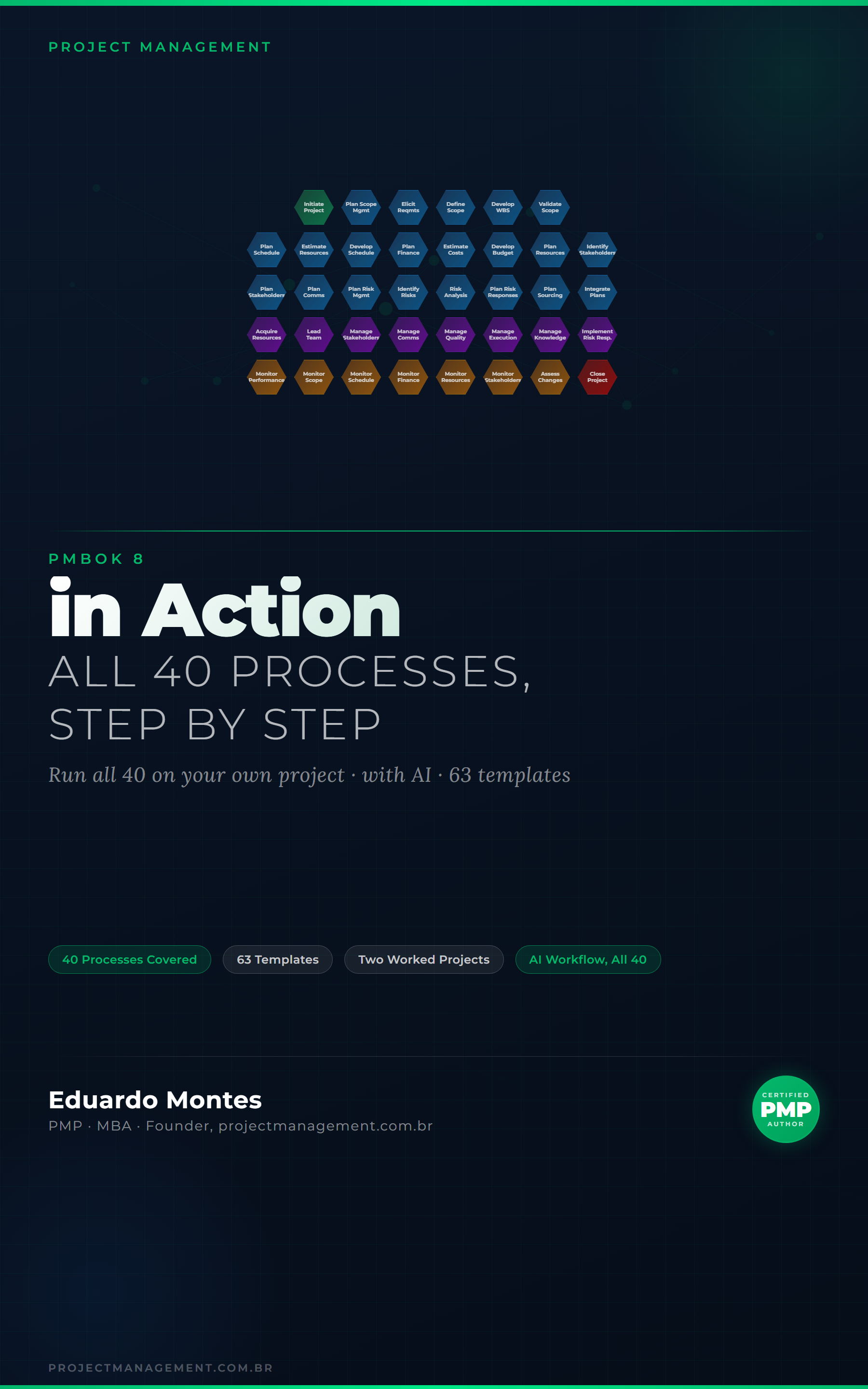
PMBOK 8 in Action
The 40 processes of the PMBOK 8 Guide applied to one real project, with the finished artefact at every step.
See the book — US$ 9.98 →


 Project Management