
This guide covers everything you need to know about the scope management plan in PMBOK 8. The scope management plan defines how the project scope will be defined, validated, and controlled — it is the governance framework for all scope-related activities from requirements elicitation through closure.
What Is the Scope Management Plan?
The scope management plan is a component of the project management plan that establishes the processes and procedures for defining the project scope, developing the WBS, verifying and accepting deliverables, and controlling changes to the scope baseline. It answers the governance questions: Who defines scope? How is scope documented and approved? How will scope changes be managed? How will completed deliverables be verified and accepted?
The scope management plan prevents two of the most common project failure modes: scope creep (unauthorized, unmanaged additions to scope) and gold-plating (delivering more than what was specified without authorization). By defining clear processes for scope definition, change control, and acceptance, the plan creates the governance infrastructure that keeps scope under control.
For agile or hybrid projects, the scope management plan addresses how the product backlog will be managed, how requirements will be prioritized, and how scope will evolve across iterations while remaining traceable to the project’s business objectives.
Scope Management Plan in PMBOK 8 — Domain and Process
In the PMBOK Guide 8th Edition, the scope management plan belongs to the Scope Performance Domain and is produced during the Plan Scope Management process. It is the first output of scope planning and establishes the framework within which requirements documentation, the WBS, and the scope baseline are developed.
The scope management plan guides the Elicit and Analyze Requirements process, the Define Scope process, the Develop Scope Structure process, and scope control activities throughout execution.
Key Elements of the Scope Management Plan
A well-structured scope management plan typically includes:
- Scope Definition Approach — how the project scope will be defined and what documentation format will be used
- WBS Development Approach — the level of decomposition required and the responsible parties
- Scope Verification Process — how deliverables will be inspected and formally accepted
- Scope Change Control Process — how scope change requests will be submitted, evaluated, and approved
- Roles and Responsibilities — who has authority to approve scope, sign off deliverables, and approve scope changes
- Stability Assessment — the expected frequency and impact of scope changes based on project risk assessment
Scope Management Plan Example — Project Phoenix
The Project Phoenix scope management plan established Alex Morgan as the scope definition facilitator, with Sarah Chen as the scope approval authority for all deliverables and Riley Park as the CCB chair for scope baseline changes. The WBS was required to decompose scope to Level 3 (work package level), with each work package having an estimate of 8-80 hours as a quality check on decomposition adequacy.
Scope verification required a formal written acceptance form for each of the seven major deliverables, signed by Sarah Chen within five business days of delivery. The scope change control process required written change requests for any addition, deletion, or modification affecting the scope baseline, with a 5-day CCB review SLA. The stability assessment predicted 2-3 scope changes over the project lifecycle — the actual count was five requests submitted, two approved, two rejected, one withdrawn.
You can download the complete filled-in example below — it shows exactly how the scope management plan was structured for a real project.
Frequently Asked Questions
What is the scope management plan in PMBOK 8?
It defines how project scope will be defined, validated, and controlled. It belongs to the Scope Performance Domain.
Which process produces the scope management plan?
The Plan Scope Management process produces it, alongside the requirements management plan.
Is the scope management plan part of the project management plan?
Yes. It is a subsidiary component of the overall project management plan, integrated and aligned with the other plans.
Download Free Scope Management Plan Template and Example
We have prepared two free resources to help you build a scope management plan for your own projects:
- Download the Scope Management Plan Template — PMBOK 8 (blank, ready to fill in)
- Download the Scope Management Plan Example — Project Phoenix (filled in for a real $72K website launch)
Both are free downloads — no registration required.
Scope Management Plan — Best Practices and Common Mistakes
Define who can approve scope changes at each level — not all scope changes require sponsor approval. Build a realistic scope stability assessment: a highly innovative project will have more scope volatility than a routine project, and the plan should reflect this. Review the scope management plan at major phase gates to confirm it remains fit for purpose.
The scope management plan is most effective when the acceptance process is non-negotiable — every major deliverable requires a signed acceptance form, no exceptions. Teams that skip or rush this plan often find that informal approvals given verbally during execution are reversed at formal acceptance, creating expensive last-minute rework.
Want to master project management with PMBOK 8? The PMBOK Guide 8th Edition is the definitive reference. Get your copy and use it alongside these free resources.
As an Amazon Associate, ProjectManagement.com.br earns from qualifying purchases. Links to Amazon on this page are affiliate links; the price you pay is unchanged.
Free Template & Filled-In Example
Apply what you’ve learned with these two free resources:
- Download the Free Scope Management Plan Template (PMBOK 8) — Ready-to-use blank template for your next project.
- Download the Filled-In Example — Project Phoenix — See exactly how this document was completed for a real $72K website launch project.
Exclusive launch offer · for readers of the books
The PMBOK 8 Quick Reference Guide is now only in the Together Kit
Buy PMBOK 8 in Action or Project Management in 10 Steps on Amazon, create your free account here, and download the book’s Together Kit: the templates, the worked examples, the one-page Guide with the 6 principles, the 7 performance domains and the 40 processes, and the PMBOK 8 Glossary. This is a launch offer and may be withdrawn.
PMBOK 8 in Action — $9.98 on Kindle →Project Management in 10 Steps — $6.99 on Kindle →
Free Template
Scope Management Plan Template

Scope Management Plan Template — Free Download (PMBOK 8)
Project Together
Track your progress through PMBOK 8
Create your free account to save your reading progress, earn points on every quiz, and unlock certificates as you master each domain.
Create Free Account →Free forever • No credit card required
QUIZ
Want to test what you learned from this article?
One multiple-choice question + one practical reflection. Earn Project Together points!
Go deeper in the book
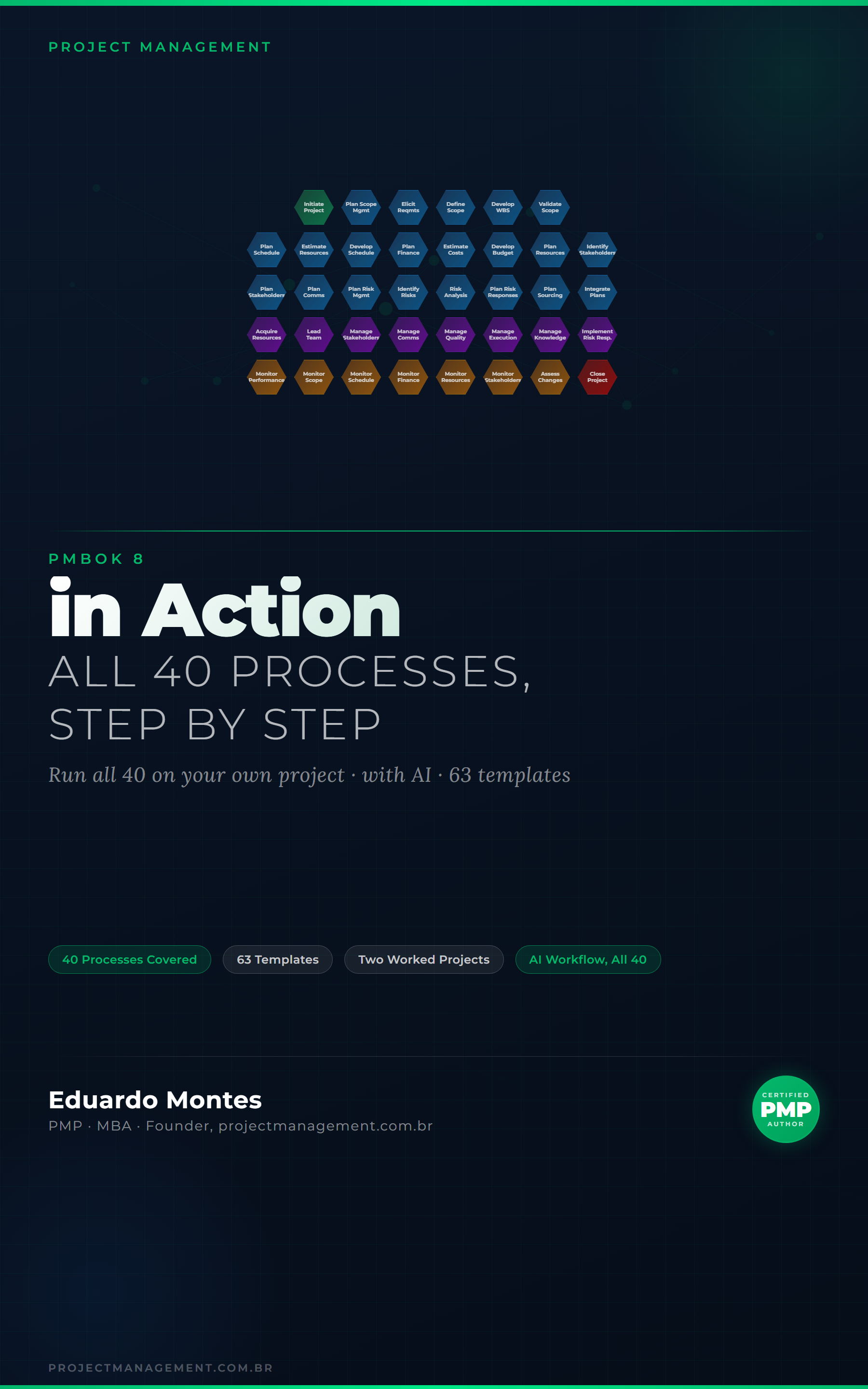
PMBOK 8 in Action
The 40 processes of the PMBOK 8 Guide applied to one real project, with the finished artefact at every step.
See the book — US$ 9.98 →
 Project Management