
New on Amazon · Kindle
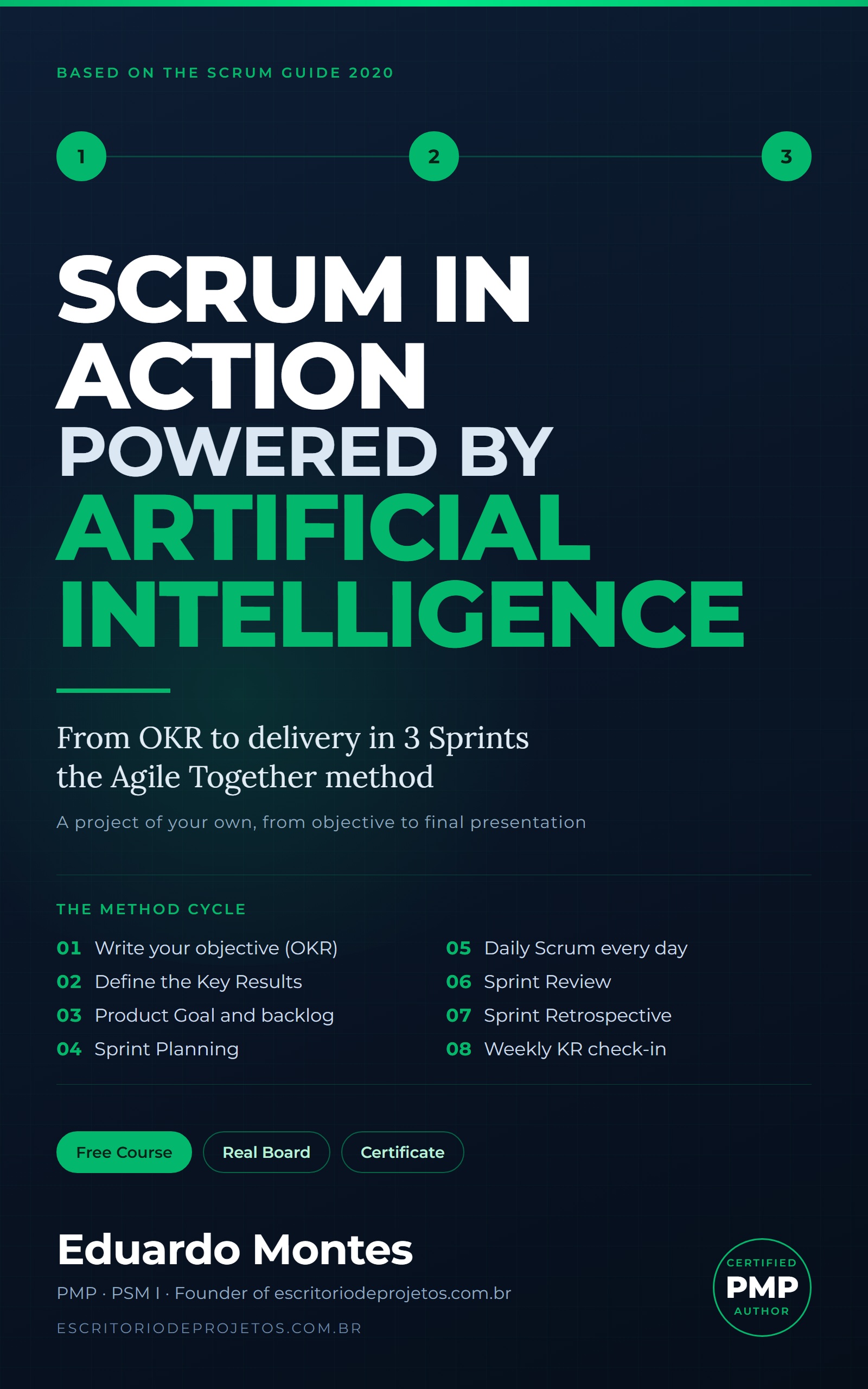
Scrum in Action
From OKR to delivery in 3 Sprints — the Agile Together method
Three real Sprints on a project of your own, from the Objective to the final presentation — with the whole of Scrum along the way and the AI you already use helping at every event.
Included with Kindle Unlimited. 96 pages.
The Scrum Guide has thirteen pages. They do not tell you where to start.
Thirteen pages in the original English. They describe what Scrum is, and they describe it well. Almost every book about Scrum does the same thing at greater length, and you finish knowing what Scrum is — still without knowing what to do on Monday morning.
I wrote this one to run the other way round. It puts you to work on three Sprints over a project of your own, starting from nothing: you write the Objective, define four Key Results, build the Product Backlog, plan the Sprint, run the Daily, hold the Review, hold the Retrospective, and arrive at a final presentation made of what you actually built. The theory enters where it is needed — in the middle of the work.
The AI you already use (ChatGPT, Gemini, Claude, any of them) helps at every step: I hand you the prompt, it proposes, and you decide. No decision about your project belongs to the machine.
3
Sprints, start to finish
21
Scrum events: 3 Plannings, 12 Dailies, 3 Reviews, 3 Retrospectives
4
Key Results, measured from your board
96
pages · 6 figures
What you will have done by the last page
- An Objective written in your own words, and four Key Results the course measures on its own.
- A Product Backlog refined, prioritised and broken down into tasks of about a day each.
- Three complete Sprints — the 21 events that prove the cadence, not one of them a formality.
- A Definition of Done that is yours, written before the first Sprint and used in every Review.
- A final presentation built from what happened on the board, and not from what you remember.
- And Chapter 7: what to do afterwards, when the three Sprints end and the practice has to keep going.
Why the four Key Results are the same for everybody
Completion rate, rising velocity, consistency of the events, and how much you leaned on the AI. Your Objective is yours alone; the Key Results measure whether you are running the method that gets you there. They are calculated from your board, never from your opinion of how it went.
That is the difference between thinking you learned something and holding the evidence that you did.
What is inside
10 chapters and appendices · about 18,395 words · one sitting to read, a few weeks to apply.
- Chapter 1 — Introduction and Setup
- Chapter 2 — Sprint Planning and the First Sprint
- Chapter 3 — Daily Scrum and Execution with AI
- Chapter 4 — Sprint Review
- Chapter 5 — OKR Check-in and Sprint Retrospective
- Chapter 6 — Final Presentation and Lessons Learned
- Chapter 7 — After the 3 Sprints
- Appendix A — Your AI and the method
- Appendix B — Prompt Library
- Appendix C — Glossary
Free · the course this book came from
Agile Together — 18 lessons, three Sprints, a certificate
The method in this book is the method of the Agile Together course, which runs by email at your own pace and ends with a certificate. The book is the route for anyone who would rather read the whole thing at once instead of waiting for the lessons.
Your project lives on a real board in ProjectAdm. Each step hands you a prompt already carrying your data; you paste it into whichever AI you use, read what comes back, cut what does not serve you and bring in the rest. The package carries its own Python, so there is nothing to install.
Prefer the lessons by email? Start the free course here — it takes a free account on this site. Or read how the course works first.
Who I wrote it for
- Anyone about to run their first Sprint, who would rather start with the work than with the theory.
- Anyone studying Scrum who wants to practise it, including anyone preparing for the PSM I.
- Anyone leading a small team who needs cadence without bureaucracy.
- Anyone running a project alone — a product, a course, a piece of research, a podcast.
- Anyone who has tried OKR and watched it turn into a to-do list.
The AI proposes. You decide.
Every step of the method comes with the prompt ready to paste into the AI you already use. I never choose one for you, and I never let the machine decide what belongs to your project: it drafts, organises and suggests, and the decision stays yours. That is why the result holds up in a meeting.
About the author
Eduardo Montes is PMP and PSM I, a project management consultant, professor and author, and the founder of projectmanagement.com.br. He has spent more than twenty years training project professionals in Brazil, Mozambique and other countries.
Start Sprint 1 this week
$5.99 on Kindle — included if you already have Kindle Unlimited.
The course is free either way: get the package →
Questions
Do I need to know Scrum already?
No. Chapter 1 builds the vocabulary from zero — the Agile Manifesto, the Scrum values, the three accountabilities, the artefacts and the events — and the rest of the book uses it on your project. No certification and no prior course is assumed.
Do I have to buy the book to take the course?
No. The Agile Together course is free and complete on its own: 18 lessons, the package, the board and the certificate. The book gathers the same journey into one place, with the reasoning behind each decision, for anyone who prefers to read it all at once.
Which AI do I need?
Whichever you already use. The prompts are plain text and are tied to no provider. You paste, you read, and you decide what to keep — and where you have not supplied something, the step leaves the field empty and says so instead of inventing a number.
Do I need to install anything?
The course package carries its own Python: you download it, extract it and double-click Start. You will also need a free ProjectAdm account, where your board lives.
What kind of project can I use?
One that is yours and that you can move in three Sprints — at work or outside it. A product, a service, a study plan, a piece of research, a launch. Chapter 1 helps you cut it down to a size that fits three Sprints.
Is there a print edition?
The Kindle edition is out now. The paperback is in preparation.
Is it in Portuguese too?
Yes — this is the English edition of Scrum na Prática com Inteligência Artificial, sold on escritoriodeprojetos.com.br.
The other three books
BPM in Action
One real process of your own through the five phases of the BPM lifecycle: the AS-IS as a BPMN 2.0 diagram, the analysis, the TO-BE, and indicators that prove what changed. See the book →
Project Management in 10 Steps
Ten steps from an idea to a formal close, in the order you actually run them, with twelve free templates and two projects worked end to end. The place to start if you have never run a project. See the book →
PMBOK 8 in Action
All 40 processes of the PMBOK Guide, Eighth Edition, one chapter each, with their inputs, outputs, tools and techniques, and two projects carried end to end. The reference volume of the family. See the book →
Based on the Scrum Guide 2020. This is an independent practitioner's guide: it is not an official publication and it is not endorsed by the authors of the Scrum Guide.
As an Amazon Associate, ProjectManagement.com.br earns from qualifying purchases. Links to Amazon on this page are affiliate links; the price you pay is unchanged.
 Project Management