
This guide covers everything you need to know about work performance data in PMBOK 8. Work performance data is the raw, unprocessed observations and measurements collected during project execution — the basic facts about project activities and deliverables before they are analyzed and interpreted into work performance information.
What Is Work Performance Data?
Work performance data consists of the raw observations and measurements identified during activities being performed to carry out the project work. This includes: the percentage complete for schedule activities, start and finish dates of activities, number of change requests submitted, number of defects identified, actual costs incurred, actual durations, test results, and any other objective measurement of project execution status.
Work performance data is the input to the control processes — it is transformed into work performance information (analyzed, contextualized data) and then into work performance reports (formatted, communicated summaries). The data itself is not meaningful in isolation; its value lies in how it is interpreted and compared to the project baselines.
PMBOK 8 makes an important distinction between data (raw facts), information (analyzed facts), and reports (communicated information). This distinction emphasizes that collecting data is necessary but not sufficient — the data must be analyzed to produce the insights that drive project control decisions.
Work Performance Data in PMBOK 8 — Domain and Process
In the PMBOK Guide 8th Edition, work performance data belongs to the Governance Performance Domain and is produced during the Manage Project Execution process. It is the primary output of project execution monitoring — the collected facts that feed all subsequent analysis, forecasting, and reporting activities.
Work performance data is the direct input to the Monitor and Control Project Work process, where it is analyzed and transformed into work performance information. It also feeds into quality control (raw measurement data), risk monitoring (trigger event data), and issue management (incident data).
Key Elements of Work Performance Data
Work performance data collected during project execution typically includes:
- Schedule Data — actual start and finish dates, percent complete for in-progress activities
- Cost Data — actual costs incurred by period and cumulative, invoices received and paid
- Quality Data — defect counts, test case results, inspection findings
- Scope Data — deliverables completed, work packages started and finished
- Risk Data — new risk events observed, trigger conditions identified
- Issue Data — new issues logged, existing issues resolved
Work Performance Data Example — Project Phoenix
Alex Morgan collected work performance data every Friday after the team standup. By the end of week 14, the collected data included: 58 of 67 scheduled activities completed (87%), with 4 in progress and 5 not yet started; actual costs to date of $53,600 against a planned value of $54,200; 47 test cases executed with a 93.6% first-pass rate; 3 change requests submitted (2 approved, 1 pending); 11 issues logged with 9 closed; and 2 new risk events observed (Stripe API parameter change and potential CDN timeout under load).
This raw data was collected in Alex’s tracking spreadsheet each week and then analyzed to produce work performance information: the CPI of 1.04, SPI of 1.03, EAC forecast of $63,831, and the risk score update for the new Stripe API risk. The work performance data was the input to every biweekly status report and every risk report — without it, the reporting would have been opinion rather than evidence. The discipline of weekly data collection was identified in the lessons learned register as a key contributor to the project’s strong financial and schedule control record.
You can download the complete filled-in example below — it shows exactly how work performance data was collected and used in a real project.
Frequently Asked Questions
What is work performance data in PMBOK 8?
It is the raw, unprocessed observations and measurements collected during execution — the basic facts about activities and deliverables before analysis.
Which process produces work performance data?
It is collected during Manage Project Execution as work is carried out.
How is work performance data different from work performance information?
Data is raw measurements; work performance information is that data analyzed and compared against baselines to produce meaningful insight.
Download Free Work Performance Data Template and Example
We have prepared two free resources to help you collect and manage work performance data on your own projects:
- Download the Work Performance Data Template — PMBOK 8 (blank, ready to fill in)
- Download the Work Performance Data Example — Project Phoenix (filled in for a real $72K website launch)
Both are free downloads — no registration required.
Work Performance Data — Best Practices and Common Mistakes
Collect work performance data at a consistent frequency — weekly is appropriate for most projects. Inconsistent collection creates gaps that distort trend analysis. Ensure data is objective and verifiable — “this activity feels about 80% done” is not work performance data; “6 of the 8 frontend templates have been completed and committed to the repository” is. Build data collection into the team’s weekly routine so it becomes automatic rather than an extra burden.
The work performance data collection process is most effective when it is lightweight and integrated into existing team workflows. Teams that skip or rush this collection often find their project reporting is opinion-based rather than fact-based, reducing its credibility with sponsors and stakeholders.
Want to master project management with PMBOK 8? The PMBOK Guide 8th Edition is the definitive reference. Get your copy and use it alongside these free resources.
As an Amazon Associate, ProjectManagement.com.br earns from qualifying purchases. Links to Amazon on this page are affiliate links; the price you pay is unchanged.
Free Template & Filled-In Example
Apply what you’ve learned with these two free resources:
- Download the Free Work Performance Data Template (PMBOK 8) — Ready-to-use blank template for your next project.
- Download the Filled-In Example — Project Phoenix — See exactly how this document was completed for a real $72K website launch project.
Exclusive launch offer · for readers of the books
The PMBOK 8 Quick Reference Guide is now only in the Together Kit
Buy PMBOK 8 in Action or Project Management in 10 Steps on Amazon, create your free account here, and download the book’s Together Kit: the templates, the worked examples, the one-page Guide with the 6 principles, the 7 performance domains and the 40 processes, and the PMBOK 8 Glossary. This is a launch offer and may be withdrawn.
PMBOK 8 in Action — $9.98 on Kindle →Project Management in 10 Steps — $6.99 on Kindle →
Free Template
Work Performance Data — PMBOK 8

Work Performance Data Template — Free Download (PMBOK 8)
Project Together
Track your progress through PMBOK 8
Create your free account to save your reading progress, earn points on every quiz, and unlock certificates as you master each domain.
Create Free Account →Free forever • No credit card required
QUIZ
Want to test what you learned from this article?
One multiple-choice question + one practical reflection. Earn Project Together points!
Go deeper in the book
PMBOK 8 in Action
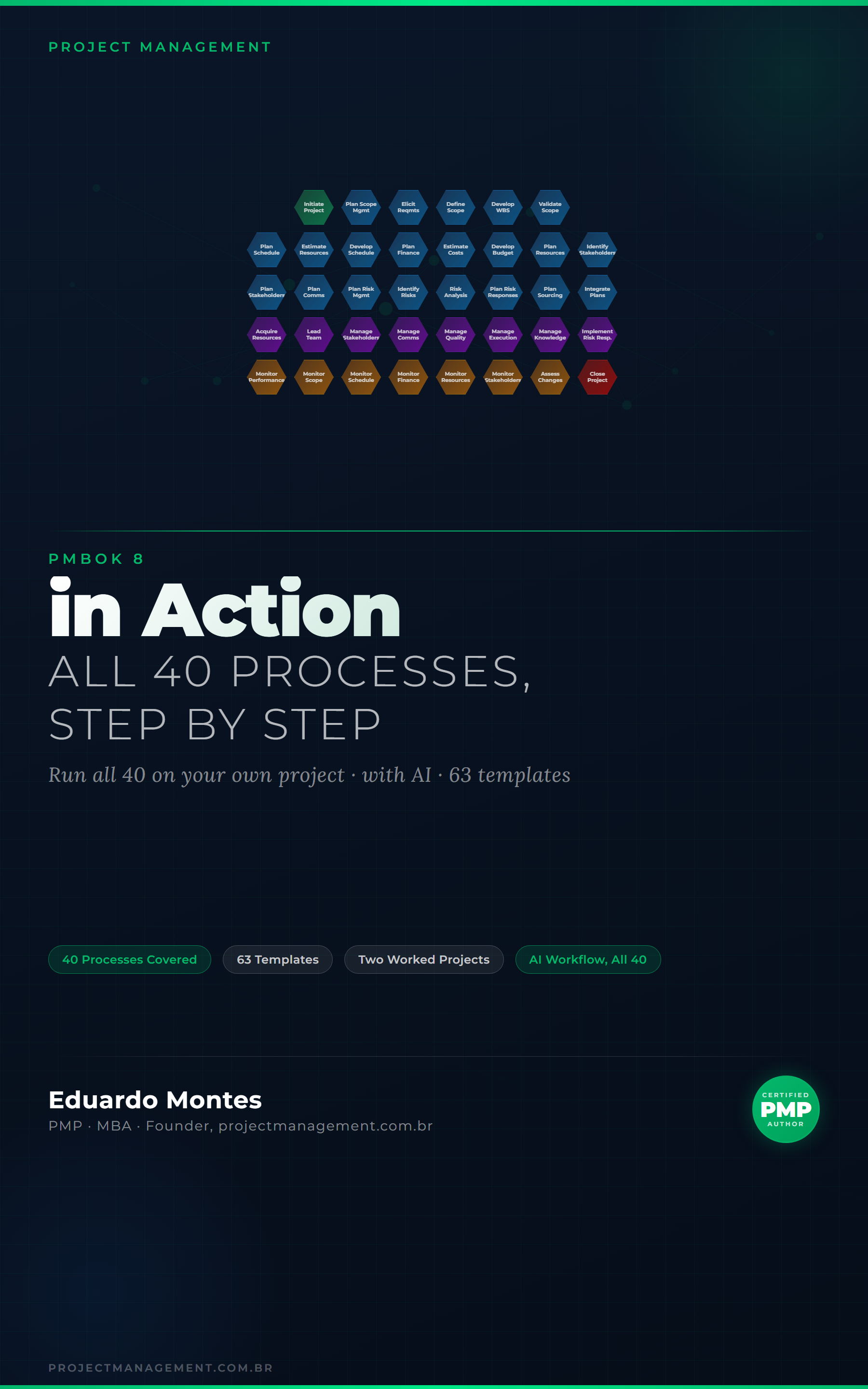
The 40 processes of the PMBOK 8 Guide applied to one real project, with the finished artefact at every step.
See the book — US$ 9.98 →


 Project Management