
Description
Sign up free to download
Project Management templates are exclusive to Project Together community members. Create your free account to download this and every other template — and follow the course and materials.
Create free account & downloadAlready a member? Sign in here to download.
Get Your Free Filled-In Example
Enter your name and email below to download the Project Phoenix example instantly. No payment required.
This Lessons Learned Updates example shows how Alex Morgan, PMP, captured knowledge iteratively throughout Project Phoenix — not just at the end. Unlike a final lessons learned document, this example shows the in-project updates added to the Lessons Learned Register during each of the six execution periods of the $72,250 website launch managed using the PMBOK Guide 8th Edition.
What Are Lessons Learned Updates?
Lessons Learned Updates refer to the iterative additions made to the Lessons Learned Register throughout a project's execution, rather than a single end-of-project capture. In PMBOK 8, this practice is explicitly encouraged within the Uncertainty and Measurement Performance Domains — the guidance is that lessons should be captured when they occur, while the context and details are still clear, rather than being reconstructed weeks later at project close. This approach produces richer, more accurate lessons because team members can articulate not just what happened, but why specific decisions were made in the moment.
What's Inside This Lessons Learned Updates Example
This Lessons Learned Updates example for Project Phoenix includes:
- Period 1 (March 17–31) update: design brief delivery delayed 4 days because BrightFrame's SOW did not specify a delivery SLA — lesson: all future vendor SOWs must include explicit milestone delivery dates with consequences for delay
- Period 2 (April 1–14) update: Sam Lee was pulled to a competing project for 3 days — lesson: establish a formal resource conflict escalation path with Operations Director before project kickoff, not during an active conflict
- Period 3 (April 15–30) update: content delivery delayed by 3 weeks because the marketing team was not briefed on content requirements until Week 4 — lesson: implement a placeholder content strategy from Day 1 of development, and engage content owners in the requirements workshop
- Period 4 (May 1–14) update: IT hosting migration blocked for 11 days due to conflicting infrastructure maintenance window — lesson: schedule all infrastructure-dependent project activities at least 2 weeks ahead of the IT team's quarterly maintenance calendar
- Period 5 (May 15–31) update: load testing failure in QA exposed a server performance issue that was not caught in earlier sprint reviews — lesson: integrate basic load testing into Sprint 3 developer testing, not just the formal QA sprint
- Period 6 (June 1–13) update: the 2-hour CMS training session was insufficient for the marketing team to feel confident managing all content types independently — lesson: CMS training should be planned as a multi-session program across two weeks, not a single session on the final day
How Alex Morgan Used These Lessons Learned Updates
Alex Morgan allocated the last 10 minutes of every weekly status meeting to lessons capture — a practice she called "the retrospective minute." By normalizing the habit of reflection during execution, the team became comfortable raising concerns and insights in real time, rather than saving them for a post-mortem that might feel like a blame session. Each update was logged in the Lessons Learned Register in Confluence, tagged by category (Vendor Management, Resource Management, Technical, Quality), and assigned an owner responsible for proposing an actionable recommendation. This systematic approach meant that the final lessons learned document at project close was largely already written — it was a synthesis of six periods of accumulated knowledge.
Download and Customize
This Lessons Learned Updates example is available as a free download. Use it as a reference to build your own iterative lessons capture process, or start with the blank template and fill it in for your project.
- Download the Lessons Learned Updates Template — PMBOK 8 (blank, ready to use)
- Read the article: Lessons Learned Updates in PMBOK 8 — Guide and Best Practices
Lessons Learned Updates Example: Key Takeaways
The key lesson from this Lessons Learned Updates example is that 10 minutes per week during execution is more valuable than 3 hours at project close. Alex Morgan's team captured richer, more contextual lessons because they logged them when the experience was fresh. The Period 3 content delay lesson, for example, included specific names, dates, and decision rationale that would have been forgotten by June. The iterative approach also allowed some lessons to be acted on during the same project — the placeholder content strategy was implemented in Period 3 as a direct result of the lesson captured in that same period, partially recovering the content delay before it became a critical path issue.
Want to go deeper? The PMBOK Guide 8th Edition is the definitive reference for modern project management. Get your copy and use it alongside these examples to build a solid, practical understanding of every performance domain.
New on Amazon
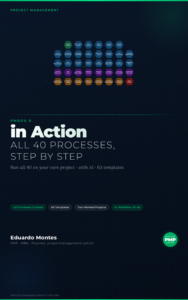
PMBOK 8 in Action
All 40 project management processes, step by step — with 63 templates, two worked examples, and an AI prompt for every process you can run on your own project.
Free templates from the book: the Starter Kit.
As an Amazon Associate, ProjectManagement.com.br earns from qualifying purchases. Links to Amazon on this page are affiliate links; the price you pay is unchanged.
Categories & Tags
Similar Downloads

 Project Management