
A Project Management Office (PMO) is the organizational entity that turns scattered project work into a coherent, value-delivering portfolio. The PMBOK 8 Guide (2025) redefines the PMO from a process-centric standardizer to a customer-centric partner — and that shift changes everything: who runs it, what it produces, and how its success is measured.
This complete guide covers the PMO definition from PMBOK 8, the three main types, what changed in the 2025 edition, how to implement one step by step, common mistakes, and the templates you need. Written for practitioners who want a PMO that actually delivers value, not paperwork.
- What is a Project Management Office?
- The 3 types of PMO (supportive, controlling, directive)
- What’s new for PMOs in PMBOK 8 (2025)
- PMO responsibilities under PMBOK 8
- How to implement a PMO step by step
- PMO maturity models
- Common PMO mistakes
- PMO templates and tools
- Frequently asked questions
What is a Project Management Office?
The PMBOK Guide, Eighth Edition (published by the Project Management Institute) defines a Project Management Office as:
“Organizational entities, typically established as departments or teams, primarily tasked with centralizing activities related to the management of portfolios, programs, and/or projects. The nature of these activities can vary according to the unique needs of each organization.”
— PMBOK Guide, Eighth Edition, Glossary
Three things stand out in that definition:
- Organizational entity, not a process. A PMO is a department or team with people, a budget, and a leader — not a methodology document.
- Centralizes activities. The PMO is the place where standards, knowledge, and reporting come together so that individual projects don’t have to reinvent every wheel.
- Tailored to the organization. There is no universal PMO. The activities of a 5-person SaaS startup PMO and a 200-person bank PMO will look almost nothing alike — and both are correct.
The PMBOK 8 Guide treats the PMO as part of the Governance performance domain (section 2.1.6). Under a structured governance model, the PMO leader is one of the four key roles, alongside the executive sponsor, the governance board, and the project manager.
The 3 main types of PMO
PMBOK 8 explicitly states (Appendix X2) that PMO models “should not be viewed as mutually exclusive paths. Instead, these models should be seen as a palette of options that can be combined to meet specific organizational needs.” Still, three archetypes remain useful as starting points:
| Type | Authority over projects | Best when | Risk if misapplied |
|---|---|---|---|
| Supportive PMO | Low — advisory | Mature project culture, autonomous teams | Becomes invisible, struggles to prove value |
| Controlling PMO | Medium — compliance + reporting | Multiple projects need consistent governance | Seen as bureaucracy if reports aren’t actionable |
| Directive PMO | High — full project ownership | Strategic transformation, high-stakes delivery | Bottleneck if it tries to manage everything |
Most organizations land in a hybrid — for example, controlling for delivery projects and supportive for innovation work. PMBOK 8 encourages this kind of contextual mixing rather than forcing a single label.
What’s new for PMOs in PMBOK 8 (2025 Edition)
If you’re moving from PMBOK 6 or 7 to PMBOK 8, the biggest mindset shift for PMOs is the move from process-centric to customer-centric. Appendix X2.1 of the PMBOK 8 Guide states:
“The concept of the project management office (PMO) has evolved over the last few decades, moving from a process-focused entity that standardizes methodologies and tools for project management to a customer-oriented partner focused on delivering a value that is perceived by the customers and stakeholders within the organization.”
— PMBOK Guide, Eighth Edition, Appendix X2
Five concrete differences in the 2025 edition:
1. PMO under the Governance domain, not a separate function
PMBOK 8 reorganized the entire guide around 7 performance domains. The PMO sits inside Governance (domain 2.1) rather than being treated as an external management overhead. This means PMO success is measured by governance outcomes — strategic alignment, value delivery, decision speed — not by template completion rates.
2. Customer-centric value proposition
Appendix X2.2 frames the PMO’s value proposition through what stakeholders perceive, not what the PMO produces. A status report nobody reads is not value, even if it took 4 hours to assemble. PMBOK 8 explicitly ties PMO relevance to its ability to translate effort into visible, day-to-day contributions that reflect what the business values most.
3. Aligned with the 6 PMBOK 8 principles
Every PMO activity should reinforce at least one of the six PMBOK 8 principles: holistic view, focus on value, embed quality, accountable leadership, sustainability, and empowered culture. A PMO that issues standards without empowering teams is misaligned with principle 3.8 (Build an Empowered Culture).
4. Tailoring is now a PMO core responsibility
PMBOK 8 Section 3 on Tailoring explicitly mentions the PMO as a partner in approving tailored development approaches. The PMO no longer enforces a single methodology — it helps teams pick and combine approaches based on project context (predictive, agile, hybrid).
5. AI and automation in PMO operations
Appendix X2 acknowledges AI’s role in PMO work: predictive analytics for planning, automated compliance checks, lessons-learned capture, governance assistance. PMBOK 8 is the first edition to position the PMO as an active user of AI tools, not just a process keeper.
PMO responsibilities under PMBOK 8
Drawing from Appendix X2 and the Governance performance domain, a modern PMO’s responsibilities fall into six areas:
- Methodology and standards. Define, maintain, and tailor the project management approach. PMBOK 8 emphasizes tailored standards — methodology that bends to project context, not the other way around.
- Resource and capacity management. Centralize visibility into who is working on what across the portfolio, so the organization can make informed prioritization decisions.
- Strategic alignment. Ensure every active project ties back to a business objective. The PMO is the bridge between corporate strategy and execution.
- Knowledge management. Capture lessons learned from completed projects and make them accessible to future teams. PMBOK 8 ties this to the Embed Quality principle (3.5).
- Coaching and mentoring. Develop the project management capability of the broader organization, not just the PMO team. This is where the Empowered Culture principle (3.8) comes in.
- Reporting and decision support. Produce dashboards and recommendations that help executives make portfolio decisions in days instead of weeks.
Notice what’s not on this list: enforcement, audit-style compliance, gate-keeping. PMBOK 8 has decisively moved away from the “PMO as project police” framing.
How to implement a PMO step by step
Implementing a PMO is itself a project — and the cleanest way to do it is to apply PMBOK 8 to the implementation. Here’s a four-phase approach that we’ve used with real clients (see the Project Atlas case study for a worked example).
Phase 1: Charter the PMO (weeks 1-2)
- Write a one-page PMO charter with a clear mission, scope, success metrics, and sponsor signature. Use the Project Charter template as a starting point.
- Identify the single business problem the PMO must solve in its first 6 months. Resist the temptation to list 20.
- Get explicit executive sponsorship — without it, the PMO becomes a casualty of the next reorganization.
Phase 2: Pilot with 1 to 3 projects (weeks 3-12)
- Pick projects where the sponsor wants help, not projects you have to push. Voluntary participation is critical.
- Apply your minimum methodology (charter, simple plan, weekly status, lessons learned). Resist building 50 templates on day one.
- Measure outcomes against the PMO charter success metrics — not against template adoption rates.
Phase 3: Roll out methodology (weeks 13-24)
- Codify what worked in the pilot into a tailored methodology. PMBOK 8’s tailoring approach is your friend here.
- Train project managers and team leads on the new approach. Coaching beats classroom training.
- Build a knowledge repository so lessons learned actually compound.
Phase 4: Measure value and iterate (ongoing)
- Publish quarterly PMO value reports showing the business outcomes you helped deliver — not the deliverables you produced.
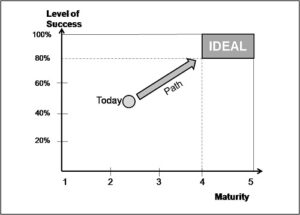
- Run a maturity self-assessment annually (see Prado-PM Maturity Model).
- Adjust services based on stakeholder feedback. A PMO that doesn’t evolve loses relevance fast.
PMO maturity models
PMBOK 8 Appendix X2.4 (and the companion PMI PMO Practice Guide) mentions PMO maturity as a key dimension of value: “the perception of value is often shaped by the organization’s project management maturity; more mature organizations tend to recognize and leverage PMO contributions more fully.”
Two maturity models are worth knowing:
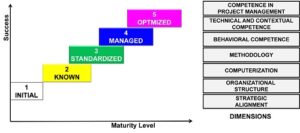
- Prado-PM Maturity Model — a practical 5-level framework used by hundreds of organizations in Brazil, Europe, and the USA. Read the foundations.
- PPPMM (Project, Program, and Portfolio Management Maturity) — a broader view that spans the three management disciplines together. Read more on PPPMM.
The right model is the one your team will actually run. A simple 1-page self-assessment beats an unused 50-question framework every time.
Common PMO mistakes to avoid
- Building 50 templates before delivering one outcome. Templates are a means, not the goal. Deliver one project successfully first.
- Mistaking compliance reports for value. If your weekly report nobody reads, it’s not value — it’s overhead.
- Acting as project police instead of project partner. PMBOK 8’s customer-centric framing kills this anti-pattern explicitly.
- Skipping executive sponsorship. A PMO without a powerful sponsor will not survive its first budget cycle.
- Trying to standardize everything at once. Tailoring is now a core PMBOK 8 principle. Standardize what improves outcomes; let teams adapt the rest.
PMO templates and tools
Free downloads to get your PMO started, all aligned with PMBOK 8 (2025):
- Project Charter Template — Use it as your PMO charter
- Project Management Plan Template — Tailor for portfolio reporting
- Risk Register Template — Standardize risk reporting across projects
- Status Report Template — Customize for executive audiences
For a complete worked example of how a PMO uses these documents end to end, see the Project Atlas case study — a fictional but realistic PMO implementation at a 120-person consulting firm.
Frequently asked questions
What’s the difference between a PMO and a project manager?
A project manager runs a single project to its conclusion. A PMO is an organizational entity that supports many project managers across many projects, providing methodology, reporting, resources, and strategic alignment. One PMO usually serves multiple PMs.
How long does it take to set up a PMO?
A pilot PMO with 1 to 3 projects can be operational in 4 to 6 weeks. A full-organization PMO that’s actually delivering measurable value typically takes 6 to 12 months. Anyone selling you a 30-day PMO transformation is selling templates, not change.
Does every company need a PMO?
No. Small organizations with 1 to 3 simultaneous projects often don’t need a formal PMO — a single experienced project manager covers the same ground. PMBOK 8 (Section 2.5.2 on governance) explicitly accepts self-governance models where project managers collectively handle PMO-style responsibilities.
How is a PMO different in PMBOK 8 vs PMBOK 6 or 7?
The biggest shift is from process-centric (template enforcement, methodology compliance) to customer-centric (business value delivery, stakeholder perception). PMBOK 8 also moves the PMO under the Governance performance domain and ties it to the 6 principles, especially Focus on Value and Build an Empowered Culture.
What’s the ROI of a PMO?
A well-run PMO typically pays for itself within 12 to 18 months through three channels: (1) better prioritization (stop doing low-value projects), (2) faster delivery (less rework, fewer blocked projects), and (3) higher project success rate (10–20 percentage points is common). The measurement should always tie back to business outcomes, not internal PMO activity counts.
Next steps
If you’re serious about building or evolving a PMO that delivers value the way PMBOK 8 envisions, start here:
- Read the full PMBOK 8 Guide overview if you haven’t yet.
- Download the free PMBOK 8 templates and use them as your PMO baseline.
- Run a maturity self-assessment using the Prado-PM model.
- Join the Project Together community to connect with other PMO leaders and share what’s working.
This article is based on the official PMBOK Guide, Eighth Edition (2025), specifically Appendix X2 (Project Management Offices), Section 2.1.6 (Governance Performance Domain), Section 3 (Tailoring), and the Glossary. Page numbers are not cited per editorial policy — see the original PDF for exact references.
Project Together
Track your progress through PMBOK 8
Create your free account to save your reading progress, earn points on every quiz, and unlock certificates as you master each domain.
Create Free Account →Free forever • No credit card required

 Project Management